School of Geographical Sciences, University of Bristol, Bristol BS8 1SS, UK.
Int J Environ Res Public Health. 2021 Jul 6;18(14):7222. doi: 10.3390/ijerph18147222.
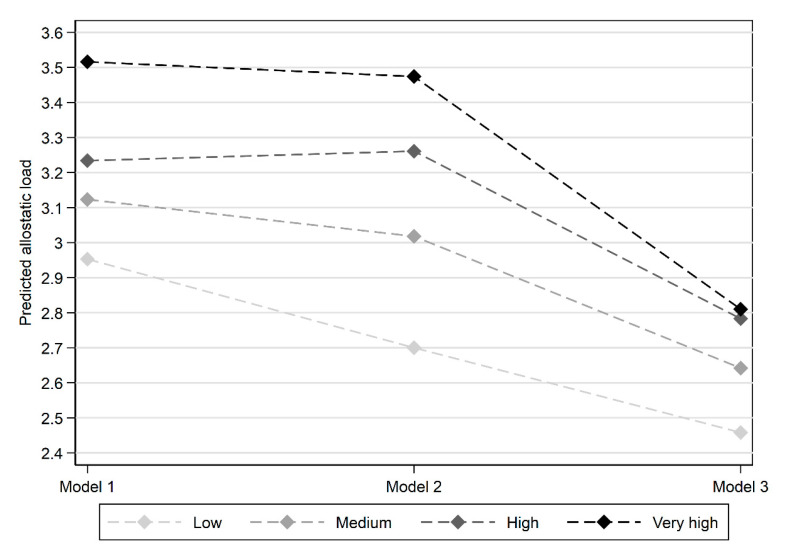
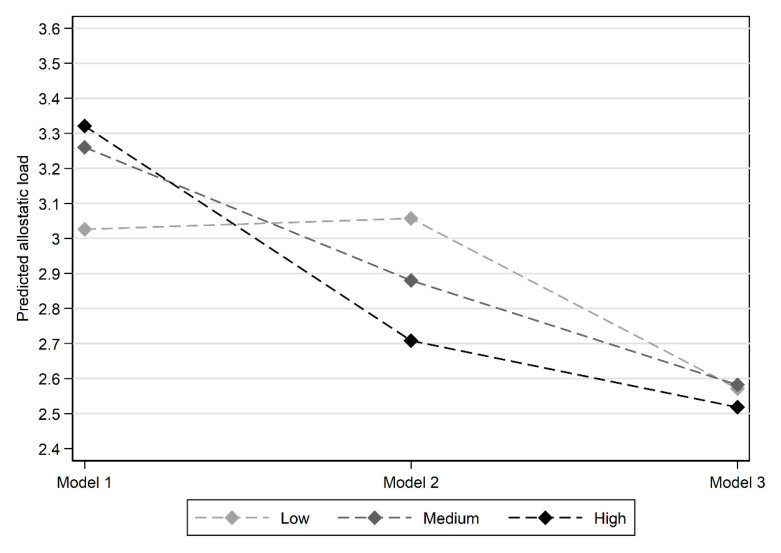
The stress pathway posits that those in disadvantaged circumstances are exposed to a higher degree of stressful experiences over time resulting in an accumulated biological burden which subsequently relates to poorer health. Trajectories of disadvantage, in the form of neighbourhood deprivation and structural social capital, are evaluated in their relation to allostatic load representing the cumulative "wear and tear" of chronic stress. This paper uses data from the British Household Panel Survey and Understanding Society in a latent class growth analysis. We identify groups of exposure trajectories over time using these classes to predict allostatic load at the final wave. The results show that persistent exposure to higher deprivation is related to worse allostatic load. High structural social capital over time relates to lower allostatic load, in line with a stress buffering effect, though this relationship is not robust to controlling for individual sociodemographic characteristics. By demonstrating a gradient in allostatic load by histories of deprivation, this analysis supports a biological embedding of disadvantage through chronic exposure to stressful environments as an explanation for social health inequalities.
压力途径假设,那些处于不利环境中的人随着时间的推移会经历更高程度的压力体验,从而导致累积的生物负担,进而与较差的健康状况相关。不利的轨迹,以社区贫困和结构性社会资本的形式,在与代表慢性压力“磨损”的全身适应综合征负担的关系方面得到了评估。本文使用了来自英国家庭面板调查和社会理解调查的数据,在潜在类别增长分析中使用这些类别来预测最终波的全身适应综合征负担。结果表明,随着时间的推移持续暴露于更高的贫困水平与更差的全身适应综合征负担相关。随着时间的推移,较高的结构性社会资本与较低的全身适应综合征负担有关,这与压力缓冲效应一致,但这种关系在控制个体社会人口特征后并不稳健。通过显示全身适应综合征负担的梯度,通过对压力环境的慢性暴露来解释劣势的生物嵌入,这种分析支持了社会健康不平等的生物学解释。