School of Life Science, University of Science and Technology of China, No. 96, JinZhai Road, Baohe District, Hefei, Anhui, 230026, People's Republic of China.
Tianjin Institute of Industrial Biotechnology, Chinese Academy of Sciences, 32 West 7th Avenue, Tianjin Airport Economic Area, Tianjin, 300308, People's Republic of China.
Microb Cell Fact. 2021 Jul 28;20(1):148. doi: 10.1186/s12934-021-01641-z.
Tailoring gene expression to balance metabolic fluxes is critical for the overproduction of metabolites in yeast hosts, and its implementation requires coordinated regulation at both transcriptional and translational levels. Although synthetic minimal yeast promoters have shown many advantages compared to natural promoters, their transcriptional strength is still limited, which restricts their applications in pathway engineering.
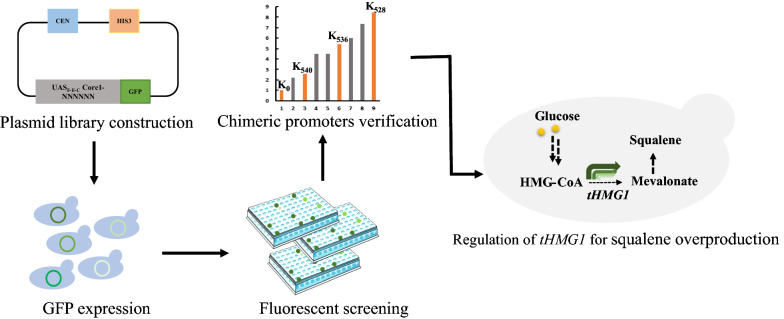
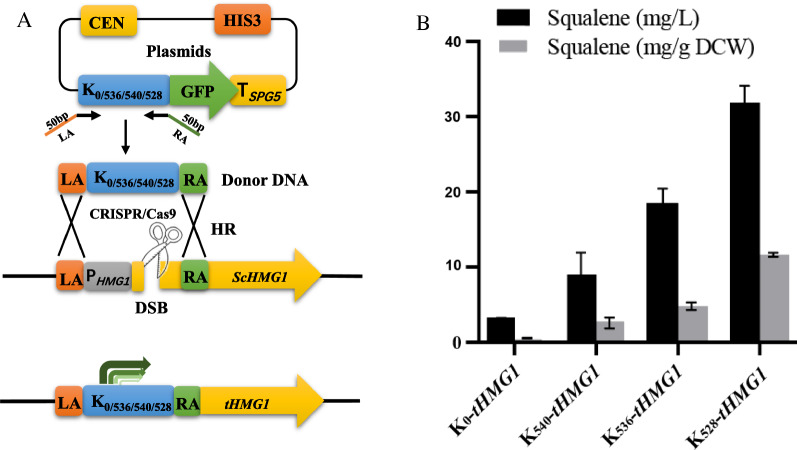
In this work, we sought to expand the application scope of synthetic minimal yeast promoters by enhancing the corresponding translation levels using specific Kozak sequence variants. Firstly, we chose the reported UAS-Core1 minimal promoter as a library template and determined its Kozak motif (K). Next, we randomly mutated the K to generate a chimeric promoter library, which was able to drive green fluorescent protein (GFP) expression with translational strengths spanning a 500-fold range. A total of 14 chimeric promoters showed at least two-fold differences in GFP expression strength compared to the K control. The best one named K even showed 8.5- and 3.3-fold increases in fluorescence intensity compared with UAS-Core1 and the strong native constitutive promoter P, respectively. Subsequently, we chose three representative strong chimeric promoters (K, K, and K) from this library to regulate pathway gene expression. In conjunction with the tHMG1 gene for squalene production, the K variant produced the best squalene titer of 32.1 mg/L in shake flasks, which represents a more than 10-fold increase compared to the parental K control (3.1 mg/L).
All these results demonstrate that this chimeric promoter library developed in this study is an effective tool for pathway engineering in yeast.
为了在酵母宿主中过量生产代谢物,将基因表达进行定制以平衡代谢通量是至关重要的,这需要在转录和翻译水平上进行协调调节。尽管合成的最小酵母启动子与天然启动子相比显示出许多优势,但它们的转录强度仍然有限,这限制了它们在途径工程中的应用。
在这项工作中,我们试图通过使用特定的 Kozak 序列变体来提高相应的翻译水平,从而扩展合成最小酵母启动子的应用范围。首先,我们选择了报道的 UAS-Core1 最小启动子作为文库模板,并确定了其 Kozak 基序(K)。接下来,我们随机突变 K 以生成一个嵌合启动子文库,该文库能够驱动绿色荧光蛋白(GFP)表达,其翻译强度跨越 500 倍的范围。共有 14 个嵌合启动子与 K 对照相比,GFP 表达强度至少相差两倍。最好的一个命名为 K,与 UAS-Core1 和强天然组成型启动子 P 相比,荧光强度分别增加了 8.5 倍和 3.3 倍。随后,我们从这个文库中选择了三个有代表性的强嵌合启动子(K、K 和 K)来调节途径基因表达。与 squalene 生产的 tHMG1 基因结合,K 变体在摇瓶中产生了最佳的 squalene 产量为 32.1mg/L,比亲本 K 对照(3.1mg/L)增加了 10 多倍。
所有这些结果表明,本研究中开发的这种嵌合启动子文库是酵母途径工程的有效工具。