Sirivarasai Jintana, Chaisungnern Kanchaporn, Panpunuan Pachara, Chanprasertyothin Suwannee, Chansirikanjana Sirintorn, Sritara Piyamitr
Graduate Program in Nutrition, Faculty of Medicine Ramathibodi Hospital, Mahidol University, Bangkok, Thailand.
Master of Science Program in Food and Nutritional Toxicology, Institute of Nutrition, Mahidol University, Bangkok, Thailand.
Neuropsychiatr Dis Treat. 2021 Jul 22;17:2429-2439. doi: 10.2147/NDT.S320374. eCollection 2021.
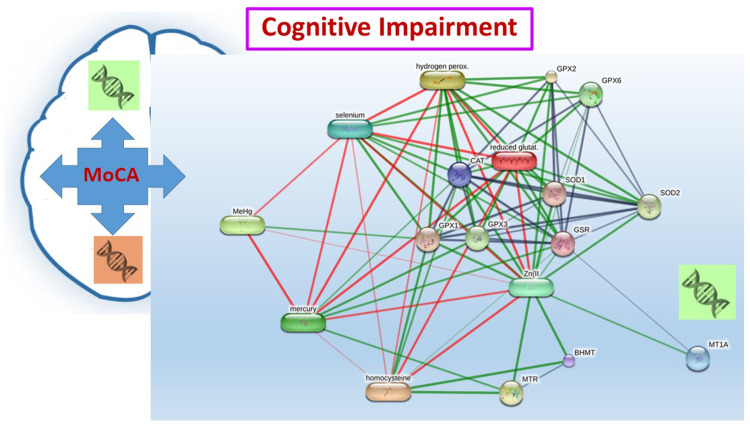
Many age-related structural and functional changes in the brain have important consequences. Long-term exposure to mercury and the impact of functional polymorphisms of metal-regulating proteins such as metallothioneins (MTs) can result in neurological-neurobehavioral effects in elderly individuals. Therefore, the aims of this study are to examine the associations between biomarkers of mercury exposure and cognitive impairment and to investigate the effect of the rs8052394 single nucleotide polymorphism (SNP) of the potential modifier gene MT1A on different domains of the Montreal Cognitive Assessment (MoCA).
We studied 436 participants aged ≥55 years from the Electricity Generating Authority of Thailand study. They underwent a physical examination, an extensive cognitive assessment with the MoCA (cutoff <26 points), and a biochemical analysis related to diabetes and dyslipidemia. The blood mercury level was determined by inductively coupled plasma mass spectrometry. Genotyping of the MT1A rs8052394 SNP was performed by the restriction fragmentation length polymorphism method.
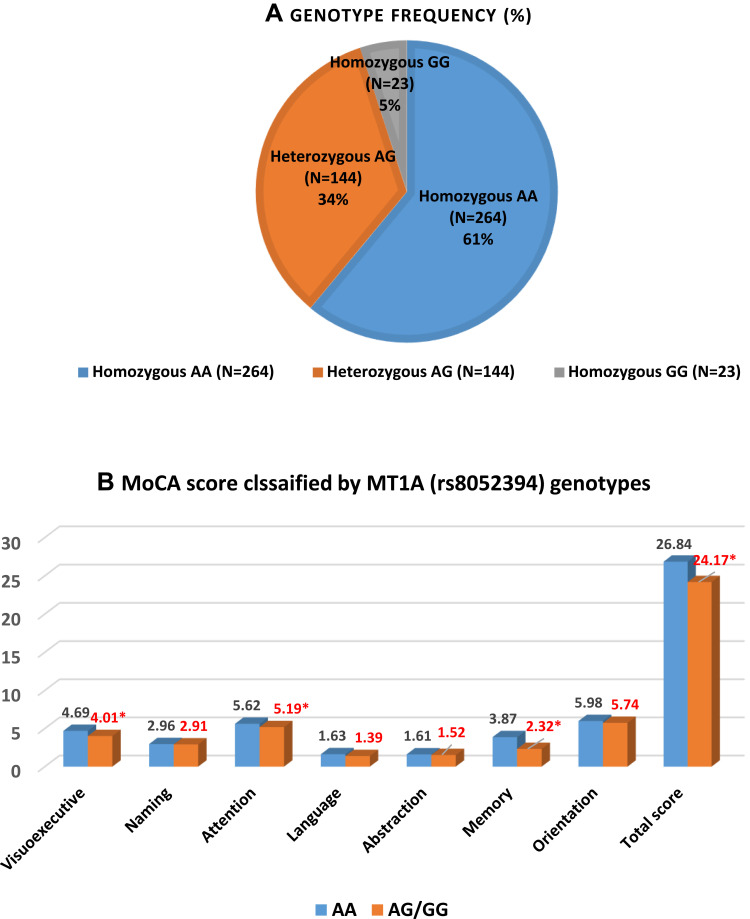
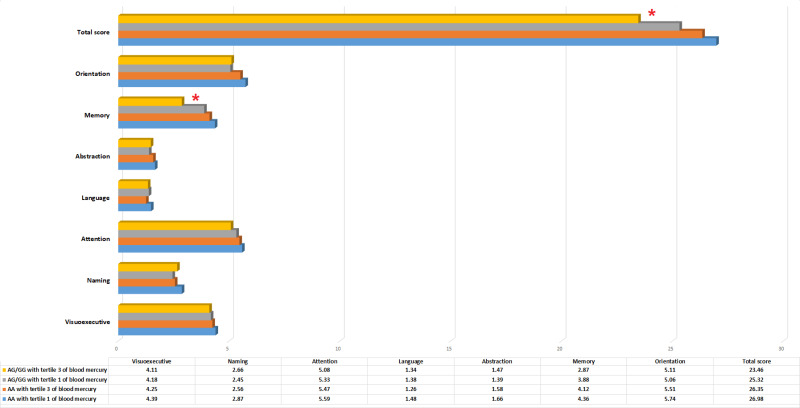
The mean age of the study population was 58.8±3.01 years, and most had ≥12 years of education (75.7%). The primary study finding was that the prevalence of mild cognitive impairment (MCI) in older Thai adults was 39.7%. The frequency distributions of the G allele of the rs8052394 SNP of the MT1A gene were significantly associated with the total and sub-domain MoCA scores. The prevalence of MCI was significantly associated with increased age, hypertriglyceridemia, hyperhomocysteinemia, the third tertile of blood mercury concentration, and the rs8052394 variant genotype of MT1A (P values for all odds ratios <0.05).
These findings suggested that neurocognitive effects associate with mercury exposure and genetic susceptibility in toxicokinetics. Public health strategies can be used to implement as a comprehensive action plan to educate vulnerable populations on how to reduce mercury exposure. Concurrently, impact of such genetic predisposition requires replication for identifying and protecting susceptible individuals from mercury toxicity.
大脑中许多与年龄相关的结构和功能变化都具有重要影响。长期接触汞以及金属调节蛋白(如金属硫蛋白(MTs))功能多态性的影响可能会在老年人中导致神经-神经行为效应。因此,本研究的目的是检查汞暴露生物标志物与认知障碍之间的关联,并研究潜在修饰基因MT1A的rs8052394单核苷酸多态性(SNP)对蒙特利尔认知评估(MoCA)不同领域的影响。
我们研究了泰国发电管理局研究中436名年龄≥55岁的参与者。他们接受了体格检查、使用MoCA进行的广泛认知评估(临界值<26分)以及与糖尿病和血脂异常相关的生化分析。通过电感耦合等离子体质谱法测定血液汞水平。通过限制性片段长度多态性方法对MT1A rs8052394 SNP进行基因分型。
研究人群的平均年龄为58.8±3.01岁,大多数人接受过≥12年的教育(75.7%)。主要研究发现是,泰国老年成年人中轻度认知障碍(MCI)的患病率为39.7%。MT1A基因rs8052394 SNP的G等位基因频率分布与MoCA总分及各子领域得分显著相关。MCI的患病率与年龄增加、高甘油三酯血症、高同型半胱氨酸血症、血液汞浓度的第三个三分位数以及MT1A的rs8052394变异基因型显著相关(所有比值比的P值<0.05)。
这些发现表明,神经认知效应与汞暴露以及毒代动力学中的遗传易感性相关。公共卫生策略可作为一项全面行动计划来实施,以教育易感人群如何减少汞暴露。同时,这种遗传易感性的影响需要重复研究,以识别和保护易感个体免受汞毒性影响。