Centre for Psychiatry Research, Department of Clinical Neuroscience, Karolinska Institutet, Sweden.
Stockholm Health Care Services, Region Stockholm, Stockholm, Sweden.
JAMA Netw Open. 2021 Jul 1;4(7):e2118516. doi: 10.1001/jamanetworkopen.2021.18516.
Therapist-guided, internet-delivered cognitive behavioral therapy is an effective treatment option for children and adolescents with obsessive-compulsive disorder, but to our knowledge, its cost-effectiveness compared with traditional in-person treatment has not been established.
To evaluate the cost-effectiveness of guided internet-delivered cognitive behavioral therapy implemented within a stepped-care model compared with in-person cognitive behavioral therapy for young people with obsessive-compulsive disorder.
DESIGN, SETTING, AND PARTICIPANTS: This economic evaluation of a randomized noninferiority trial conducted at 2 specialist obsessive-compulsive disorder clinics in Sweden enrolled 152 children and adolescents aged 8 to 17 years with obsessive-compulsive disorder, mainly through clinician referrals (110 [72%]). Recruitment began October 6, 2017, and ended May 24, 2019. Follow-up ended April 14, 2020.
Participants were randomly assigned to receive either guided internet-delivered cognitive behavioral therapy or in-person cognitive behavioral therapy during a 16-week period. At the 3-month follow-up, nonresponders in both groups were offered additional in-person cognitive behavior therapy sessions.
Health outcomes were treatment response rates (primary outcome), remission rates, and quality-adjusted life-years. Cost data were collected before treatment, after treatment, at 3-month follow-up, and at 6-month follow-up (primary end point) and are presented in 2020 US dollars. The differences in incremental costs and health outcomes were compared between the groups and presented from the health care professional, health care sector, and societal perspectives.
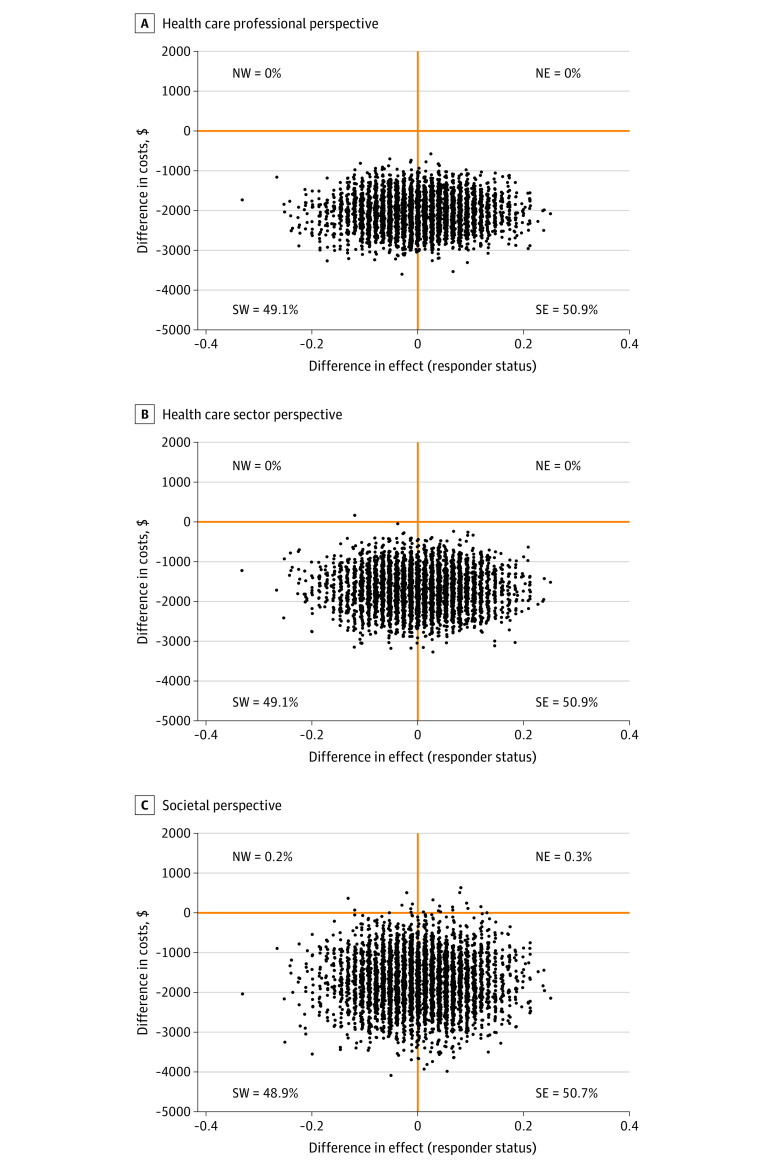
A total of 152 participants (94 girls [62%]; mean [SD] age, 13.4 [2.5] years) were randomized; 151 (99%) completed the trial. At the 6-month follow-up, 50 of 74 participants (68%) in the stepped-care group and 52 of 77 participants (68%) in the in-person cognitive behavioral therapy group were classified as treatment responders (odds ratio, 1.00 [95% CI, 0.51-1.98]; P = .99). Health economic analyses showed that the stepped-care group used fewer therapist resources than the in-person cognitive behavioral therapy group, resulting in a mean cost savings of $2104 (95% CI, $1202-$3006) per participant for the full study period of 10 months, corresponding to a relative savings of 39%. The cost savings remained largely comparable when taking wider health care sector and societal perspectives.
This study suggests that, for young people with obsessive-compulsive disorder, a low-cost digital intervention followed by in-person treatment for nonresponders was cost-effective compared with in-person cognitive behavior therapy alone.
治疗师指导的互联网提供的认知行为疗法是治疗儿童和青少年强迫症的有效治疗选择,但据我们所知,其与传统面对面治疗相比的成本效益尚未确定。
评估在阶梯式护理模型中实施的指导型互联网提供的认知行为疗法与面对面认知行为疗法治疗强迫症青少年的成本效益。
设计、设置和参与者:这是一项在瑞典两家强迫症专科诊所进行的随机非劣效性试验的经济评估,共招募了 152 名 8 至 17 岁的强迫症儿童和青少年(110 名[72%]),主要通过临床医生推荐。招募于 2017 年 10 月 6 日开始,2019 年 5 月 24 日结束。随访于 2020 年 4 月 14 日结束。
参与者被随机分配接受为期 16 周的指导型互联网提供的认知行为疗法或面对面认知行为疗法。在 3 个月随访时,两组中的无反应者均提供了额外的面对面认知行为治疗。
健康结果为治疗反应率(主要结果)、缓解率和质量调整生命年。成本数据在治疗前、治疗后、3 个月随访和 6 个月随访(主要终点)收集,并以 2020 年美元表示。从卫生保健专业人员、卫生保健部门和社会角度比较了两组之间的增量成本和健康结果。
共有 152 名参与者(94 名女孩[62%];平均[标准差]年龄,13.4[2.5]岁)被随机分配;151 名(99%)完成了试验。在 6 个月的随访中,阶梯式护理组的 74 名参与者中有 50 名(68%)和面对面认知行为疗法组的 77 名参与者中有 52 名(68%)被归类为治疗反应者(优势比,1.00[95%CI,0.51-1.98];P=0.99)。健康经济学分析表明,阶梯式护理组比面对面认知行为疗法组使用的治疗师资源更少,因此每个参与者在 10 个月的整个研究期间平均节省 2104 美元(95%CI,1202-3006 美元),相当于节省 39%。当从更广泛的卫生保健部门和社会角度考虑时,节省成本仍然基本相当。
这项研究表明,对于强迫症青少年,低成本的数字干预措施加后续非反应者的面对面治疗比单独面对面认知行为疗法更具成本效益。
