Department of Pathology and Genomic Medicine, Houston Methodist Research Institute, Houston, TX, United States of America.
Department of Epidemiology, Human Genetics & Environmental Sciences, The University of Texas Health Science Center School of Public Health, Houston, TX, United States of America.
PLoS One. 2021 Jul 30;16(7):e0255544. doi: 10.1371/journal.pone.0255544. eCollection 2021.
Since February 2020, over 2.5 million Texans have been diagnosed with COVID-19, and 20% are young adults at risk for SARS-CoV-2 exposure at work, academic, and social settings. This study investigated demographic and clinical risk factors for severe disease and readmission among young adults 18-29 years old, who were diagnosed at a hospital encounter in Houston, Texas, USA.
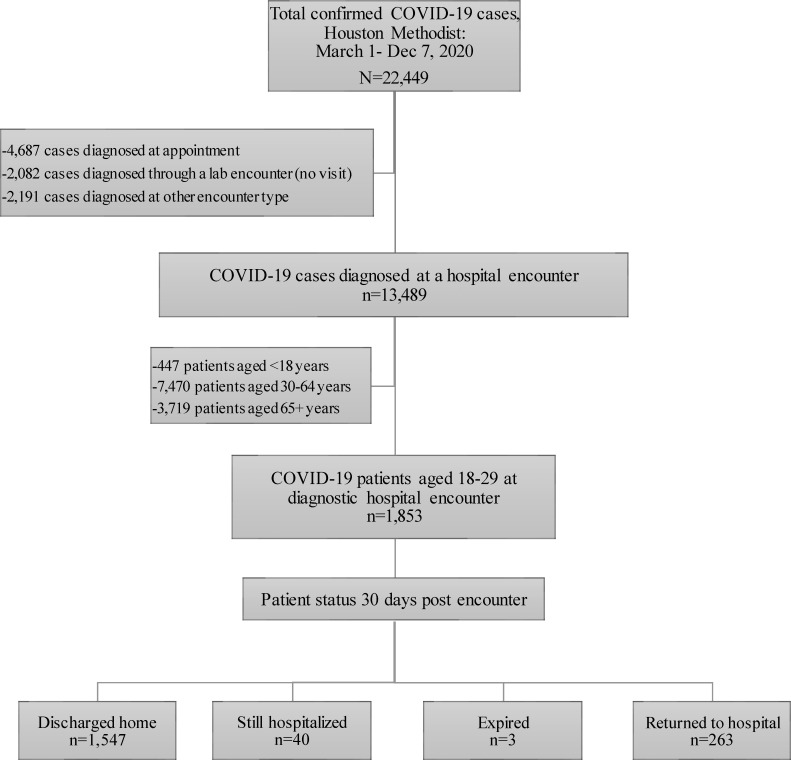
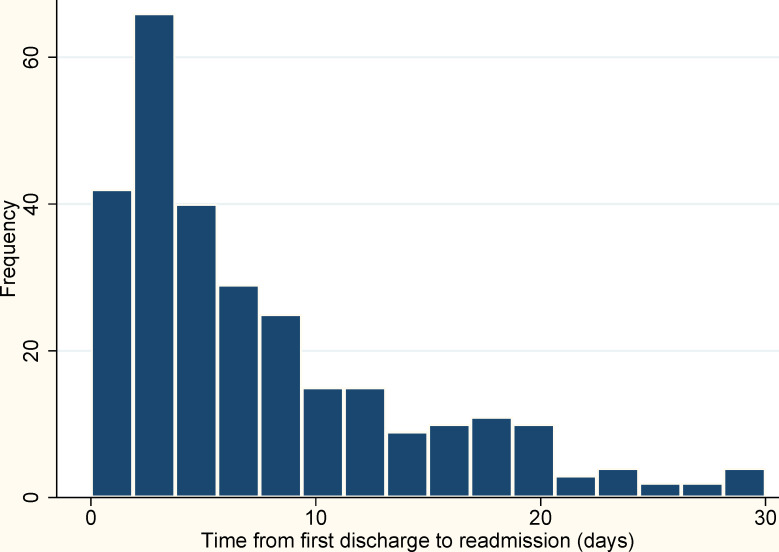
A retrospective registry-based chart review was conducted investigating demographic and clinical risk factors for severe COVID-19 among patients aged 18-29 with positive SARS-CoV-2 tests within a large metropolitan healthcare system in Houston, Texas, USA. In the cohort of 1,853 young adult patients diagnosed with COVID-19 infection at a hospital encounter, including 226 pregnant women, 1,438 (78%) scored 0 on the Charlson Comorbidity Index, and 833 (45%) were obese (≥30 kg/m2). Within 30 days of their diagnostic encounter, 316 (17%) patients were diagnosed with pneumonia, 148 (8%) received other severe disease diagnoses, and 268 (14%) returned to the hospital after being discharged home. In multivariable logistic regression analyses, increasing age (adjusted odds ratio [aOR] 1.1, 95% confidence interval [CI] 1.1-1.2, p<0.001), male gender (aOR 1.8, 95% CI 1.2-2.7, p = 0.002), Hispanic ethnicity (aOR 1.9, 95% CI 1.2-3.1, p = 0.01), obesity (3.1, 95% CI 1.9-5.1, p<0.001), asthma history (aOR 2.3, 95% CI 1.3-4.0, p = 0.003), congestive heart failure (aOR 6.0, 95% CI 1.5-25.1, p = 0.01), cerebrovascular disease (aOR 4.9, 95% CI 1.7-14.7, p = 0.004), and diabetes (aOR 3.4, 95% CI 1.9-6.2, p<0.001) were predictive of severe disease diagnoses within 30 days. Non-Hispanic Black race (aOR 1.6, 95% CI 1.0-2.4, p = 0.04), obesity (aOR 1.7, 95% CI 1.0-2.9, p = 0.046), asthma history (aOR 1.7, 95% CI 1.0-2.7, p = 0.03), myocardial infarction history (aOR 6.2, 95% CI 1.7-23.3, p = 0.01), and household exposure (aOR 1.5, 95% CI 1.1-2.2, p = 0.02) were predictive of 30-day readmission.
This investigation demonstrated the significant risk of severe disease and readmission among young adult populations, especially marginalized communities and people with comorbidities, including obesity, asthma, cardiovascular disease, and diabetes. Health authorities must emphasize COVID-19 awareness and prevention in young adults and continue investigating risk factors for severe disease, readmission and long-term sequalae.
自 2020 年 2 月以来,超过 250 万德克萨斯人被诊断出患有 COVID-19,其中 20%是在工作、学术和社交场所面临 SARS-CoV-2 暴露风险的年轻成年人。本研究调查了美国德克萨斯州休斯顿医院就诊的 18-29 岁年轻成年人中严重疾病和再入院的人口统计学和临床风险因素。
对美国德克萨斯州休斯顿一家大型大都市医疗保健系统中,在医院就诊时 SARS-CoV-2 检测呈阳性的 18-29 岁年轻成年人中严重 COVID-19 的人口统计学和临床风险因素进行了回顾性基于登记的图表审查。在 1853 名年轻成年 COVID-19 感染患者的队列中,包括 226 名孕妇,1438 名(78%)Charlson 合并症指数得分为 0,833 名(45%)肥胖(≥30kg/m2)。在他们的诊断性就诊后的 30 天内,316 名(17%)患者被诊断为肺炎,148 名(8%)患有其他严重疾病,268 名(14%)出院回家后再次返回医院。在多变量逻辑回归分析中,年龄增加(调整后的优势比[aOR]1.1,95%置信区间[CI]1.1-1.2,p<0.001)、男性(aOR 1.8,95%CI 1.2-2.7,p=0.002)、西班牙裔(aOR 1.9,95%CI 1.2-3.1,p=0.01)、肥胖(aOR 3.1,95%CI 1.9-5.1,p<0.001)、哮喘史(aOR 2.3,95%CI 1.3-4.0,p=0.003)、充血性心力衰竭(aOR 6.0,95%CI 1.5-25.1,p=0.01)、脑血管疾病(aOR 4.9,95%CI 1.7-14.7,p=0.004)和糖尿病(aOR 3.4,95%CI 1.9-6.2,p<0.001)与 30 天内严重疾病诊断相关。非西班牙裔黑人种族(aOR 1.6,95%CI 1.0-2.4,p=0.04)、肥胖(aOR 1.7,95%CI 1.0-2.9,p=0.046)、哮喘史(aOR 1.7,95%CI 1.0-2.7,p=0.03)、心肌梗死史(aOR 6.2,95%CI 1.7-23.3,p=0.01)和家庭暴露(aOR 1.5,95%CI 1.1-2.2,p=0.02)与 30 天内再入院相关。
本研究表明,年轻成年人,尤其是弱势群体和合并症患者(包括肥胖、哮喘、心血管疾病和糖尿病),患有严重疾病和再入院的风险显著。卫生当局必须强调年轻成年人对 COVID-19 的认识和预防,并继续调查严重疾病、再入院和长期后遗症的风险因素。