Department of Biomedical Engineering, Illinois Institute of Technology, Chicago, IL, USA.
Rush Alzheimer's Disease Center, Rush University Medical Center, Chicago, IL, USA.
Neuroimage Clin. 2021;31:102768. doi: 10.1016/j.nicl.2021.102768. Epub 2021 Jul 24.
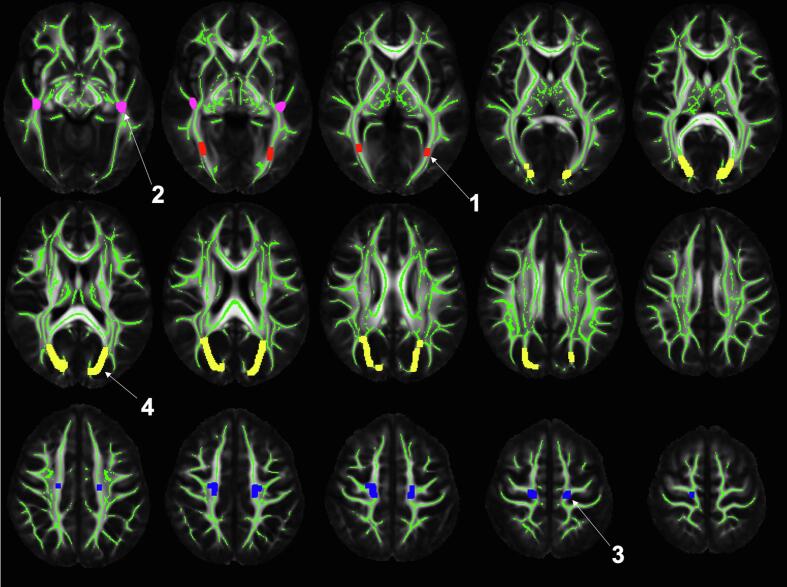
Brain arteriolosclerosis, one of the main pathologies of cerebral small vessel disease, is common in older adults and has been linked to lower cognitive and motor function and higher odds of dementia. In spite of its frequency and associated morbidity, arteriolosclerosis can only be diagnosed at autopsy. Therefore, the purpose of this work was to develop an in-vivo classifier of arteriolosclerosis based on brain MRI. First, an ex-vivo classifier of arteriolosclerosis was developed based on features related to white matter hyperintensities, diffusion anisotropy and demographics by applying machine learning to ex-vivo MRI and pathology data from 119 participants of the Rush Memory and Aging Project (MAP) and Religious Orders Study (ROS), two longitudinal cohort studies of aging that recruit non-demented older adults. The ex-vivo classifier showed good performance in predicting the presence of arteriolosclerosis, with an average area under the receiver operating characteristic curve AUC = 0.78. The ex-vivo classifier was then translated to in-vivo based on available in-vivo and ex-vivo MRI data on the same participants. The in-vivo classifier was named ARTS (short for ARTerioloSclerosis), is fully automated, and provides a score linked to the likelihood a person suffers from arteriolosclerosis. The performance of ARTS in predicting the presence of arteriolosclerosis in-vivo was tested in a separate, 91% dementia-free group of 79 MAP/ROS participants and exhibited an AUC = 0.79 in persons with antemortem intervals shorter than 2.4 years. This level of performance in mostly non-demented older adults is notable considering that arteriolosclerosis can only be diagnosed at autopsy. The scan-rescan reproducibility of the ARTS score was excellent, with an intraclass correlation of 0.99, suggesting that application of ARTS in longitudinal studies may show high sensitivity in detecting small changes. Finally, higher ARTS scores in non-demented older adults were associated with greater decline in cognition two years after baseline MRI, especially in perceptual speed which has been linked to arteriolosclerosis and small vessel disease. This finding was shown in a separate group of 369 non-demented MAP/ROS participants and was validated in 72 non-demented Black participants of the Minority Aging Research Study (MARS) and also in 244 non-demented participants of the Alzheimer's Disease Neuroimaging Initiative 2 and 3. The results of this work suggest that ARTS may have broad implications in the advancement of diagnosis, prevention and treatment of arteriolosclerosis. ARTS is publicly available at https://www.nitrc.org/projects/arts/.
脑小血管病的主要病理学之一是脑小动脉病,常见于老年人,与认知和运动功能降低以及痴呆症的发病几率增加有关。尽管脑小动脉病很常见且会引起相关疾病,但只能通过尸检诊断。因此,本研究旨在开发一种基于脑 MRI 的脑小动脉病活体分类器。首先,通过将机器学习应用于来自 Rush 记忆与衰老项目(MAP)和宗教秩序研究(ROS)的 119 名参与者的离体 MRI 和病理学数据,基于与脑白质高信号、扩散各向异性和人口统计学相关的特征,开发了一种离体脑小动脉病分类器。这个离体分类器在预测脑小动脉病的存在方面表现出了良好的性能,其平均接收者操作特征曲线下面积 AUC 为 0.78。然后,基于同一参与者的可获得的活体和离体 MRI 数据,将离体分类器转化为活体分类器。活体分类器被命名为 ARTS(ARTerioloSclerosis 的缩写),它是完全自动化的,并且提供了与个体患有脑小动脉病的可能性相关的评分。ARTS 在预测活体脑小动脉病存在方面的性能在 79 名 MAP/ROS 参与者的另一个、91%无痴呆的独立组中进行了测试,其 AUC 在生前间隔时间短于 2.4 年的个体中为 0.79。考虑到脑小动脉病只能通过尸检诊断,这在大多数无痴呆的老年人中是显著的。ARTS 评分的扫描-再扫描重现性极好,组内相关系数为 0.99,这表明 ARTS 在纵向研究中的应用可能具有很高的敏感性,能够检测到微小的变化。最后,在基线 MRI 后两年,无痴呆的老年人的 ARTS 评分越高,认知能力下降越大,尤其是与脑小动脉病和小血管病相关的知觉速度。这一发现在 369 名无痴呆的 MAP/ROS 参与者的另一个组中得到了验证,在 Minority Aging Research Study (MARS) 的 72 名无痴呆的黑人参与者和 Alzheimer's Disease Neuroimaging Initiative 2 和 3 的 244 名无痴呆的参与者中也得到了验证。这项工作的结果表明,ARTS 可能在脑小动脉病的诊断、预防和治疗方面具有广泛的意义。ARTS 可在 https://www.nitrc.org/projects/arts/ 上获得。