Yadav Arun Kumar, Ghosh S, Kotwal Atul, Kaushik S K, Bobdey Saurabh, Sahu Rajesh, Kapoor Suraj, Faujdar D S, Teli Prabhakar T, Anand Vivek
Associate Professor, Department of Community Medicine, Armed Forces Medical College, Pune, India.
Col AFMS (Health), O/o DGAFMS, New Delhi, India.
Med J Armed Forces India. 2021 Jul;77(Suppl 2):S379-S384. doi: 10.1016/j.mjafi.2021.06.007. Epub 2021 Jul 26.
The immune response after SARS-CoV-2 is complex and may be affected by severity of the disease, race, etc. The present study was conducted to assess the serial antibody response among the COVID-19 patients admitted in the hospital.
The study was conducted between July and October 2020 in a dedicated COVID-19 hospital. All consented patients underwent serial testing of antibodies using a rapid chromatographic immunoassay-based qualitative IgG/IgM kit every third day until their discharge or death. The data about age, sex, severity of disease, length of stay, onset of symptoms, date of molecular testing were also collected. Appropriate statistical tests were used.
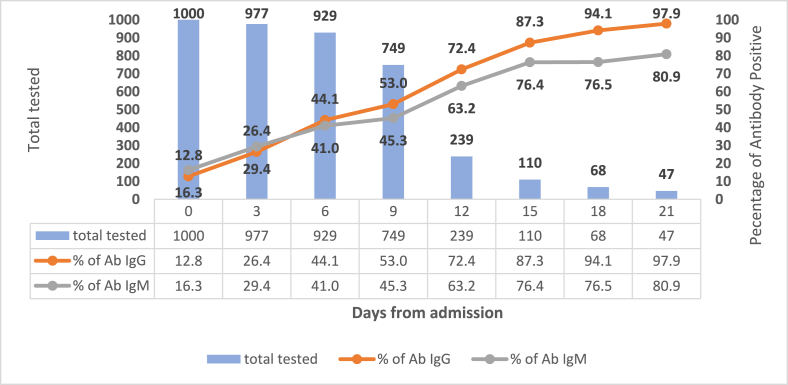
The mean age of 1000 COVID-19 patients was 47.5 ± 17.9 years. Out of the total, 687 (68.7%) were males. With respect to severity, 682 (68.2%) were asymptomatic/mild, 200 (20%) were moderate and 118 (11.8%) were severe cases. The seroconversion percentage increased from 12.8% to 97.9% and 16.3% to 80.9% for IgG and IgM respectively in 21 days. The median time for seroconversion was 10 days (IQR:6-12 days) for IgG and eight days (IQR: 6-11 days) for IgM. At the time of discharge (median nine days), detectable IgG and IgM antibodies were present in 502 (52.46%) and 414 (43.26%) participants respectively. Seroconversion was associated with days after the symptoms, increasing severity of the disease and the presence of co-morbidity.
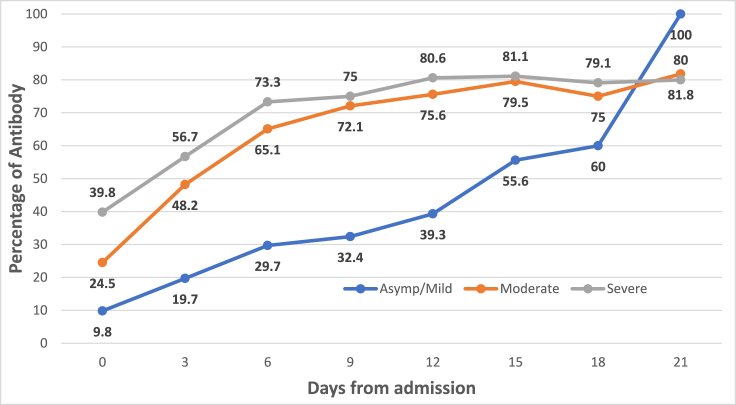
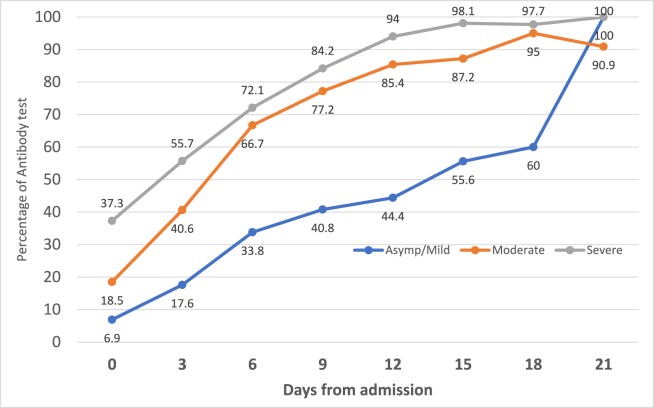
Seroconversion increased during the period of observation. The severe/moderate cases of COVID-19 tend to have an early seroconversion as compared to the asymptomatic/mild cases. Only half of the patients were seroconverted at discharge.
新型冠状病毒肺炎(SARS-CoV-2)感染后的免疫反应复杂,可能受疾病严重程度、种族等因素影响。本研究旨在评估住院的新型冠状病毒病(COVID-19)患者的系列抗体反应。
本研究于2020年7月至10月在一家专门的COVID-19医院进行。所有同意参与的患者每三天使用基于快速色谱免疫分析的定性IgG/IgM试剂盒进行一次抗体系列检测,直至出院或死亡。同时收集患者的年龄、性别、疾病严重程度、住院时间、症状出现时间、分子检测日期等数据,并采用适当的统计学检验方法。
1000例COVID-19患者的平均年龄为47.5±17.9岁。其中,男性687例(68.7%)。按疾病严重程度划分,无症状/轻症患者682例(68.2%),中症患者200例(20%),重症患者118例(11.8%)。21天内,IgG和IgM的血清学转换率分别从12.8%升至97.9%和从16.3%升至80.9%。IgG血清学转换的中位时间为1天(四分位间距:6-12天),IgM为8天(四分位间距:6-11天)。出院时(中位时间为9天),分别有502例(52.46%)和414例(43.26%)参与者检测到IgG和IgM抗体。血清学转换与症状出现后的天数、疾病严重程度增加以及合并症的存在有关。
在观察期内血清学转换增加。与无症状/轻症病例相比,COVID-19重症/中症病例往往血清学转换较早。出院时只有一半的患者发生了血清学转换。