Yang Yun, Ye Wen-Long, Zhang Ruo-Nan, He Xiao-Shun, Wang Jing-Ru, Liu Yu-Xuan, Wang Yi, Yang Xue-Mei, Zhang Yu-Juan, Gan Wen-Juan
Department of Pathology, Medical College of Soochow University, Soochow University, Suzhou 215123, China.
Department of Pathology, The First Affiliated Hospital of Soochow University, Soochow University, Suzhou 215006, China.
Evid Based Complement Alternat Med. 2021 Jul 22;2021:6675208. doi: 10.1155/2021/6675208. eCollection 2021.
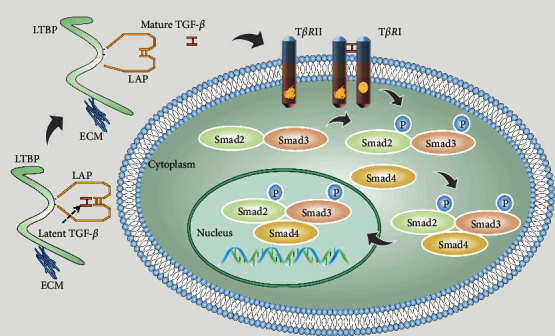
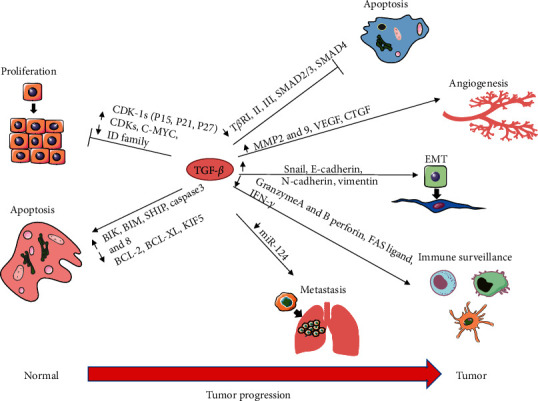
The transforming growth factor- (TGF-) signaling pathway mediates various biological functions, and its dysregulation is closely related to the occurrence of malignant tumors. However, the role of TGF- signaling in tumorigenesis and development is complex and contradictory. On the one hand, TGF- signaling can exert antitumor effects by inhibiting proliferation or inducing apoptosis of cancer cells. On the other hand, TGF- signaling may mediate oncogene effects by promoting metastasis, angiogenesis, and immune escape. This review summarizes the recent findings on molecular mechanisms of TGF- signaling. Specifically, this review evaluates TGF-'s therapeutic potential as a target by the following perspectives: ligands, receptors, and downstream signaling. We hope this review can trigger new ideas to improve the current clinical strategies to treat tumors related to the TGF- signaling pathway.
转化生长因子-β(TGF-β)信号通路介导多种生物学功能,其失调与恶性肿瘤的发生密切相关。然而,TGF-β信号在肿瘤发生和发展中的作用复杂且矛盾。一方面,TGF-β信号可通过抑制癌细胞增殖或诱导其凋亡发挥抗肿瘤作用。另一方面,TGF-β信号可能通过促进转移、血管生成和免疫逃逸介导癌基因效应。本综述总结了TGF-β信号分子机制的最新研究发现。具体而言,本综述从配体、受体和下游信号等方面评估TGF-β作为靶点的治疗潜力。我们希望本综述能引发新思路,以改进当前治疗与TGF-β信号通路相关肿瘤的临床策略。