Adams Ellen M, Pezzotti Simone, Ahlers Jonas, Rüttermann Maximilian, Levin Maxim, Goldenzweig Adi, Peleg Yoav, Fleishman Sarel J, Sagi Irit, Havenith Martina
Lehrstuhl für Physkalische Chemie II, Ruhr Universität Bochum, 44801 Bochum, Germany.
Department of Biological Regulation, Weizmann Institute of Science, Rehovot 7610001, Israel.
JACS Au. 2021 Jul 26;1(7):1076-1085. doi: 10.1021/jacsau.1c00155. Epub 2021 Jun 18.
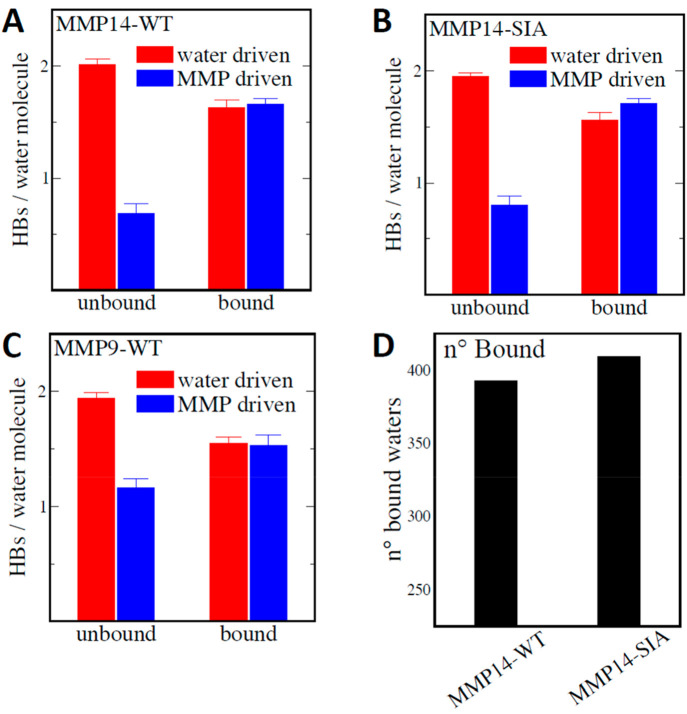
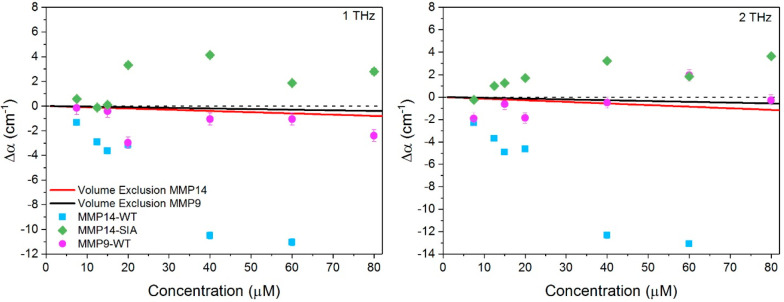
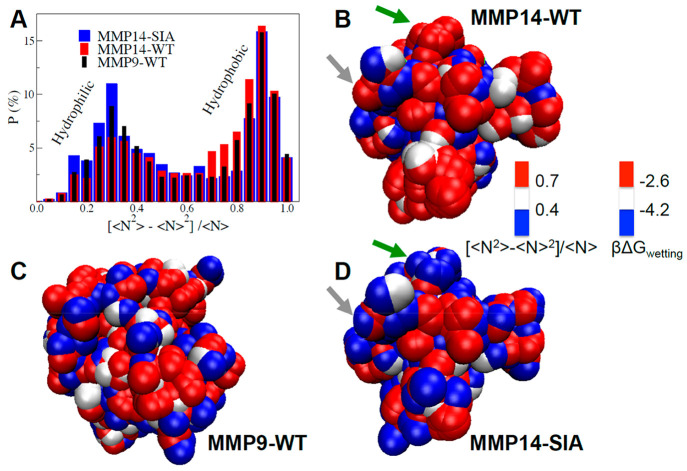
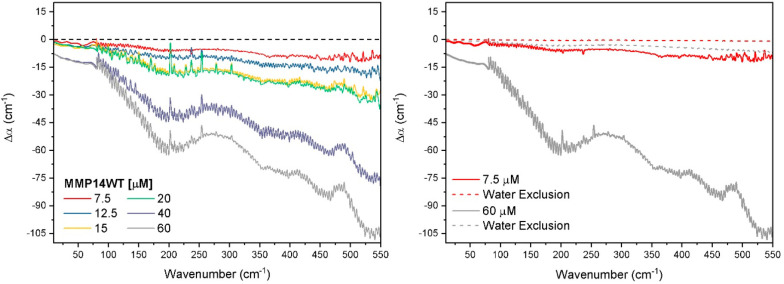
Although it is well-known that limited local mutations of enzymes, such as matrix metalloproteinases (MMPs), may change enzyme activity by orders of magnitude as well as its stability, the completely rational design of proteins is still challenging. These local changes alter the electrostatic potential and thus local electrostatic fields, which impacts the dynamics of water molecules close the protein surface. Here we show by a combined computational design, experimental, and molecular dynamics (MD) study that local mutations have not only a local but also a global effect on the solvent: In the specific case of the matrix metalloprotease MMP14, we found that the nature of local mutations, coupled with surface morphology, have the ability to influence large patches of the water hydrogen-bonding network at the protein surface, which is correlated with stability. The solvent contribution can be experimentally probed via terahertz (THz) spectroscopy, thus opening the door to the exciting perspective of rational protein design in which a systematic tuning of hydration water properties allows manipulation of protein stability and enzymatic activity.
尽管众所周知,诸如基质金属蛋白酶(MMPs)等酶的有限局部突变可能会使酶活性发生几个数量级的变化及其稳定性,但蛋白质的完全合理设计仍然具有挑战性。这些局部变化会改变静电势,从而改变局部静电场,这会影响靠近蛋白质表面的水分子动力学。在这里,我们通过计算设计、实验和分子动力学(MD)相结合的研究表明,局部突变不仅对溶剂有局部影响,而且有全局影响:在基质金属蛋白酶MMP14的特定情况下,我们发现局部突变的性质与表面形态相结合,有能力影响蛋白质表面大片的水氢键网络,这与稳定性相关。溶剂的贡献可以通过太赫兹(THz)光谱进行实验探测,从而为合理的蛋白质设计打开了令人兴奋的前景,即通过系统调节水合水的性质来操纵蛋白质的稳定性和酶活性。