Department of Cardiology, Maastricht University Medical Centre and Cardiovascular Research Institute Maastricht, Universiteitssingel 50, 6229 ER Maastricht, the Netherlands.
Department of Biomedical Sciences, Faculty of Health and Medical Sciences, University of Copenhagen, Blegdamsvej 3B, 2200 Copenhagen, Denmark.
Eur Heart J. 2021 Sep 14;42(35):3521-3525. doi: 10.1093/eurheartj/ehab467.
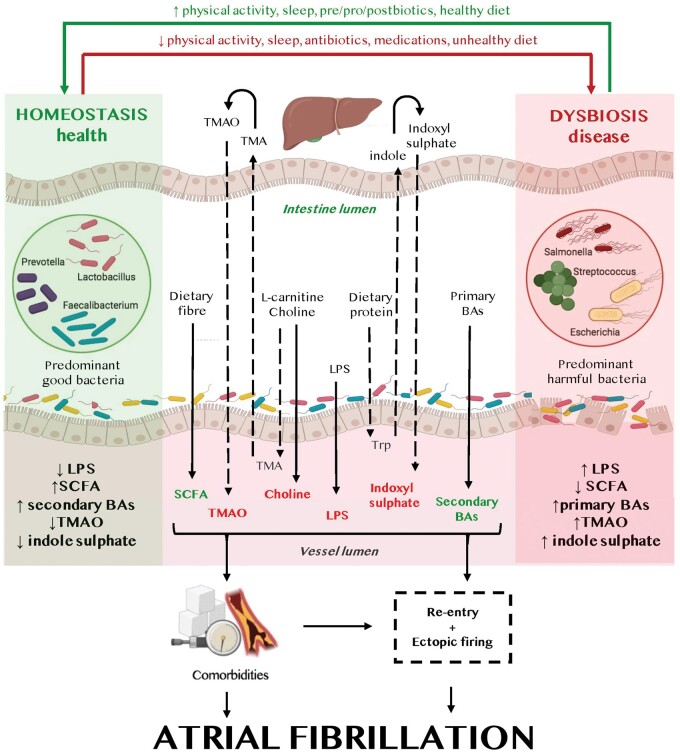
Dietary intake has been shown to change the composition of gut microbiota and some changes in microbiota (dysbiosis) have been linked to diabetes, hypertension, and obesity, which are established risk factors for atrial fibrillation (AF). In addition, intestinal dysbiosis generates microbiota-derived bioactive metabolites that might exert proarrhythmic actions. Although emerging preclinical investigations and clinical observational cohort studies suggest a possible role of gut dysbiosis in AF promotion, the exact mechanisms through which dysbiosis contributes to AF remain unclear. This Viewpoint article briefly reviews evidence suggesting that abnormalities in the intestinal microbiota play an important and little-recognized role in the pathophysiology of AF and that an improved understanding of this role may open up new possibilities in the management of AF.
饮食摄入已被证明会改变肠道微生物群的组成,而微生物群的一些变化(失调)与糖尿病、高血压和肥胖有关,这些都是心房颤动(AF)的既定风险因素。此外,肠道失调会产生可能产生致心律失常作用的微生物衍生生物活性代谢物。尽管新兴的临床前研究和临床观察队列研究表明肠道失调在促进 AF 方面可能起作用,但失调如何导致 AF 的确切机制尚不清楚。本文观点简要回顾了一些证据,表明肠道微生物组的异常在 AF 的病理生理学中起着重要而尚未被认识的作用,对这一作用的深入了解可能为 AF 的治疗开辟新的可能性。