The Francis Crick Institute, The Genome Function Laboratory, London NW1 1AT, UK.
Hum Mol Genet. 2021 Oct 1;30(R2):R187-R197. doi: 10.1093/hmg/ddab219.
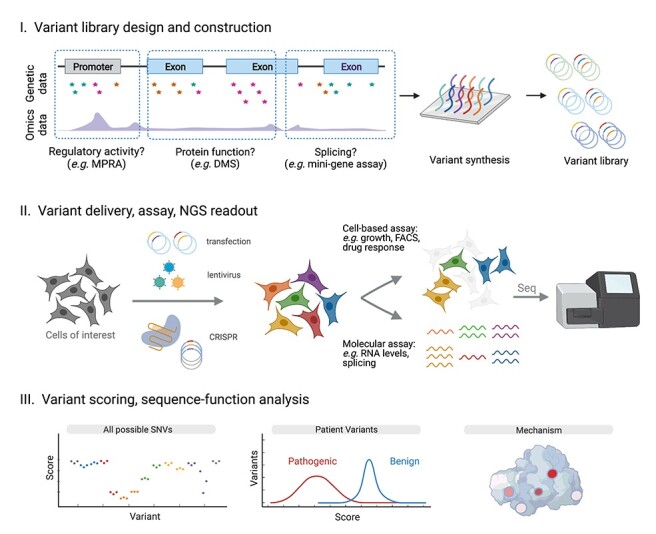
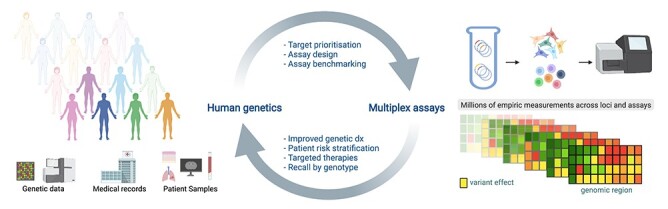
The application of genomics to medicine has accelerated the discovery of mutations underlying disease and has enhanced our knowledge of the molecular underpinnings of diverse pathologies. As the amount of human genetic material queried via sequencing has grown exponentially in recent years, so too has the number of rare variants observed. Despite progress, our ability to distinguish which rare variants have clinical significance remains limited. Over the last decade, however, powerful experimental approaches have emerged to characterize variant effects orders of magnitude faster than before. Fueled by improved DNA synthesis and sequencing and, more recently, by CRISPR/Cas9 genome editing, multiplex functional assays provide a means of generating variant effect data in wide-ranging experimental systems. Here, I review recent applications of multiplex assays that link human variants to disease phenotypes and I describe emerging strategies that will enhance their clinical utility in coming years.
基因组学在医学中的应用加速了对疾病相关突变的发现,并增进了我们对多种病理的分子基础的了解。近年来,随着通过测序查询的人类遗传物质数量呈指数级增长,观察到的稀有变体数量也在增加。尽管取得了进展,但我们区分哪些稀有变体具有临床意义的能力仍然有限。然而,在过去十年中,出现了强大的实验方法,可以以前所未有的速度对变体的影响进行排序。得益于 DNA 合成和测序的改进,以及最近的 CRISPR/Cas9 基因组编辑,多重功能测定为在广泛的实验系统中生成变体效应数据提供了一种手段。在这里,我回顾了将人类变体与疾病表型联系起来的多重测定的最新应用,并描述了未来几年将提高它们临床实用性的新兴策略。