Faculty of Business, University of Technology Sydney, Australia.
Centre for Business Intelligence and Data Analytics (BIDA), University of Technology Sydney, Australia.
Vaccine. 2021 Aug 23;39(36):5116-5128. doi: 10.1016/j.vaccine.2021.07.056. Epub 2021 Jul 23.
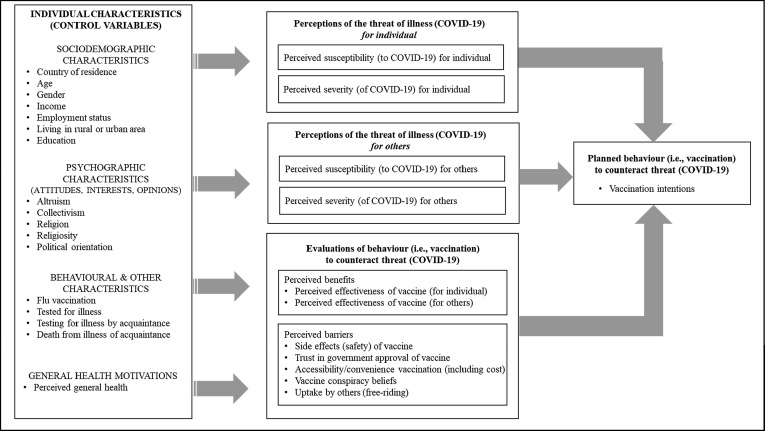
The development of COVID-19 vaccines is occurring at unprecedented speeds, but require high coverage rates to be successful. This research examines individuals' psychological beliefs that may act as enablers and barriers to vaccination intentions. Using the health beliefs model as a guide to our conceptual framework, we explore factors influencing vaccine hesitancy and health beliefs regarding risks and severity of the disease, along with individual variables such as income, age, religion, altruism, and collectivism. A questionnaire using newly created measures for various antecedents provided 4303 usable responses from Australia, Canada, England, New Zealand, and the United States. A factor analytic and structural equation model indicates that trust in vaccine approval, the perceived effectiveness of the vaccine for protecting others, and conspiracy beliefs are the most significant drivers of intentions to vaccinate. Older people, those seeking employment, and those who have received a recent influenza vaccine are more likely to be vaccinated against COVID-19. The findings have implications for improving communication strategies targeting individuals about the merits of vaccination, particularly focusing on younger individuals and expanded message framing to include altruistic considerations, and to improve government transparency regarding the effectiveness and side effects of vaccines.
COVID-19 疫苗的研发速度前所未有,但需要高覆盖率才能成功。本研究考察了个人的心理信念,这些信念可能成为接种意愿的促进因素和障碍。我们以健康信念模型为指导,探讨了影响疫苗犹豫和对疾病风险和严重程度的健康信念的因素,以及收入、年龄、宗教、利他主义和集体主义等个体变量。一份使用新创建的各种前置因素的问卷从澳大利亚、加拿大、英国、新西兰和美国收集到了 4303 份可用的回复。一项因素分析和结构方程模型表明,对疫苗批准的信任、疫苗对保护他人的有效性的认知以及阴谋论信念是接种意愿的最重要驱动因素。老年人、寻求就业的人和最近接种过流感疫苗的人更有可能接种 COVID-19 疫苗。这些发现对改善针对个人的疫苗接种优势的沟通策略具有重要意义,特别是要关注年轻人群体,并扩大信息框架,纳入利他主义考虑因素,提高政府对疫苗有效性和副作用的透明度。