College of Biomedical Engineering, Sichuan University, Chengdu, China.
Mental Health Center, West China Hospital of Sichuan University, Chengdu, China.
Biomed Eng Online. 2021 Aug 3;20(1):75. doi: 10.1186/s12938-021-00915-2.
Schizophrenia is a chronic and severe mental disease, which largely influences the daily life and work of patients. Clinically, schizophrenia with negative symptoms is usually misdiagnosed. The diagnosis is also dependent on the experience of clinicians. It is urgent to develop an objective and effective method to diagnose schizophrenia with negative symptoms. Recent studies had shown that impaired speech could be considered as an indicator to diagnose schizophrenia. The literature about schizophrenic speech detection was mainly based on feature engineering, in which effective feature extraction is difficult because of the variability of speech signals.
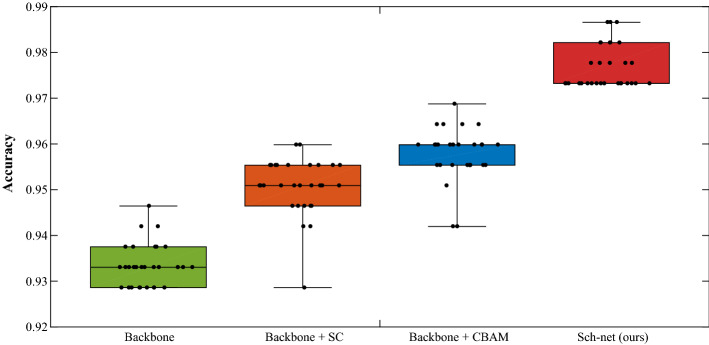
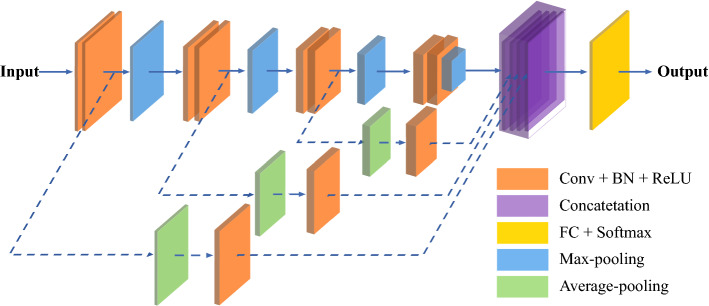
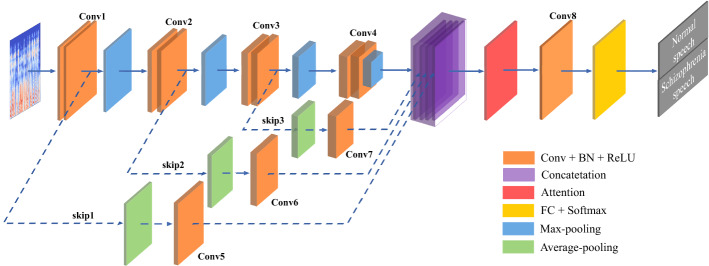
This work designs a novel Sch-net neural network based on a convolutional neural network, which is the first work for end-to-end schizophrenic speech detection using deep learning techniques. The Sch-net adds two components, skip connections and convolutional block attention module (CBAM), to the convolutional backbone architecture. The skip connections enrich the information used for the classification by emerging low- and high-level features. The CBAM highlights the effective features by giving learnable weights. The proposed Sch-net combines the advantages of the two components, which can avoid the procedure of manual feature extraction and selection.
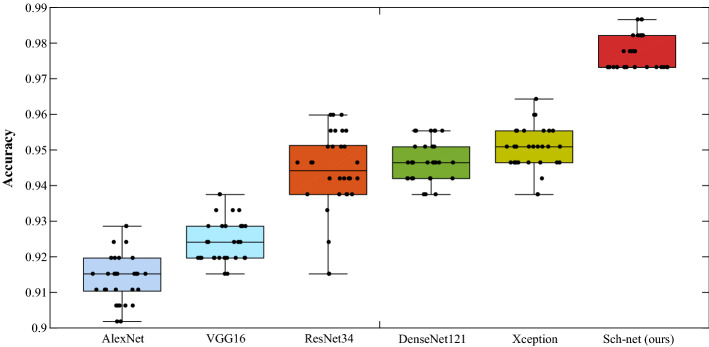
We validate our Sch-net through ablation experiments on a schizophrenic speech data set that contains 28 patients with schizophrenia and 28 healthy controls. The comparisons with the models based on feature engineering and deep neural networks are also conducted. The experimental results show that the Sch-net has a great performance on the schizophrenic speech detection task, which can achieve 97.68% accuracy on the schizophrenic speech data set. To further verify the generalization of our model, the Sch-net is tested on open access LANNA children speech database for specific language impairment detection. The results show that our model achieves 99.52% accuracy in classifying patients with SLI and healthy controls. Our code will be available at https://github.com/Scu-sen/Sch-net .
Extensive experiments show that the proposed Sch-net can provide aided information for the diagnosis of schizophrenia and specific language impairment.
精神分裂症是一种慢性且严重的精神疾病,它在很大程度上影响着患者的日常生活和工作。临床上,伴有阴性症状的精神分裂症常被误诊。其诊断也依赖于临床医生的经验。因此,迫切需要开发一种客观有效的方法来诊断伴有阴性症状的精神分裂症。最近的研究表明,言语障碍可被视为诊断精神分裂症的一个指标。关于精神分裂症言语检测的文献主要基于特征工程,由于言语信号的可变性,有效的特征提取较为困难。
本研究设计了一种新颖的基于卷积神经网络的 Sch-net 神经网络,这是首次使用深度学习技术对精神分裂症言语进行端到端检测。Sch-net 在卷积骨干网络结构中添加了两个组件,即跳跃连接和卷积注意力模块(CBAM)。跳跃连接通过引入低水平和高水平特征来丰富分类所用的信息。CBAM 通过赋予可学习的权重来突出有效特征。所提出的 Sch-net 结合了这两个组件的优点,可以避免手动特征提取和选择的过程。
我们通过在一个包含 28 名精神分裂症患者和 28 名健康对照者的精神分裂症言语数据集上进行消融实验来验证我们的 Sch-net。还与基于特征工程和深度神经网络的模型进行了比较。实验结果表明,Sch-net 在精神分裂症言语检测任务中具有优异的性能,在精神分裂症言语数据集上的准确率可达 97.68%。为了进一步验证模型的泛化能力,我们将 Sch-net 应用于公开的儿童言语数据库(用于特定语言损伤检测),结果表明,在对特定语言损伤患者和健康对照者的分类中,我们的模型达到了 99.52%的准确率。我们的代码将在 https://github.com/Scu-sen/Sch-net 上提供。
大量实验表明,所提出的 Sch-net 可为精神分裂症和特定语言损伤的诊断提供辅助信息。