Cancer Prevention Group, School of Cancer and Pharmaceutical Sciences, King's College London, London, UK
Research Department of Behavioural Science and Health, University College London, London, UK.
Sex Transm Infect. 2022 Jun;98(4):255-261. doi: 10.1136/sextrans-2020-054780. Epub 2021 Aug 3.
Many countries are now using primary human papillomavirus (HPV) testing for cervical screening, testing for high-risk HPV and using cytology as triage. An HPV-positive result can have an adverse psychological impact, at least in the short term. In this paper, we explore the psychological impact of primary HPV screening over 12 months.
Women were surveyed soon after receiving their results (n=1133) and 6 (n=762) and 12 months (n=537) later. Primary outcomes were anxiety (Short-Form State Anxiety Inventory-6) and distress (General Health Questionnaire-12). Secondary outcomes included concern, worry about cervical cancer and reassurance. Mixed-effects regression models were used to explore differences at each time point and change over time across four groups according to their baseline result: control (HPV negative/HPV cleared/normal cytology and not tested for HPV); HPV positive with normal cytology; HPV positive with abnormal cytology; and HPV persistent (ie, second consecutive HPV-positive result).
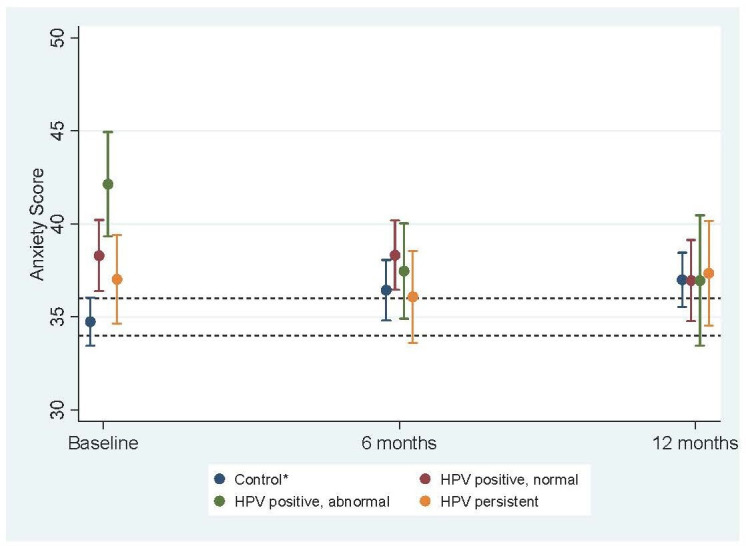
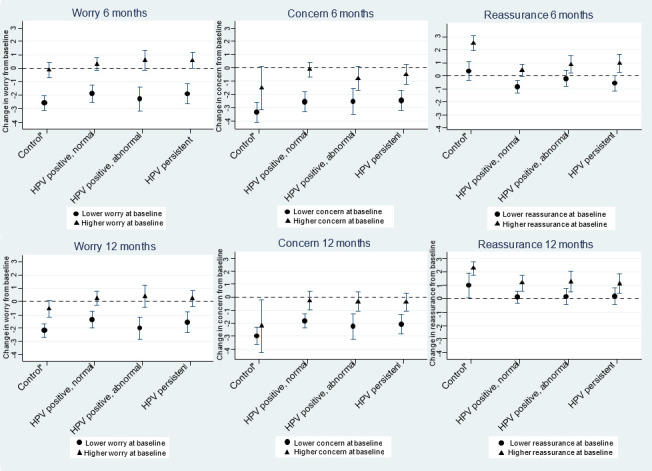
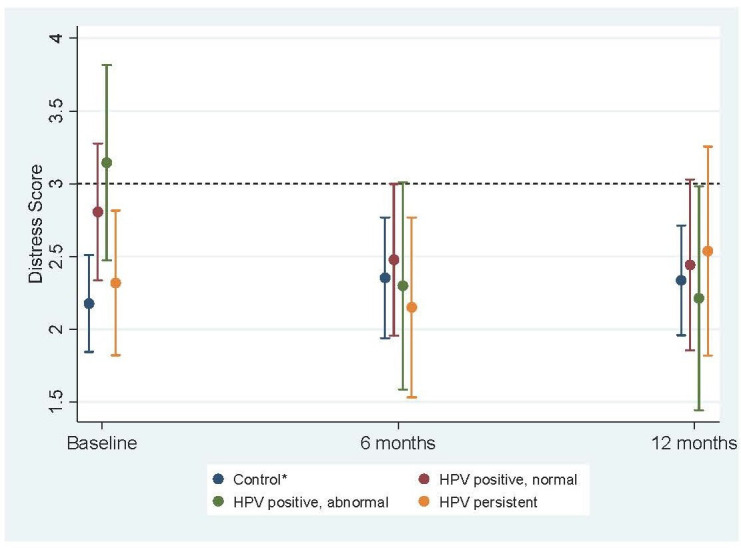
Women who were HPV positive with abnormal cytology had the highest anxiety scores at baseline (mean=42.2, SD: 15.0), but this had declined by 12 months (mean=37.0, SD: 11.7) and was closer to being within the 'normal' range (scores between 34 and 36 are considered 'normal'). This group also had the highest distress at baseline (mean=3.3, SD: 3.8, scores of 3+ indicate case-level distress), but the lowest distress at 12 months (mean=1.9, SD: 3.1). At 6 and 12 months, there were no between-group differences in anxiety or distress for any HPV-positive result group when compared with the control group. The control group were less concerned and more reassured about their result at 6 and 12 months than the HPV-positive with normal cytology group.
Our findings suggest the initial adverse impact of an HPV-positive screening result on anxiety and distress diminishes over time. Specific concerns about the result may be longer lasting and efforts should be made to address them.
许多国家目前正在使用原发性人乳头瘤病毒(HPV)检测进行宫颈筛查,检测高危型 HPV 并将细胞学检查作为分流。HPV 阳性结果至少在短期内会产生不良的心理影响。本文探讨了原发性 HPV 筛查在 12 个月内的心理影响。
在收到结果后不久(n=1133)、6 个月(n=762)和 12 个月(n=537)后对女性进行调查。主要结局指标为焦虑(短式状态焦虑量表-6)和困扰(一般健康问卷-12)。次要结局指标包括关注、对宫颈癌的担忧和安心。采用混合效应回归模型探索每个时间点的差异,并根据基线结果将四个组在 12 个月内的变化情况进行比较:对照组(HPV 阴性/HPV 清除/细胞学正常且未检测 HPV);HPV 阳性且细胞学正常;HPV 阳性且细胞学异常;HPV 持续存在(即连续两次 HPV 阳性结果)。
HPV 阳性伴细胞学异常的女性基线时焦虑评分最高(平均=42.2,标准差:15.0),但 12 个月时已下降(平均=37.0,标准差:11.7),更接近“正常”范围(34 到 36 分被认为是“正常”)。该组在基线时困扰程度最高(平均=3.3,标准差:3.8,3+分表示病例水平的困扰),但在 12 个月时困扰程度最低(平均=1.9,标准差:3.1)。与对照组相比,任何 HPV 阳性结果组在 6 个月和 12 个月时焦虑或困扰均无组间差异。与 HPV 阳性伴细胞学正常组相比,对照组在 6 个月和 12 个月时对结果的担忧更少,安心程度更高。
我们的研究结果表明,HPV 阳性筛查结果对焦虑和困扰的初始不利影响随时间推移而减弱。对结果的具体担忧可能持续时间更长,应努力解决这些担忧。