Li Chao, He Qifang, Qian Hebu, Liu Jun
Department of Critical Care Medicine, The Affiliated Suzhou Hospital of Nanjing Medical University, Suzhou Municipal Hospital, Gusu School, Nanjing Medical University, Suzhou, Jiangsu 215001, P.R. China.
Department of Critical Care Medicine, Suzhou Ninth People's Hospital, The Affiliated Wujiang Hospital of Nantong University, Suzhou, Jiangsu 215001, P.R. China.
Exp Ther Med. 2021 Sep;22(3):1011. doi: 10.3892/etm.2021.10444. Epub 2021 Jul 15.
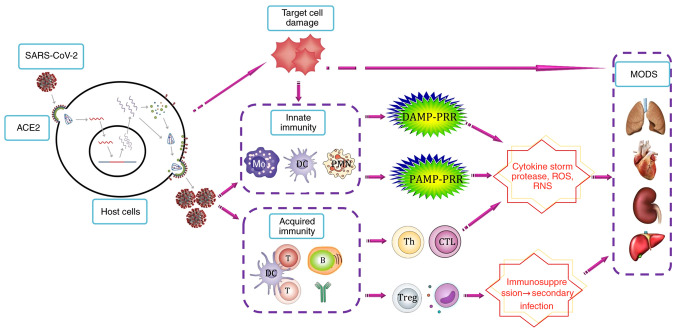
At present, the pathogenesis of the novel coronavirus disease 2019 (COVID-19) has not been fully elucidated. Clinical and experimental findings from studies investigating COVID-19 have suggested that the immune-inflammatory response has a crucial role in severe acute respiratory syndrome coronavirus 2 (SARS-CoV-2) infection. The present article aimed to systematically review the available literature on the pathogenesis of COVID-19. Severe COVID-19 is characterized by organ dysfunction, hypercytokinemia and lymphopenia. It is assumed that the direct cytopathological damage of host cells and the dysregulated immune response caused by SARS-CoV-2 may be the primary underlying mechanisms of COVID-19. Based on the published literature, this review attempts to provide an integrated view of the immunological mechanisms and the potential pathogenesis of COVID-19, providing an in-depth summary of the host-pathogen interaction and host immune responses. It is of great importance to elucidate the possible pathogenesis of COVID-19 to determine the direction of future research.
目前,2019年新型冠状病毒病(COVID-19)的发病机制尚未完全阐明。对COVID-19进行研究的临床和实验结果表明,免疫炎症反应在严重急性呼吸综合征冠状病毒2(SARS-CoV-2)感染中起关键作用。本文旨在系统综述关于COVID-19发病机制的现有文献。重症COVID-19的特征是器官功能障碍、细胞因子血症和淋巴细胞减少。据推测,宿主细胞的直接细胞病理学损伤以及SARS-CoV-2引起的免疫反应失调可能是COVID-19的主要潜在机制。基于已发表的文献,本综述试图提供COVID-19免疫机制和潜在发病机制的综合观点,深入总结宿主与病原体的相互作用以及宿主免疫反应。阐明COVID-19可能的发病机制对于确定未来研究方向至关重要。