
在巴布亚新几内亚利希尔群岛大规模分发长效驱虫蚊帐两年后,对其覆盖范围、使用决定因素和重新定位的横断面研究。
Coverage, determinants of use and repurposing of long-lasting insecticidal nets two years after a mass distribution in Lihir Islands, Papua New Guinea: a cross-sectional study.
机构信息
ISGlobal, Hospital Clínic-Universitat de Barcelona, Barcelona, Spain.
Lihir Malaria Elimination Programme (LMEP), Lihir Island, Papua New Guinea.
出版信息
Malar J. 2021 Aug 4;20(1):336. doi: 10.1186/s12936-021-03867-z.
BACKGROUND
Universal coverage with long-lasting insecticidal nets (LLINs) is an essential component of malaria control programmes. Three-yearly mass distribution of LLINs in Papua New Guinea (PNG) has been successful in reducing infection transmission since 2009, but malaria prevalence ramped up from 2015 onwards. Although LLIN universal coverage is mostly achieved during these campaigns, it may not be related with net use over time. Uses given to LLINs and non-compliance of this strategy were evaluated.
METHODS
A knowledge, attitude and practice (KAP) cross-sectional study was conducted in Lihir Islands, PNG, 2-2.5 years after the last LLIN mass distribution campaign. Data on bed net ownership, use and maintenance behaviour was collected using a household questionnaire administered by trained community volunteers. Logistic regression models were used to identify factors associated with owning at least one LLIN and sleeping under a LLIN the previous night.
RESULTS
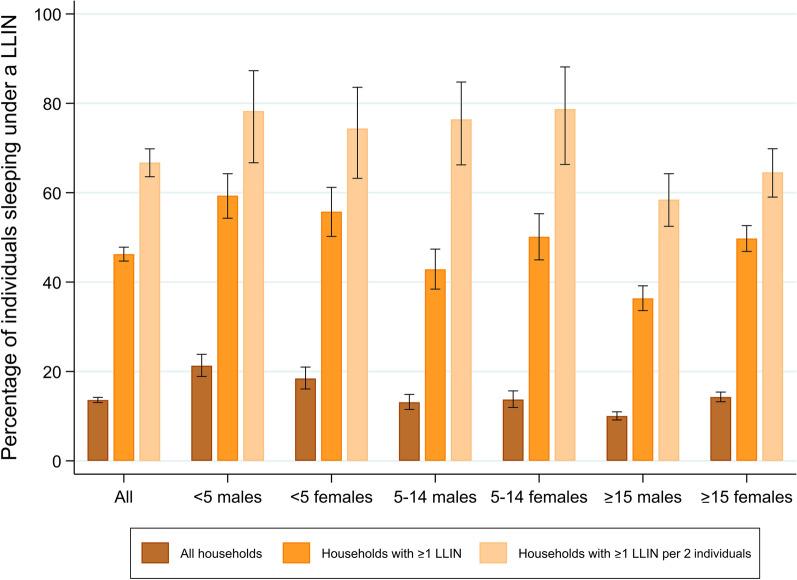
Among 2694 households surveyed, 27.4 % (95 % CI: 25.8-29.2) owned at least one LLIN and 8.7 % (95 % CI: 7.6-9.8) had an adequate LLIN coverage (at least one LLIN for every two people). Out of 13,595 individuals in the surveyed households, 13.6 % (95 % CI: 13.0--4.2) reported having slept under a LLIN the preceding night. Determinants for sleeping under LLIN included living in a household with adequate LLIN coverage [adjusted OR (aOR) = 5.82 (95 % CI: 3.23-10.49)], household heads knowledge about LLINs [aOR = 16.44 (95 % CI: 8.29-32.58)], and female gender [aOR = 1.92 (95 % CI: 1.53-2.40)] (all p-values < 0.001). LLIN use decreased with older age [aOR = 0.29 (95 % CI: 0.21-0.40) for ≥ 15 year-olds, aOR = 0.38 (95 % CI: 0.27-0.55) for 5-14 year-olds] compared to < 5 year-olds (p-value < 0.001). Knowledge on the use of LLIN was good in 37.0 % of the household heads. Repurposed nets were reported serving as fishing nets (30.4 %), fruits and seedlings protection (26.6 %), covering up food (19.0 %) and bed linen (11.5 %).
CONCLUSIONS
Two years after mass distribution, LLIN coverage and use in Lihir Islands is extremely low. Three yearly distribution campaigns may not suffice to maintain an acceptable LLIN coverage unless knowledge on maintenance and use is promoted trough educational campaigns.
背景
普及长效驱虫蚊帐(LLINs)是疟疾控制规划的重要组成部分。自 2009 年以来,巴布亚新几内亚(PNG)每三年进行一次大规模 LLIN 分发,成功降低了感染传播,但从 2015 年开始,疟疾患病率上升。尽管在此类活动中,LLIN 已基本普及,但与长期使用情况可能没有关联。本研究评估了蚊帐的使用情况和该策略的不遵守情况。
方法
在 PNG 的利希尔岛,距上一次大规模 LLIN 分发活动后 2-2.5 年,进行了一项知识、态度和实践(KAP)的横断面研究。使用经过培训的社区志愿者管理的家庭调查问卷收集关于蚊帐拥有、使用和维护行为的数据。使用逻辑回归模型确定与拥有至少一个 LLIN 和前一天晚上睡在 LLIN 下相关的因素。
结果
在所调查的 2694 户家庭中,27.4%(95%CI:25.8-29.2)拥有至少一个 LLIN,8.7%(95%CI:7.6-9.8)有足够的 LLIN 覆盖率(每两个人至少有一个 LLIN)。在所调查家庭的 13595 人中,有 13.6%(95%CI:13.0-4.2)报告在前一晚睡在 LLIN 下。睡在 LLIN 下的决定因素包括居住在 LLIN 覆盖率足够的家庭[调整后的 OR(aOR)=5.82(95%CI:3.23-10.49)]、户主对 LLIN 的了解[aOR=16.44(95%CI:8.29-32.58)]和女性性别[aOR=1.92(95%CI:1.53-2.40)](所有 p 值均<0.001)。与<5 岁的儿童相比,年龄较大的儿童[≥15 岁者的 aOR=0.29(95%CI:0.21-0.40),5-14 岁者的 aOR=0.38(95%CI:0.27-0.55)]使用 LLIN 的可能性较低(p 值<0.001)。37.0%的户主对 LLIN 的使用知识良好。报告重新利用的蚊帐被用作渔网(30.4%)、水果和幼苗保护(26.6%)、覆盖食物(19.0%)和床上用品(11.5%)。
结论
大规模分发两年后,利希尔岛上的 LLIN 覆盖率和使用率极低。除非通过教育活动宣传维护和使用知识,否则每三年进行一次分发活动可能不足以维持可接受的 LLIN 覆盖率。




 Zotero 插件