Institute of Cognitive Neuroscience, Faculty of Education, Huaibei Normal University, Huaibei, China.
College of Medicine, University of the Philippines, Manila, Philippines.
PLoS One. 2021 Feb 11;16(2):e0246824. doi: 10.1371/journal.pone.0246824. eCollection 2021.
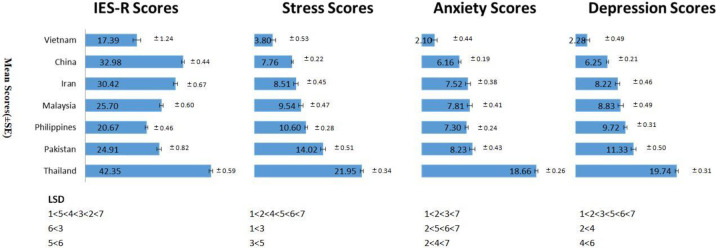
The coronavirus disease (COVID-19) pandemic has impacted the economy, livelihood, and physical and mental well-being of people worldwide. This study aimed to compare the mental health status during the pandemic in the general population of seven middle income countries (MICs) in Asia (China, Iran, Malaysia, Pakistan, Philippines, Thailand, and Vietnam). All the countries used the Impact of Event Scale-Revised (IES-R) and Depression, Anxiety and Stress Scale (DASS-21) to measure mental health. There were 4479 Asians completed the questionnaire with demographic characteristics, physical symptoms and health service utilization, contact history, knowledge and concern, precautionary measure, and rated their mental health with the IES-R and DASS-21. Descriptive statistics, One-Way analysis of variance (ANOVA), and linear regression were used to identify protective and risk factors associated with mental health parameters. There were significant differences in IES-R and DASS-21 scores between 7 MICs (p<0.05). Thailand had all the highest scores of IES-R, DASS-21 stress, anxiety, and depression scores whereas Vietnam had all the lowest scores. The risk factors for adverse mental health during the COVID-19 pandemic include age <30 years, high education background, single and separated status, discrimination by other countries and contact with people with COVID-19 (p<0.05). The protective factors for mental health include male gender, staying with children or more than 6 people in the same household, employment, confidence in doctors, high perceived likelihood of survival, and spending less time on health information (p<0.05). This comparative study among 7 MICs enhanced the understanding of metal health in the general population during the COVID-19 pandemic.
新型冠状病毒病(COVID-19)大流行对世界范围内人们的经济、生计以及身心健康产生了影响。本研究旨在比较亚洲七个中等收入国家(MICs)的普通人群在大流行期间的心理健康状况。所有国家都使用事件影响量表修订版(IES-R)和抑郁、焦虑和压力量表(DASS-21)来衡量心理健康。有 4479 名亚洲人完成了问卷,问卷内容包括人口统计学特征、身体症状和卫生服务利用情况、接触史、知识和关注度、预防措施以及他们对 IES-R 和 DASS-21 的心理健康评分。采用描述性统计、单因素方差分析(ANOVA)和线性回归来确定与心理健康参数相关的保护因素和风险因素。在 7 个 MIC 之间,IES-R 和 DASS-21 评分存在显著差异(p<0.05)。泰国的 IES-R、DASS-21 压力、焦虑和抑郁评分均为最高,而越南的评分均为最低。COVID-19 大流行期间不良心理健康的风险因素包括年龄<30 岁、高教育背景、单身和离异状态、被其他国家歧视和接触 COVID-19 患者(p<0.05)。心理健康的保护因素包括男性、与儿童或同一家庭超过 6 人同住、就业、对医生的信心、高生存可能性和较少关注健康信息(p<0.05)。本研究对亚洲 7 个 MIC 进行了比较,增强了对 COVID-19 大流行期间普通人群心理健康的理解。