School of Public Health, University of the Witwatersrand, Johannesburg, South Africa.
Division of Epidemiology and Biostatistics, Wits School of Public Health, University of the Witwatersrand, Johannesburg, South Africa.
BMC Womens Health. 2021 Aug 5;21(1):286. doi: 10.1186/s12905-021-01421-2.
Intimate partner violence (IPV) is an important public health problem with health and socioeconomic consequences and is endemic in Namibia. Studies assessing risk factors for IPV often use logistic and Poisson regression without geographical location information and spatial effects. We used a Bayesian spatial semi-parametric regression model to determine the risk factors for IPV in Namibia; assess the non-linear effects of age difference between partners and determine spatial effects in the different regions on IPV prevalence.
We used the couples' dataset of the 2013-2014 Namibia Demographic and Health Survey (DHS) obtained on request from Measure DHS. The DHS domestic violence module included 2226 women. We generated a binary variable measuring IPV from the questions "ever experienced physical, sexual or emotional violence?" Covariates included respondent's educational level, age, couples' age difference, place of residence and partner's educational level. All estimation was done with the full Bayesian approach using R version 3.5.2 implementing the R2BayesX package.
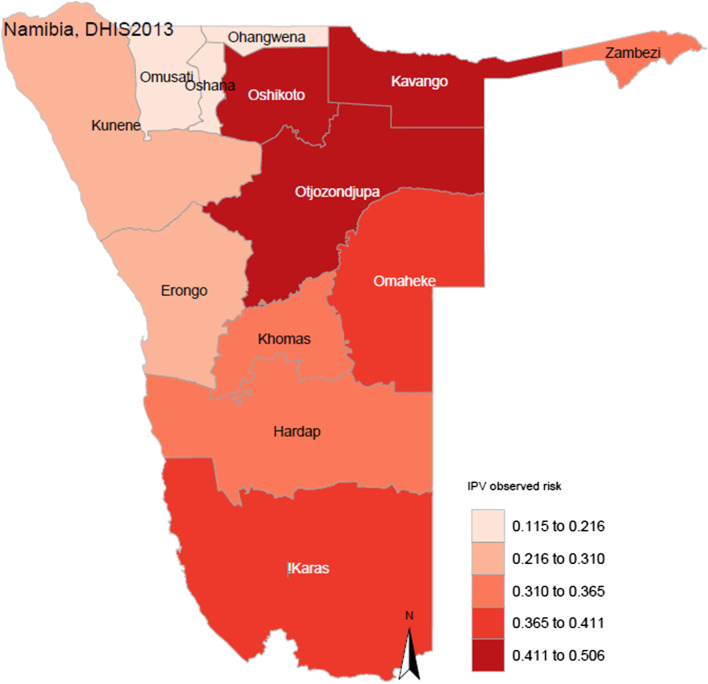
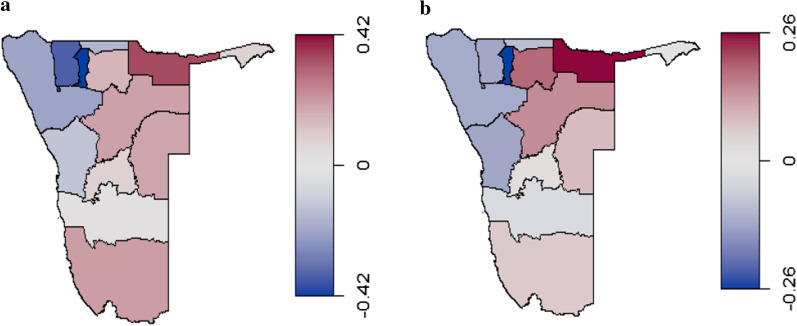
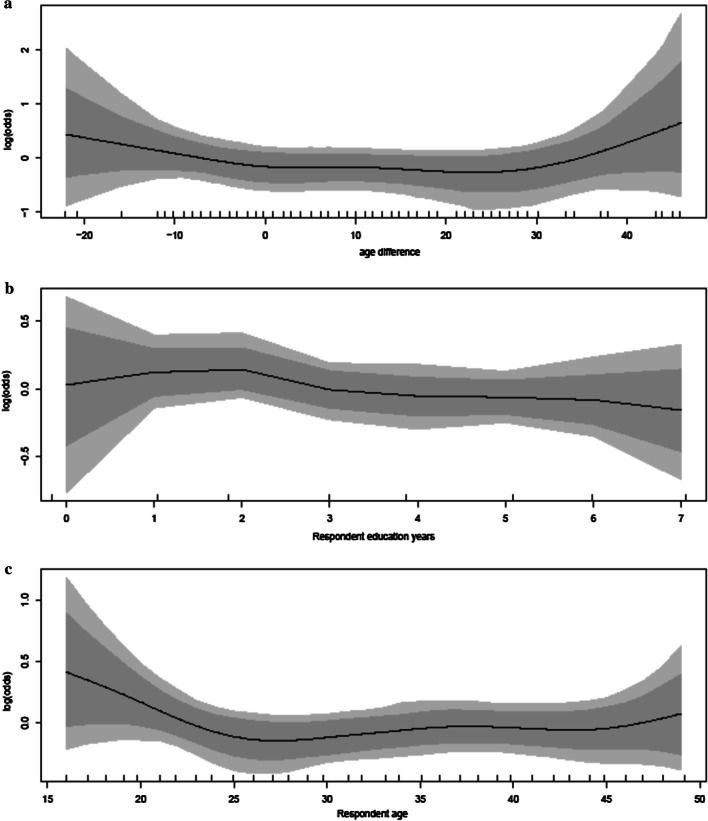
IPV country prevalence was 33.3% (95% CI = 30.1-36.5%); Kavango had the highest [50.6% (95% CI = 41.2-60.1%)] and Oshana the lowest [11.5% (95% CI = 3.2-19.9%)] regional prevalence. IPV prevalence was highest among teenagers [60.8% (95% CI = 36.9-84.7%)]). The spatial semi-parametric model used for adjusted results controlled for regional spatial effects, respondent's age, age difference, respondent's years of education, residence, wealth, and education levels. Women with higher education were 50% less likely to experience IPV [aOR: 0.46, 95% CI = 0.23-0.87]. For non-linear effects, the risk of IPV was high for women ≥ 5 years older or ≥ 25 years younger than their partners. Younger and older women had higher risks of IPV than those between 25 and 45 years. For spatial variation of IPV prevalence, northern regions had low spatial effects while western regions had very high spatial effects.
The prevalence of IPV among Namibia women was high especially among teenagers, with higher educational levels being protective. The risk of IPV was lower in rural than urban areas and higher with wide partner age differences. Interventions and policies for IPV prevention in Namibia are needed for couples with wide age differences as well as for younger women, women with lower educational attainment and in urban and western regions.
亲密伴侣暴力(IPV)是一个重要的公共卫生问题,对健康和社会经济都有影响,在纳米比亚普遍存在。评估 IPV 风险因素的研究通常使用不包含地理位置信息和空间效应的逻辑和泊松回归。我们使用贝叶斯空间半参数回归模型来确定纳米比亚 IPV 的风险因素;评估伴侣年龄差异的非线性效应,并确定不同地区对 IPV 流行率的空间效应。
我们使用了请求 Measure DHS 提供的 2013-2014 年纳米比亚人口与健康调查(DHS)中的夫妇数据集。DHS 家庭内暴力模块包括 2226 名妇女。我们从问题“是否经历过身体、性或情感暴力?”中生成了一个衡量 IPV 的二进制变量。协变量包括受访者的教育水平、年龄、伴侣的年龄差异、居住地和伴侣的教育水平。所有估计都是使用完整的贝叶斯方法完成的,使用了 R 版本 3.5.2 实现的 R2BayesX 包。
IPV 全国流行率为 33.3%(95%CI=30.1-36.5%);卡万戈地区的流行率最高[50.6%(95%CI=41.2-60.1%)],奥沙纳地区的流行率最低[11.5%(95%CI=3.2-19.9%)]。青少年中的 IPV 流行率最高[60.8%(95%CI=36.9-84.7%)]。用于调整结果的空间半参数模型控制了区域空间效应、受访者年龄、年龄差异、受访者受教育年限、居住地、财富和教育水平。受教育程度较高的妇女遭受 IPV 的可能性降低了 50%[调整后的比值比(aOR):0.46,95%置信区间(CI):0.23-0.87]。对于非线性效应,与伴侣年龄相差 5 岁以上或 25 岁以下的妇女发生 IPV 的风险较高。年轻和年长的妇女比 25 至 45 岁之间的妇女有更高的 IPV 风险。对于 IPV 流行率的空间变化,北部地区的空间效应较低,而西部地区的空间效应非常高。
纳米比亚妇女中 IPV 的流行率很高,尤其是青少年,而较高的教育水平具有保护作用。农村地区的 IPV 风险低于城市地区,年龄差异较大的伴侣风险较高。纳米比亚需要针对年龄差异较大的夫妇以及年轻妇女、教育程度较低的妇女以及城市和西部地区开展 IPV 预防干预和政策。