Helmholtz Centre for Infection Research (HZI), Microbial Strain Collection (MISG), 38124, Braunschweig, Germany.
Leibniz Institut DSMZ-German Collection of Microorganisms and Cell Cultures, 38124, Braunschweig, Germany.
Antonie Van Leeuwenhoek. 2021 Oct;114(10):1483-1496. doi: 10.1007/s10482-021-01609-4. Epub 2021 Aug 6.
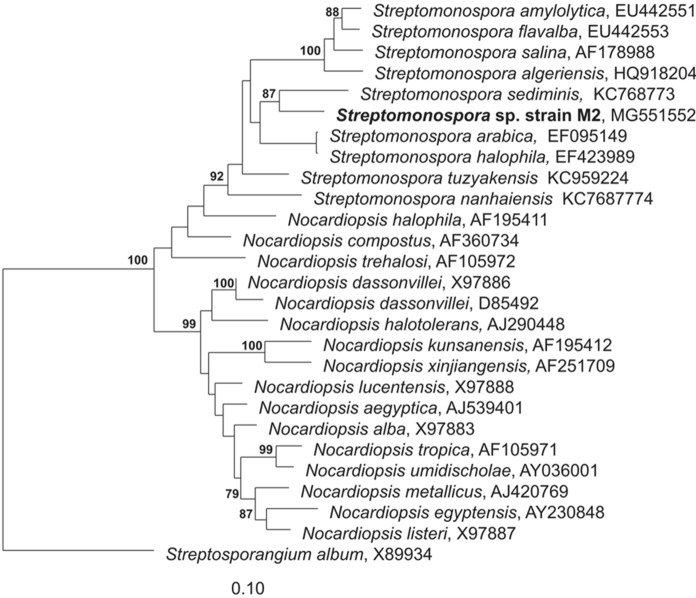
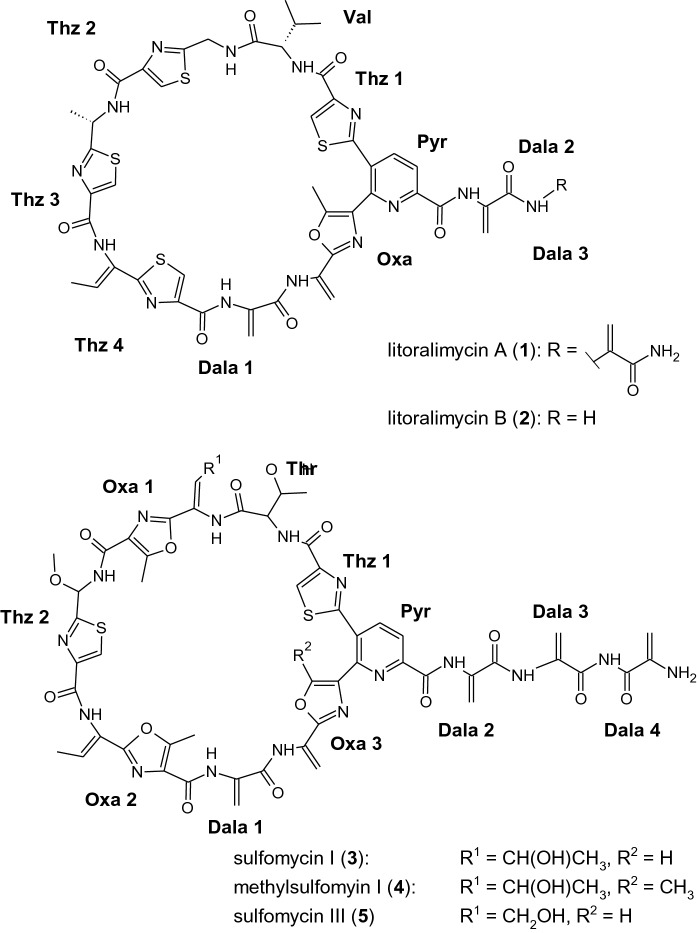
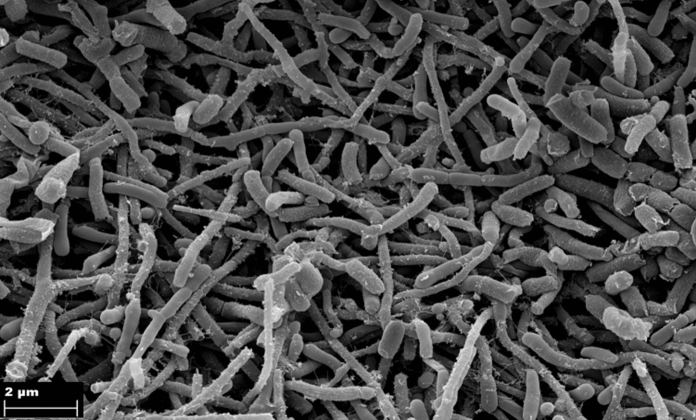
Strain M2 was isolated from the beach of Cuxhaven, Wadden Sea, Germany, in course of a program to attain new producers of bioactive natural products. Strain M2 produces litoralimycin and sulfomycin-type thiopeptides. Bioinformatic analysis revealed a potential biosynthetic gene cluster encoding for the M2 thiopeptides. The strain is Gram-stain-positive, rod shaped, non-motile, spore forming, showing a yellow colony color and forms extensively branched substrate mycelium and aerial hyphae. Inferred from the 16S rRNA gene phylogeny strain M2 affiliates with the genus Streptomonospora. It shows 96.6% 16S rRNA gene sequence similarity to the type species Streptomonospora salina DSM 44593 and forms a distinct branch with Streptomonospora sediminis DSM 45723 with 97.0% 16S rRNA gene sequence similarity. Genome-based phylogenetic analysis revealed that M2 is closely related to Streptomonospora alba YIM 90003 with a digital DNA-DNA hybridisation (dDDH) value of 26.6%. The predominant menaquinones of M2 are MK-10(H), MK-10(H), and MK-11(H) (> 10%). Major cellular fatty acids are iso-C anteiso C and C 10-methyl. The polar lipid profile consisted of diphosphatidylglycerol phosphatidyl glycerol, phosphatidylinositol, phosphatidylcholine, phosphatidylethanolamine, three glycolipids, two unknown phospholipids, and two unknown lipids. The genome size of type strain M2 is 5,878,427 bp with 72.1 mol % G + C content. Based on the results obtained from phylogenetic and chemotaxonomic studies, strain M2 (= DSM 106425 = NCCB 100650) is considered to represent a novel species within the genus Streptomonospora for which the name Streptomonospora litoralis sp. nov. is proposed.
M2 菌株是从德国瓦登海库克斯港海滩分离出来的,该菌株是为获得新的生物活性天然产物产生菌而进行的一项计划的结果。M2 菌株产生滨海霉素和硫霉素型噻肽。生物信息学分析揭示了一个潜在的生物合成基因簇,该基因簇编码 M2 噻肽。该菌株革兰氏阳性,杆状,不运动,孢子形成,呈现黄色菌落颜色,并形成广泛分枝的基质菌丝和气生菌丝。根据 16S rRNA 基因系统发育,菌株 M2 与链霉菌属相关。它与模式种盐生链霉菌 DSM 44593 的 16S rRNA 基因序列相似性为 96.6%,与海栖链霉菌 DSM 45723 的 16S rRNA 基因序列相似性为 97.0%,形成一个独特的分支。基于基因组的系统发育分析表明,M2 与白色链霉菌 YIM 90003 密切相关,数字 DNA-DNA 杂交(dDDH)值为 26.6%。M2 的主要menaquinones 为 MK-10(H), MK-10(H), 和 MK-11(H)(>10%)。主要细胞脂肪酸为异-C 前异-C 和 C 10-甲基。极性脂谱由双磷脂酰甘油、磷脂酰甘油、磷脂酰肌醇、磷脂酰胆碱、磷脂酰乙醇胺、三种糖脂、两种未知磷脂和两种未知脂组成。模式菌株 M2 的基因组大小为 5878427bp,G+C 含量为 72.1 mol%。基于系统发育和化学分类学研究的结果,菌株 M2(=DSM 106425= NCCB 100650)被认为代表链霉菌属中的一个新种,现提议将其命名为滨海链霉菌(Streptomonospora litoralis)sp. nov.。