Cronk John M, Fafoutis Eleni, Brown Michael G
Department of Microbiology, Immunology, and Cancer Biology, University of Virginia School of Medicine, Charlottesville, VA 22908, USA.
Human Biology Program, College of Arts and Sciences, University of Virginia, Charlottesville, VA 22908, USA.
Pathogens. 2021 Jul 19;10(7):908. doi: 10.3390/pathogens10070908.
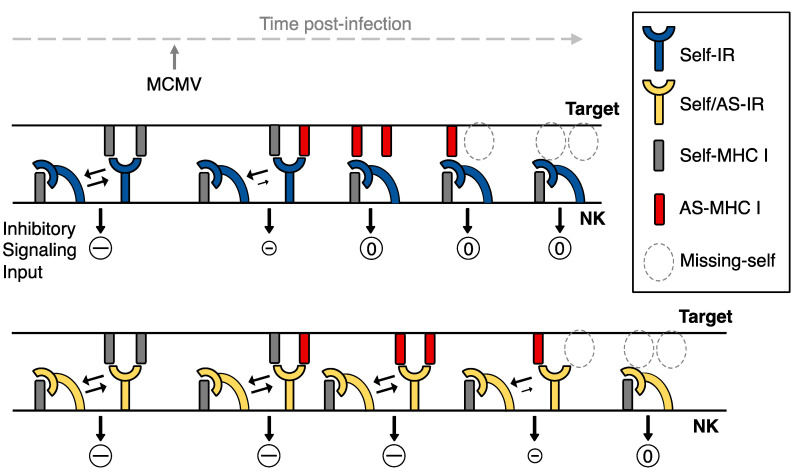
Immunoreceptor tyrosine-based inhibitory motif (ITIM)-bearing receptors (IRs) enable discrimination between self- and non-self molecules on the surface of host target cells. In this regard, they have a vital role in self-tolerance through binding and activating intracellular tyrosine phosphatases which can inhibit cellular activation. Yet, self-MHC class I (MHC I)-specific IRs are versatile in that they can also positively impact lymphocyte functionality, as exemplified by their role in natural killer (NK) cell education, often referred to as 'licensing'. Recent discoveries using defined mouse models of cytomegalovirus (CMV) infection have revealed that select self-MHC I IRs can increase NK cell antiviral defenses as well, whereas other licensing IRs cannot, or instead impede virus-specific NK responses for reasons that remain poorly understood. This review highlights a role for self-MHC I 'licensing' IRs in antiviral immunity, especially in the context of CMV infection, their impact on virus-specific NK cells during acute infection, and their potential to affect viral pathogenesis and disease.
携带基于免疫受体酪氨酸抑制基序(ITIM)的受体(IR)能够区分宿主靶细胞表面的自身和非自身分子。在这方面,它们通过结合并激活细胞内酪氨酸磷酸酶来抑制细胞活化,从而在自身耐受中发挥至关重要的作用。然而,自身主要组织相容性复合体I类(MHC I)特异性IR具有多面性,因为它们也能对淋巴细胞功能产生积极影响,以其在自然杀伤(NK)细胞“教育”(通常称为“许可”)中的作用为例。最近利用明确的巨细胞病毒(CMV)感染小鼠模型所做的发现表明,某些自身MHC I IR也能增强NK细胞的抗病毒防御能力,而其他许可IR则不能,或者反而会阻碍病毒特异性NK反应,其原因仍知之甚少。本综述强调了自身MHC I“许可”IR在抗病毒免疫中的作用,特别是在CMV感染的背景下,它们在急性感染期间对病毒特异性NK细胞的影响,以及它们影响病毒发病机制和疾病的潜力。