Taekwondo Institute of Health and Culture, Dong-A University, 37, Nakdong-Daero, 550, Sahagu, Busan 49315, Korea.
Graduate School, Dong-A University, 37, Nakdong-Daero 550, Sahagu, Busan 49315, Korea.
Int J Environ Res Public Health. 2021 Jul 28;18(15):7961. doi: 10.3390/ijerph18157961.
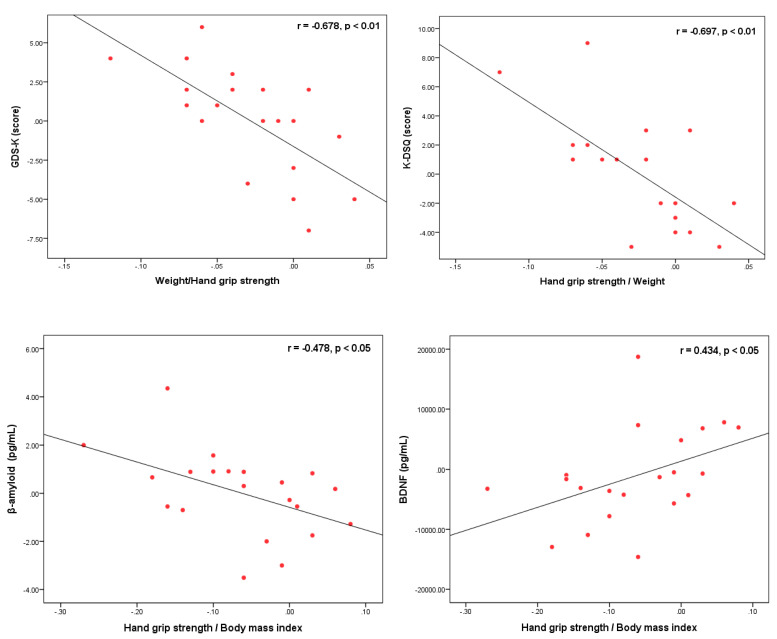
The purpose of this research is to identify the correlations between functional fitness enhancement through a long-term Taekwondo training program and the physical characteristics and risk factors of dementia among elderly women with depression. The study has found that conducting three 60-min Taekwondo training sessions a week for the duration of 12 weeks has enhanced a number of functional fitness indexes, including hand grip strength/weight ( < 0.01), 4-m gait speed ( < 0.001), 3-m timed up and go ( < 0.05), and figure-of-eight track ( < 0.05), and significantly improved general health condition indexes as well, including percent fat ( < 0.05), appendicular skeletal muscle mass index ( < 0.01), systolic blood pressure ( < 0.01), and diastolic blood pressure ( < 0.001). Furthermore, the arteriosclerosis index and cognitive function have been found to be improved with an increase of brain-derived neurotrophic factor (BDNF; which prevents dementia) and a significant decrease of β-amyloid-a risk factor of dementia-as a result of enhancements in serum lipids and adiponectin, confirming the positive effects of functional fitness enhancement on fighting depression, promoting physical characteristics, and reducing the risk factors of dementia.
本研究旨在探讨长期跆拳道训练对抑郁老年女性的功能性体能增强与痴呆的身体特征和风险因素之间的相关性。研究发现,每周进行三次 60 分钟的跆拳道训练,持续 12 周,可增强多项功能性体能指标,包括手握力/体重(<0.01)、4 米步行速度(<0.001)、3 米计时起立行走(<0.05)和 8 字形轨迹(<0.05),并显著改善一般健康状况指标,包括体脂百分比(<0.05)、四肢骨骼肌质量指数(<0.01)、收缩压(<0.01)和舒张压(<0.001)。此外,发现动脉硬化指数和认知功能随着脑源性神经营养因子(BDNF)的增加而改善(BDNF 可预防痴呆),β-淀粉样蛋白(痴呆的一个风险因素)显著减少,这是由于血脂和脂联素的增加,证实了功能性体能增强对对抗抑郁、促进身体特征和降低痴呆风险因素的积极影响。