Department of Philosophy, Social Sciences and Education, University of Perugia, Piazza Ermini 1, 06123 Perugia, Italy.
Int J Environ Res Public Health. 2021 Jul 30;18(15):8074. doi: 10.3390/ijerph18158074.
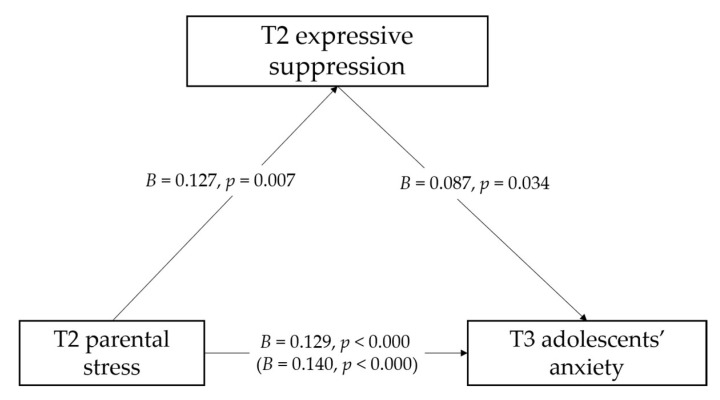
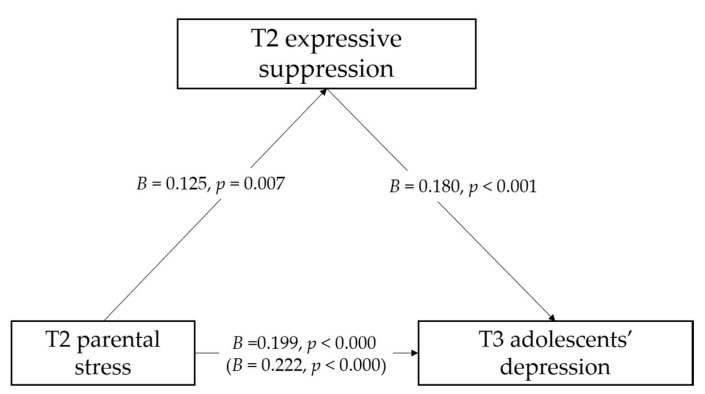
The challenges and consequences of COVID-19 imposed massive changes in adolescents' daily routines (e.g., school closures, home confinement, and social distancing rules), which impacted their mental health. This longitudinal study aimed to better understand the changes in adolescents' internalizing symptoms and the underlying mechanisms of parental stress due to COVID-19. We asked 1053 parents of adolescents to complete an online survey during the second and fifth weeks and at the end of home confinement (i.e., four weeks later). Results showed that parents reported their adolescents' anxiety and depression symptoms were more severe at Time 2 than at the first administration. Anxiety symptoms slightly decreased at Time 3, while there was no significant change in depression symptoms. Moreover, parents' expressive suppression mediated the association between parental stress and adolescents' anxiety and depression symptoms, respectively. The findings suggest that as restriction increased, adolescents' anxiety and depression became more severe. Moreover, due to the link between parental stress and adolescents' internalizing disorders helping families to cope with the distress due to the pandemic may have a positive impact on parents, the child, and the family as a whole (i.e., the family climate).
新冠疫情给青少年的日常生活带来了巨大变化(例如,学校停课、居家隔离和社交距离规定),这对他们的心理健康产生了影响。本纵向研究旨在更好地了解青少年内化症状的变化以及因新冠疫情导致的父母压力的潜在机制。我们要求 1053 名青少年的家长在第二周和第五周以及居家隔离结束时(即四周后)在线完成一项调查。结果表明,与第一次调查相比,家长报告说青少年在第二次调查时的焦虑和抑郁症状更严重。第三次调查时,焦虑症状略有下降,而抑郁症状没有明显变化。此外,父母的表达抑制分别介导了父母压力与青少年焦虑和抑郁症状之间的关联。研究结果表明,随着限制的增加,青少年的焦虑和抑郁症状变得更加严重。此外,由于父母压力与青少年内化障碍之间存在联系,帮助家庭应对大流行带来的困扰可能会对父母、孩子和整个家庭(即家庭氛围)产生积极影响。