Department of Animal Sciences, North Carolina Agricultural and Technical State University, 1601 East Market Street, Greensboro, NC 27411, USA.
Department of Agriculture, University of Arkansas at Pine Bluff, 1200 N. University Drive, Mail Slot 4913, Pine Bluff, AR 71601, USA.
Int J Mol Sci. 2021 Jul 28;22(15):8046. doi: 10.3390/ijms22158046.
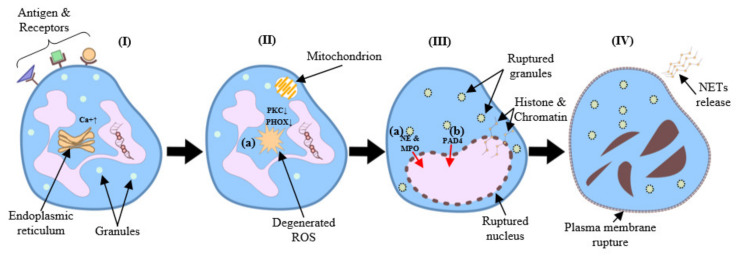
This review provides insight into the importance of understanding NETosis in cows, sheep, and goats in light of the importance to their health, welfare and use as animal models. Neutrophils are essential to innate immunity, pathogen infection, and inflammatory diseases. The relevance of NETosis as a conserved innate immune response mechanism and the translational implications for public health are presented. Increased understanding of NETosis in ruminants will contribute to the prediction of pathologies and design of strategic interventions targeting NETs. This will help to control pathogens such as coronaviruses and inflammatory diseases such as mastitis that impact all mammals, including humans. Definition of unique attributes of NETosis in ruminants, in comparison to what has been observed in humans, has significant translational implications for one health and global food security, and thus warrants further study.
本综述探讨了理解奶牛、绵羊和山羊细胞 NETosis 的重要性,因为这对于它们的健康、福利以及作为动物模型的应用具有重要意义。中性粒细胞对于先天免疫、病原体感染和炎症性疾病至关重要。本文介绍了 NETosis 作为一种保守的先天免疫反应机制的相关性及其对公共卫生的转化意义。增加对反刍动物 NETosis 的理解将有助于预测病理学,并设计针对 NET 的战略干预措施。这将有助于控制包括人类在内的所有哺乳动物的病原体,如冠状病毒和乳腺炎等炎症性疾病。与人类观察到的情况相比,定义反刍动物细胞 NETosis 的独特属性对一种健康和全球粮食安全具有重要的转化意义,因此值得进一步研究。