Inno Rain, Kikas Triin, Lillepea Kristiina, Laan Maris
Human Genetics Research Group, Institute of Biomedicine and Translational Medicine, Faculty of Medicine, University of Tartu, Tartu, Estonia.
Front Cell Dev Biol. 2021 Jul 21;9:697947. doi: 10.3389/fcell.2021.697947. eCollection 2021.
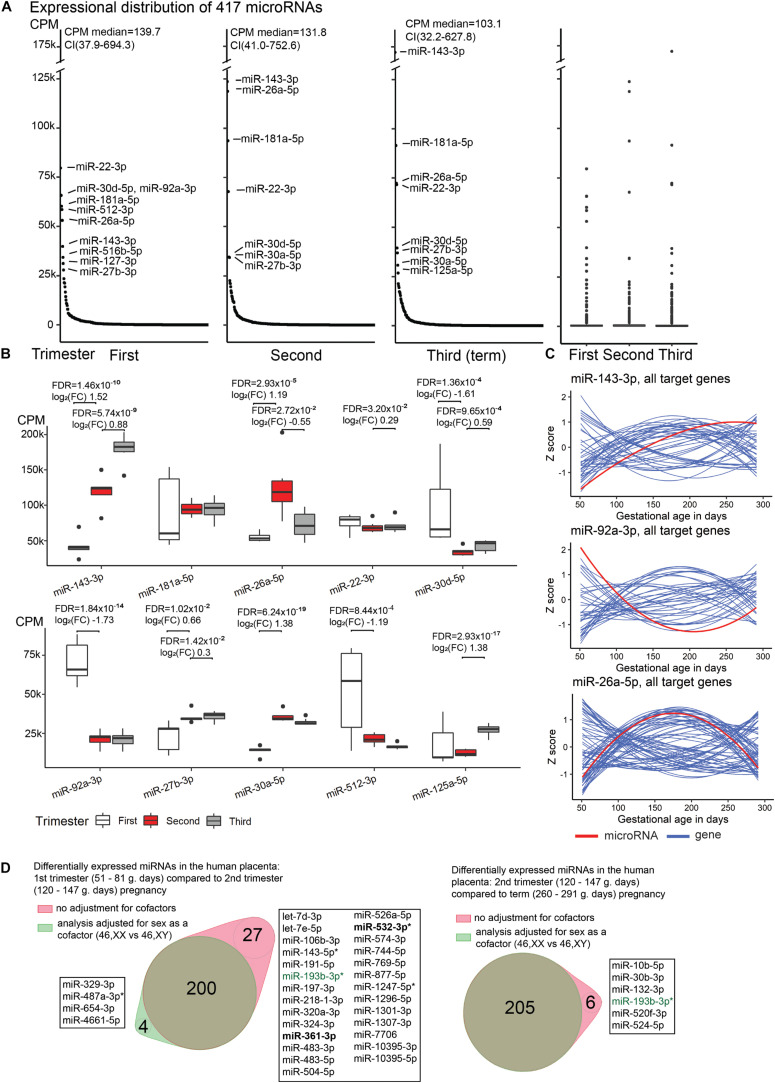
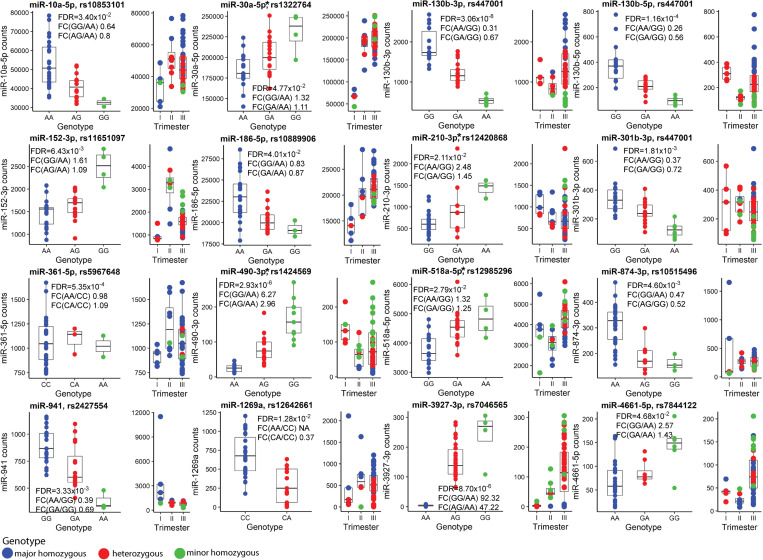
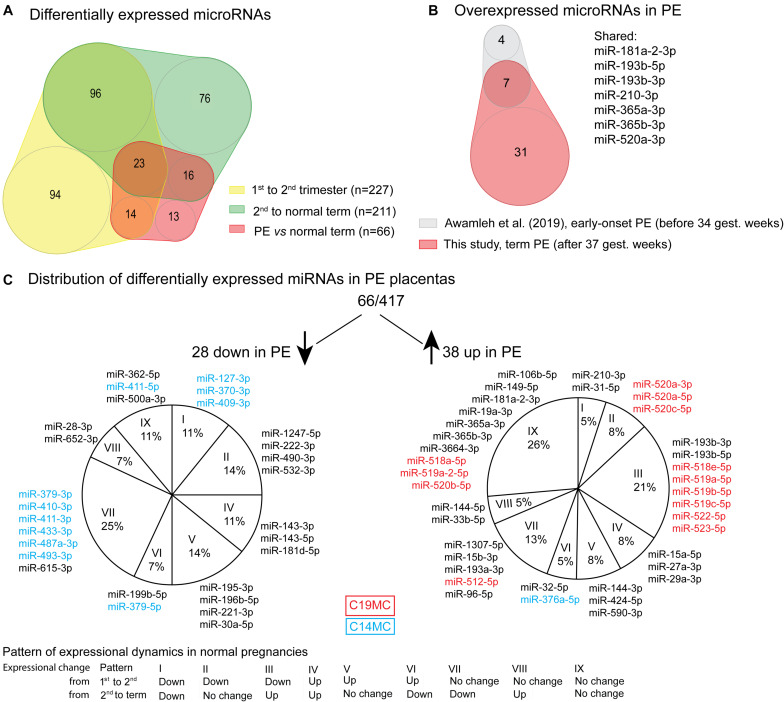
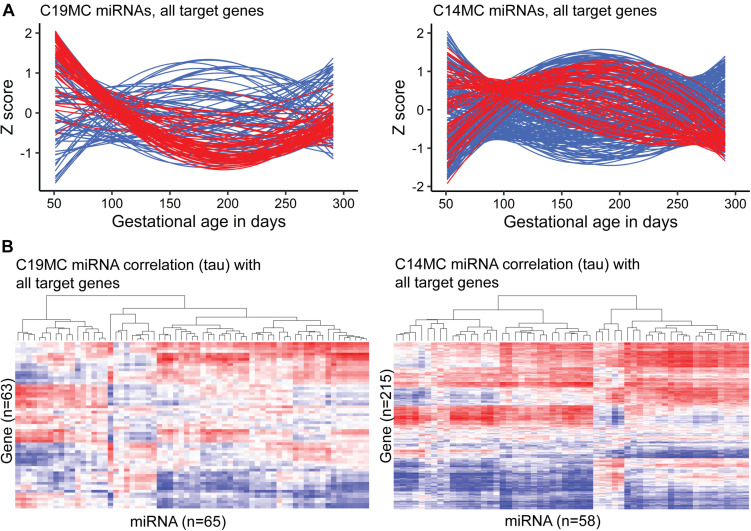
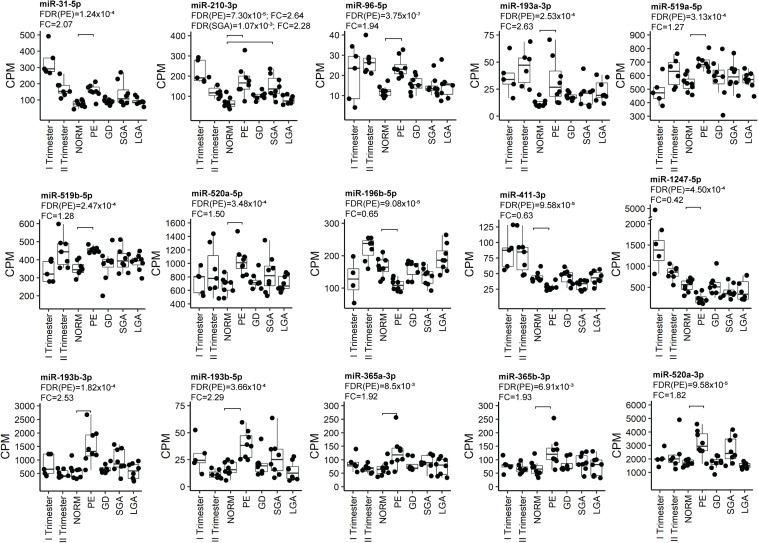
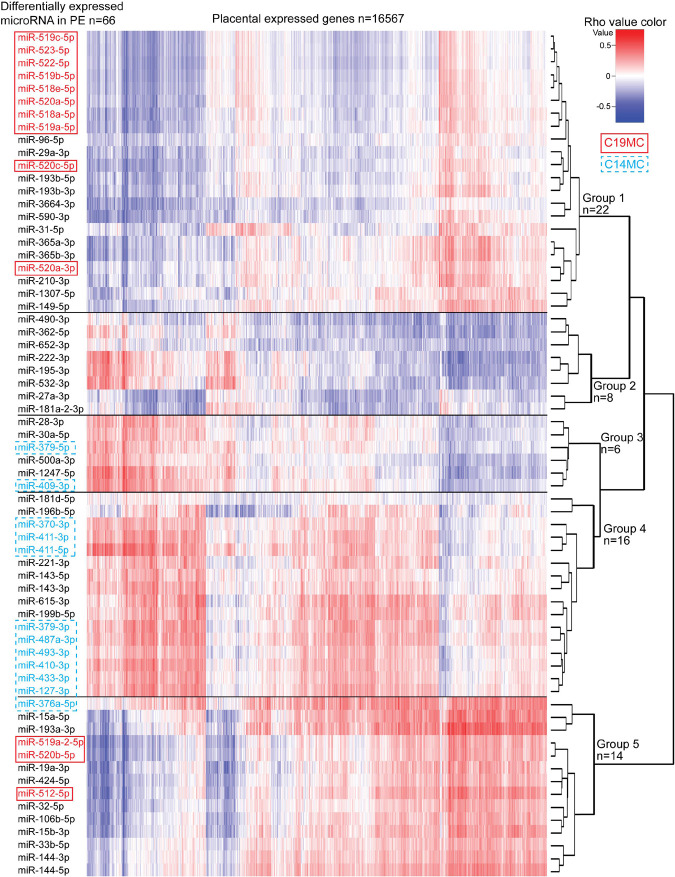
Placenta is a unique organ that serves its own function, and contributes to maternal gestational adaptation and fetal development. Coordination of its transcriptome to satisfy all the maternal-fetal needs across gestation is not fully understood. MicroRNAs are powerful transcriptome modulators capable to adjust rapidly the expression level and dynamics of large gene sets. This MiR-Seq based study presents a multi-omics investigation of the human placental miRNome and its synergy with the transcriptome. The analysis included 52 placentas representing three trimesters of normal pregnancy, and term cases of late-onset preeclampsia (LO-PE), gestational diabetes and affected fetal growth. Gestational-age dependent differential expression (FDR < 0.05) was detected for 319 of 417 tested miRNAs (76.5%). A shared list of target genes of dynamic miRNAs suggested their coordinated action. The most abundant miR-143-3p revealed as a marker for pregnancy progression. The data suggested critical, but distinct roles of placenta-specific imprinted C19MC and C14MC miRNA clusters. Paternally encoded primate-specific C19MC was highly transcribed during first trimester, potentially fine-tuning the early placental transcriptome in dosage-sensitive manner. Maternally encoded eutherian C14MC showed high expression until term, underlining its key contribution across gestation. A major shift in placental miRNome (16% miRNAs) was observed in LO-PE, but not in other term pregnancy complications. Notably, 13/38 upregulated miRNAs were transcribed from C19MC and only one from C14MC, whereas 11/28 downregulated miRNAs represented C14MC and none C19MC. miR-210-3p, miR-512-5p, miR-32-5p, miR-19a-3p, miR-590-3p, miR-379-5p were differentially expressed in LO-PE and cases of small-for-gestational-age newborns, supporting a shared etiology. Expression correlation analysis with the RNA-Seq data (16,567 genes) of the same samples clustered PE-linked miRNAs into five groups. Large notable clusters of miRNA-gene pairs showing directly and inversely correlated expression dynamics suggested potential functional relationships in both scenarios. The first genome-wide study of placental miR-eQTLs identified 66 placental SNVs associated with the expression of neighboring miRNAs, including PE-linked miRNAs miR-30a-5p, miR-210-3p, miR-490-3p and miR-518-5p. This study provided a rich catalog of miRNAs for further in-depth investigations of their individual and joint effect on placental transcriptome. Several highlighted miRNAs may serve as potential biomarkers for pregnancy monitoring and targets to prevent or treat gestational disorders.
胎盘是一个具有自身独特功能的器官,它有助于母体孕期适应和胎儿发育。目前尚不完全清楚其转录组如何协调以满足整个孕期母婴的所有需求。微小RNA是强大的转录组调节剂,能够快速调节大量基因集的表达水平和动态变化。这项基于MiR-Seq的研究对人类胎盘微小RNA组及其与转录组的协同作用进行了多组学研究。分析包括52个胎盘,代表正常妊娠的三个阶段,以及晚期子痫前期(LO-PE)、妊娠期糖尿病和胎儿生长受限的足月病例。在417个检测的微小RNA中有319个(76.5%)检测到与孕周相关的差异表达(FDR<0.05)。动态微小RNA的共同靶基因列表表明它们具有协同作用。最丰富的miR-143-3p被揭示为妊娠进展的标志物。数据表明胎盘特异性印记C19MC和C14MC微小RNA簇具有关键但不同的作用。父系编码的灵长类特异性C19MC在孕早期高度转录,可能以剂量敏感的方式微调早期胎盘转录组。母系编码的真兽亚纲C14MC在足月前一直高表达,突出了其在整个孕期的关键作用。在LO-PE中观察到胎盘微小RNA组有重大变化(16%的微小RNA),但在其他足月妊娠并发症中未观察到。值得注意的是,38个上调的微小RNA中有13个来自C19MC,只有1个来自C14MC,而28个下调的微小RNA中有11个来自C14MC,没有来自C19MC的。miR-210-3p、miR-512-5p、miR-32-5p、miR-19a-3p、miR-590-3p、miR-379-5p在LO-PE和小于胎龄新生儿病例中差异表达,支持共同的病因学。与相同样本的RNA-Seq数据(16567个基因)进行表达相关性分析,将与PE相关的微小RNA聚类为五组。大量显著的微小RNA-基因对簇显示出直接和负相关的表达动态,表明在两种情况下都可能存在潜在的功能关系。首次对胎盘miR-eQTL进行全基因组研究,确定了66个与邻近微小RNA表达相关的胎盘单核苷酸变异,包括与PE相关的微小RNA miR-30a-5p、miR-210-3p、miR-490-3p和miR-518-5p。这项研究提供了丰富的微小RNA目录,以便进一步深入研究它们对胎盘转录组的个体和联合作用。几个突出的微小RNA可能作为妊娠监测的潜在生物标志物以及预防或治疗妊娠疾病的靶点。