Hwang In Min, Lee Hee Min, Lee Hae-Won, Jung Ji-Hye, Moon Eun Woo, Khan Naeem, Kim Sung Hyun
Hygienic Safety and Analysis Center, World Institute of Kimchi, Gwangju 61755, Republic of Korea.
Strategy and Planning Division/SME Service Department, World Institute of Kimchi, Gwangju 61755, Republic of Korea.
ACS Omega. 2021 Jul 19;6(30):19427-19434. doi: 10.1021/acsomega.1c01273. eCollection 2021 Aug 3.
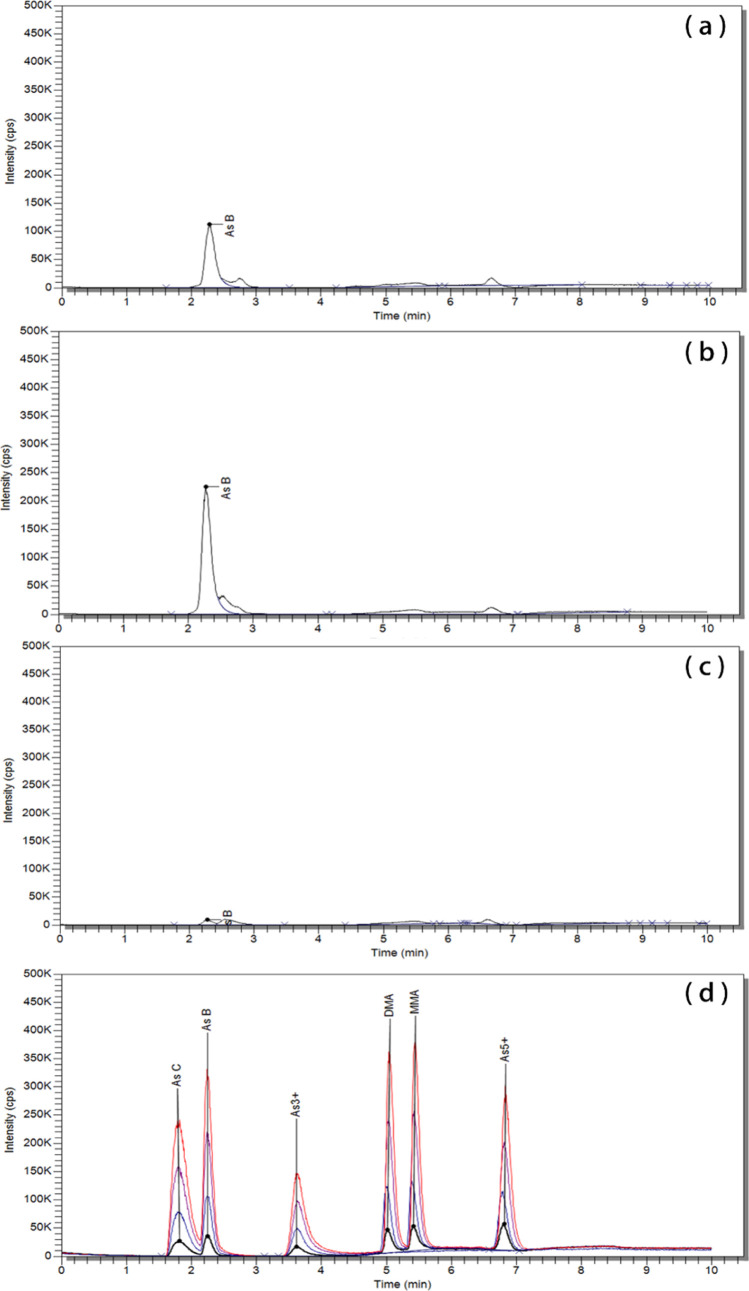
Toxic elements (Cd, Pb, and As) accumulate into the environment by industrialization and natural phenomena and then pass to organisms. Analysis of toxic elements in food must be accurately carried out on a regular basis so as to avoid any adverse impact. Salted foods are difficult samples and accurate analysis of As is not easy due to salt interference. In this study, analysis of As was carried without influence of salts in three types of salted foods via an analytical method, which was validated using spiking recovery experiments and by analyzing certified reference materials. As a result, toxic elements were detected in all samples but none of these exceeded the World Health Organization recommended limits. Among the As species, arsenobetaine (AsB) was the most abundant, while inorganic As was below the detection limit in all samples. All the analyzed salted food samples appeared to be safe for consumption. In addition, the analysis of sea shrimp, freshwater shrimp, and seawater verified As bioaccumulation in these organisms from the environment.
有毒元素(镉、铅和砷)通过工业化和自然现象在环境中累积,然后传递给生物体。必须定期准确地对食品中的有毒元素进行分析,以避免任何不利影响。腌制食品是难处理的样品,由于盐分干扰,准确分析砷并不容易。在本研究中,通过一种分析方法对三种腌制食品中的砷进行了分析,且不受盐分影响,该方法通过加标回收实验和分析有证标准物质进行了验证。结果,在所有样品中均检测到有毒元素,但这些元素均未超过世界卫生组织推荐的限值。在砷的各种形态中,砷甜菜碱(AsB)含量最高,而无机砷在所有样品中均低于检测限。所有分析的腌制食品样品似乎都可以安全食用。此外,对海虾、淡水虾和海水的分析证实了这些生物体从环境中生物累积了砷。