Department of Nuclear Medicine, Tongji Hospital, Tongji University School of Medicine, Shanghai, 200065, P.R. China.
Department of Emergency Medicine, Shanghai Pulmonary Hospital, Tongji University School of Medicine, Shanghai, 200433, P.R. China.
J Transl Med. 2021 Aug 9;19(1):337. doi: 10.1186/s12967-021-02971-7.
Radiotherapy is the mainstay treatment for lung adenocarcinoma, yet remains highly susceptible to resistance. FeO magnetic nanoparticles (MNPs) possess the ability to induce biological therapeutic effects. Herein, the current study set out to explore the effects of FeO MNPs on radiosensitivity of lung adenocarcinoma cells.
FeO MNPs loaded with both negatively-charged small interfering RNA against baculoviral IAP repeat containing 5 (siBIRC5) and oligodeoxynucleotide antisense (AS-ODN) to generate co-delivery NPs, followed by evaluation. Gel retardation assay was further performed to determine the binding ability of FeO MNPs to AS-ODN/siBIRC5. The radiosensitizing effect of NPs on lung adenocarcinoma cells was determined in the absence or the presence of NPs or radiotherapy. A549 and H460 tumor-bearing mice were established, where tumor tissues were subjected to immunohistochemistry.
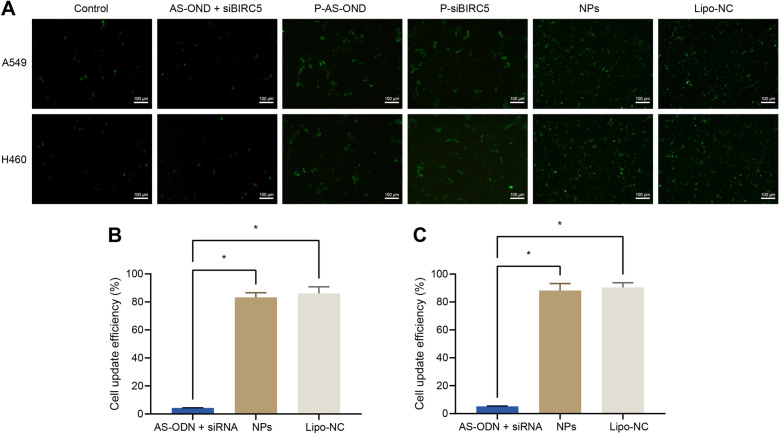
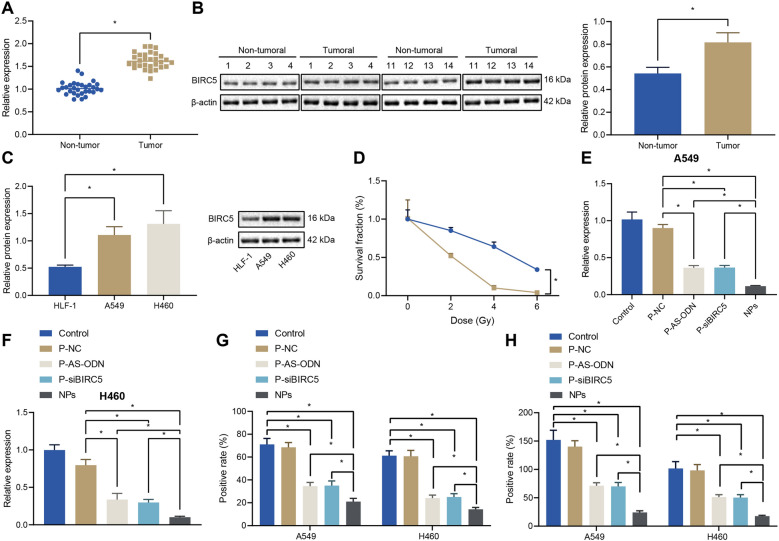
NPs were successfully prepared and characterized. BIRC5 expression levels were augmented in tissues of lung cancer patients. FeO MNPs enhanced the uptake of siBIRC5 and AS-ODN by lung adenocarcinoma cells. The presence of NPs under magnetic field reduced the BIRC5 expression and elevated the DR5 expression in lung adenocarcinoma cells. Lung adenocarcinoma cells treated with NPs exhibited inhibited tumor cell migration and increased DNA damage. After magnetic field treatment, tumors were better suppressed in the tumor-bearing mice treated with NPs, followed by radiotherapy.
Findings obtained in our study indicated that FeO MNPs-targeted delivery of siBIRC5 and AS-ODN enhances radiosensitivity, providing an innovative solution for the current clinically existing lung adenocarcinoma patients with radiotherapy resistance with a low risk of toxicity.
放射疗法是治疗肺腺癌的主要方法,但仍然高度易产生耐药性。FeO 磁性纳米粒子(MNPs)具有诱导生物治疗效果的能力。在此,本研究旨在探索 FeO MNPs 对肺腺癌细胞放射敏感性的影响。
负载带负电荷的杆状病毒 IAP 重复序列 5(siBIRC5)和反义寡核苷酸(AS-ODN)的 FeO MNPs 以生成共递 NPs,并进行评估。凝胶阻滞实验进一步测定 FeO MNPs 与 AS-ODN/siBIRC5 的结合能力。在有无 NPs 或放射治疗的情况下,确定 NPs 对肺腺癌细胞的放射增敏作用。建立 A549 和 H460 荷瘤小鼠模型,对肿瘤组织进行免疫组织化学分析。
成功制备和表征了 NPs。肺癌患者组织中 BIRC5 表达水平升高。FeO MNPs 增强了肺腺癌细胞对 siBIRC5 和 AS-ODN 的摄取。磁场下存在 NPs 降低了肺腺癌细胞中 BIRC5 的表达,提高了 DR5 的表达。用 NPs 处理的肺腺癌细胞显示出抑制肿瘤细胞迁移和增加 DNA 损伤的作用。经磁场处理后,荷瘤小鼠经 NPs 联合放射治疗,肿瘤得到更好的抑制。
本研究结果表明,FeO MNPs 靶向递送 siBIRC5 和 AS-ODN 可增强放射敏感性,为目前临床上存在放射治疗抵抗的肺腺癌患者提供了一种创新性的解决方案,且毒性风险低。