Mathew Anju, Saradamma Remadevi, Krishnapillai Vijayakumar, Muthubeevi Saboora Beegum
Dept of Psychiatry, Government Medical College, Thiruvananthapuram, Kerala, India.
Dept. of Community Medicine, Government Medical College, Thiruvananthapuram, Kerala, India.
Indian J Psychol Med. 2021 Mar;43(2):113-118. doi: 10.1177/0253717620957113. Epub 2020 Oct 26.
Suicides are among the leading cause of death among adolescents and young adults worldwide, including India. Suicide attempts are about 20 times more common than completed suicides. Teenagers and youth who attempt suicide belong to a heterogeneous group. Various biological and psychosocial factors, including family factors, contribute to such behavior. Quality of family functioning and relationships may act as an important contextual factor in deciding suicidal behavior. Hence, this study was done to explore the family factors contributing to suicide attempts.
Qualitative exploratory study design and purposive sampling were used. Data were collected from 22 adolescents and young adults using an in-depth interview method. All audio recordings were transcribed in Malayalam, and then translated to English. Codes were developed using the qualitative data analysis software. Thematic analysis was done. Themes and relationships were identified and synthesized to a framework that represents the summary of the data.
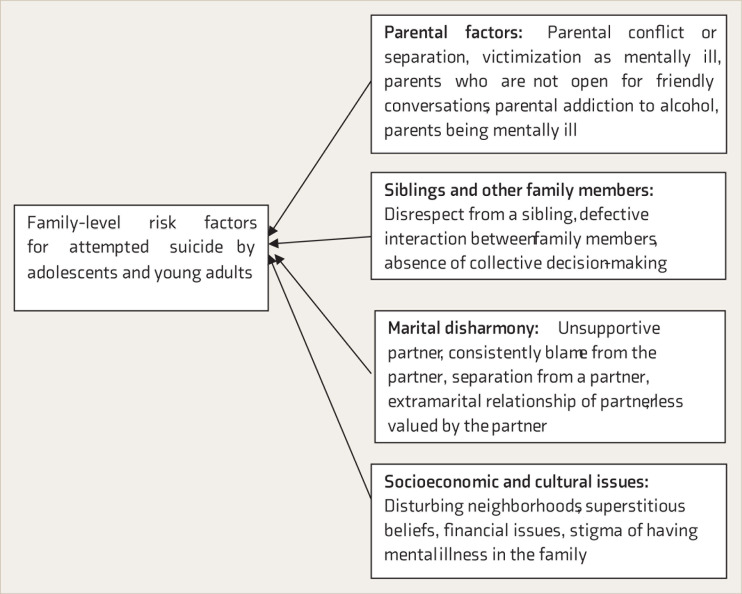
Most of the participants perceived the home environment as hostile. Problems within the family included parental conflicts and separation, conflict with a sibling or other members of the family, and marital disharmony. Most of them perceived low family support. Socioeconomic factors such as financial issues, superstitious beliefs, disturbing neighborhoods, interpersonal issues, and the stigma of having a mental illness, in a family member, were also noted.
Hostile family environment, faulty interactions between family members, and lack of perceived family support may contribute to suicidal behavior among adolescents and young adults. Hence, it is imperative to consider these factors while treating them or planning any suicide prevention program for them.
自杀是全球青少年和青年(包括印度)的主要死因之一。自杀未遂的发生率比自杀身亡高出约20倍。试图自杀的青少年和青年群体构成各异。包括家庭因素在内的各种生物和社会心理因素都会导致此类行为。家庭功能和关系的质量可能是决定自杀行为的一个重要背景因素。因此,开展本研究以探究导致自杀未遂的家庭因素。
采用定性探索性研究设计和立意抽样法。通过深入访谈法从22名青少年和青年中收集数据。所有录音均转录为马拉雅拉姆语,然后翻译成英语。使用定性数据分析软件制定编码。进行主题分析。识别主题和关系,并将其综合成一个代表数据总结的框架。
大多数参与者认为家庭环境充满敌意。家庭内部的问题包括父母冲突与分居、与兄弟姐妹或其他家庭成员的冲突以及婚姻不和谐。他们中的大多数人感到家庭支持不足。还注意到一些社会经济因素,如经济问题、迷信观念、令人不安的邻里环境、人际问题以及家庭成员患有精神疾病带来的耻辱感。
充满敌意的家庭环境、家庭成员之间错误的互动方式以及缺乏可感知的家庭支持可能导致青少年和青年出现自杀行为。因此,在治疗他们或为他们制定任何自杀预防计划时,必须考虑这些因素。