Eyayu Tahir, Wubie Amilaku, Kiros Teklehaimanot, Tiruneh Tegenaw, Damtie Shewaneh, Sema Meslo, Abebaw Aynework, Chanie Ermias Sisay, Workineh Lemma
Debre Tabor University, Debre Tabor, Ethiopia.
Glob Pediatr Health. 2021 Jul 30;8:2333794X211036605. doi: 10.1177/2333794X211036605. eCollection 2021.
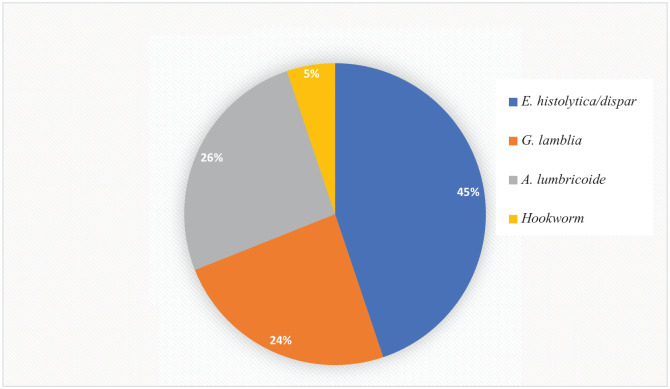
. Intestinal parasites are still a serious public health problem and important cause of morbidity and mortality all over the world, particularly in developing countries. Unfortunately, pre-school children are more susceptible to infection. However, information is scarce in the study area. Thus, this study aimed to assess the prevalence of intestinal parasitosis and associated factors among children aged 6 to 59 months in Northcentral Ethiopia. An institutional-based cross-sectional study was carried out at Mekane Eyesus primary hospital from June 10 to November 30, 2020. Stool samples were collected from 322 children and examined by using direct wet mount and formal ether concentration techniques. The data were entered and analyzed using EPI Info v7 and SPSS v23 statistical software, respectively. Both bivariable and multivariable logistic analysis was carried out and potential associated factors were identified based on adjusted odds ratio with 95% confidence interval and -value <.05. The prevalence of intestinal parasitosis was 18.0% (95% CI: 14.0%-22.0%). A total of 4 parasites were examined and the dominant parasite was E. histolytica (8.1%) followed by (4.7%). Children with irregular trimming of fingernails (AOR = 3.14, 95% CI: 1.59-6.21), and child who have habit of eating unwashed fruits/vegetables (AOR = 3.80, 95% CI: 1.14-12.82) were strongly associated with IPIs. Protozoa parasites are most common cause of diseases in children. The study identified some preventable and modifiable factors to address the prevalence of IPIs. Additionally, improving mothers/guardians awareness about source of infection and mode of transmission is necessary.
肠道寄生虫仍然是一个严重的公共卫生问题,也是全球发病和死亡的重要原因,特别是在发展中国家。不幸的是,学龄前儿童更容易感染。然而,研究区域内的相关信息匮乏。因此,本研究旨在评估埃塞俄比亚中北部6至59个月大儿童肠道寄生虫病的患病率及相关因素。2020年6月10日至11月30日,在梅卡内·埃苏斯小学医院开展了一项基于机构的横断面研究。从322名儿童中采集粪便样本,并采用直接涂片法和改良加藤厚涂片法进行检测。分别使用EPI Info v7和SPSS v23统计软件录入和分析数据。进行了双变量和多变量逻辑分析,并根据调整后的比值比、95%置信区间和P值<0.05确定潜在的相关因素。肠道寄生虫病的患病率为18.0%(95%CI:14.0%-22.0%)。共检测到4种寄生虫,主要寄生虫为溶组织内阿米巴(8.1%),其次为……(4.7%)。指甲修剪不规律的儿童(AOR=3.14,95%CI:1.59-6.21)以及有吃未清洗水果/蔬菜习惯的儿童(AOR=3.80,95%CI:1.14-12.82)与肠道寄生虫感染密切相关。原生动物寄生虫是儿童疾病最常见的病因。该研究确定了一些可预防和可改变的因素来应对肠道寄生虫感染的流行情况。此外,提高母亲/监护人对感染源和传播方式的认识是必要的。