State Key Laboratory of Microbial Technology, Microbial Technology Institute, Shandong Universitygrid.27255.37, Qingdao, People's Republic of China.
School of Basic Medicine, Shandong First Medical University & Shandong Academy of Medical Sciencegrid.410587.f, Jinan, People's Republic of China.
Microbiol Spectr. 2021 Sep 3;9(1):e0092421. doi: 10.1128/Spectrum.00924-21. Epub 2021 Aug 11.
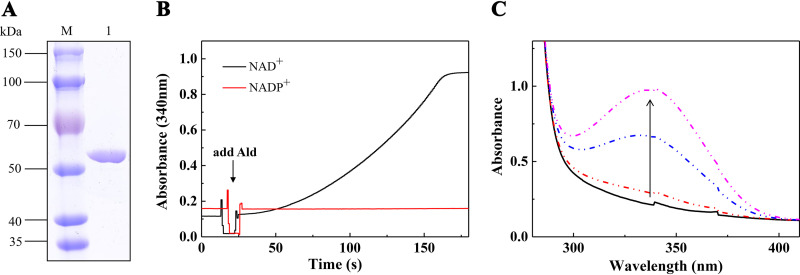
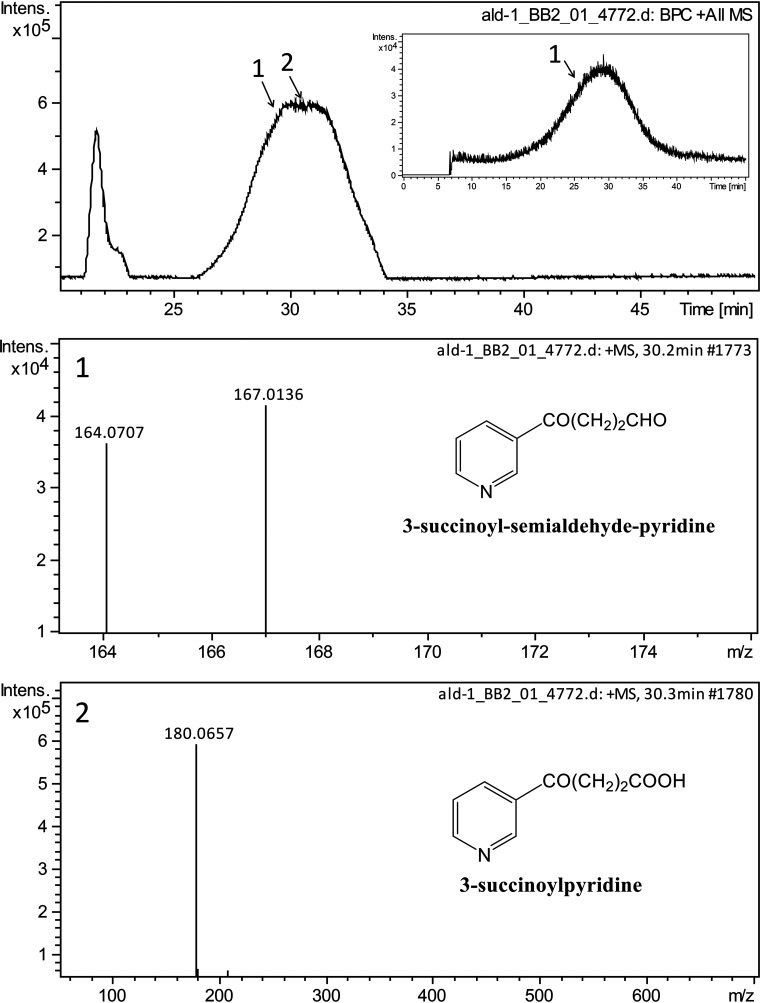
Agrobacterium tumefaciens strain S33 can catabolize nicotine via a hybrid of the pyridine and pyrrolidine pathways. Most of the enzymes involved in this biochemical pathway have been identified and characterized, except for the one catalyzing the oxidation of 6-hydroxy-3-succinoyl-semialdehyde-pyridine to 6-hydroxy-3-succinoylpyridine. Based on a previous genomic and transcriptomic analysis, an open reading frame (ORF) annotated to encode aldehyde dehydrogenase (Ald) in the nicotine-degrading cluster was predicted to be responsible for this step. In this study, we heterologously expressed the enzyme and identified its function by biochemical assay and mass spectrum analysis. It was found that Ald catalyzes the NAD-specific dehydrogenation of 6-hydroxy-3-succinoyl-semialdehyde-pyridine to 6-hydroxy-3-succinoylpyridine. With the nonhydroxylated analog 3-succinoyl-semialdehyde-pyridine (SAP) as a substrate, Ald had a specific activity of 10.05 U/mg at pH 9.0 and apparent values of around 58.68 μM and 0.41 mM for SAP and NAD, respectively. Induction at low temperature and purification and storage in low-salt buffers were helpful to prevent its aggregation and precipitation. Disruption of the gene caused a lower growth rate and biomass of strain S33 on nicotine but not on 6-hydroxy-3-succinoylpyridine. Ald has a broad range of substrates, including benzaldehyde, furfural, and acetaldehyde. Recombinant Escherichia coli cells harboring the gene can efficiently convert furfural to 2-furoic acid at a specific rate of 0.032 mmol min g dry cells, extending the application of Ald in the catalysis of bio-based furan compounds. These findings provide new insights into the biochemical mechanism of the nicotine-degrading hybrid pathway and the possible application of Ald in industrial biocatalysis. Nicotine is one of the major toxic -heterocyclic aromatic alkaloids produced in tobacco plants. Manufacturing tobacco and smoking may lead to some environmental and public health problems. Microorganisms can degrade nicotine by various biochemical pathways, but the biochemical mechanism for nicotine degradation has not been fully elucidated. In this study, we identified an aldehyde dehydrogenase responsible for the oxidation of 6-hydroxy-3-succinoyl-semialdehyde-pyridine to 6-hydroxy-3-succinoylpyridine; this was the only uncharacterized enzyme in the hybrid of the pyridine and pyrrolidine pathways in Agrobacterium tumefaciens S33. Similar to the known aldehyde dehydrogenase, the NAD-specific homodimeric enzyme presents a broad substrate range with high activity in alkaline and low-salt-containing buffers. It can catalyze not only the aldehyde from nicotine degradation but also those of benzaldehyde, furfural, and acetaldehyde. It was found that recombinant Escherichia coli cells harboring the gene could efficiently convert furfural to valuable 2-furoic acid, demonstrating its potential application for enzymatic catalysis.
根瘤农杆菌 S33 菌株可以通过吡啶和吡咯啉途径的杂交来代谢尼古丁。尽管已经鉴定和描述了这个生化途径中的大多数酶,但催化 6-羟基-3-琥珀酰亚胺基半醛吡啶氧化为 6-羟基-3-琥珀酰吡啶的酶除外。根据之前的基因组和转录组分析,在尼古丁降解簇中被注释为编码醛脱氢酶 (Ald) 的一个开放阅读框 (ORF) 被预测负责这一步骤。在这项研究中,我们通过生化测定和质谱分析异源表达了该酶并鉴定了其功能。结果发现,Ald 催化 NAD 特异性催化 6-羟基-3-琥珀酰亚胺基半醛吡啶转化为 6-羟基-3-琥珀酰吡啶。用非羟基化类似物 3-琥珀酰亚胺基半醛吡啶 (SAP) 作为底物,Ald 在 pH 9.0 时的比活为 10.05 U/mg,对 SAP 和 NAD 的表观 值分别约为 58.68 μM 和 0.41 mM。低温诱导、低盐缓冲液的纯化和储存有助于防止其聚集和沉淀。基因的破坏导致 S33 菌株在尼古丁上的生长速度和生物量降低,但在 6-羟基-3-琥珀酰吡啶上没有。Ald 具有广泛的底物,包括苯甲醛、糠醛和乙醛。携带 Ald 基因的重组大肠杆菌细胞可以以 0.032 mmol min g 干细胞的特定速率有效地将糠醛转化为 2-呋喃酸,从而扩展了 Ald 在催化生物基呋喃化合物中的应用。这些发现为尼古丁降解杂合途径的生化机制以及 Ald 在工业生物催化中的可能应用提供了新的见解。尼古丁是烟草植物中产生的主要有毒杂环芳香族生物碱之一。烟草的制造和吸烟可能会导致一些环境和公共卫生问题。微生物可以通过各种生化途径降解尼古丁,但尼古丁降解的生化机制尚未完全阐明。在这项研究中,我们鉴定了一种醛脱氢酶,负责将 6-羟基-3-琥珀酰亚胺基半醛吡啶氧化为 6-羟基-3-琥珀酰吡啶;这是根瘤农杆菌 S33 中吡啶和吡咯啉途径杂合中的唯一一种未被描述的酶。与已知的醛脱氢酶类似,NAD 特异性同二聚体酶具有广泛的底物范围,在碱性和低盐含量的缓冲液中具有高活性。它不仅可以催化尼古丁降解产生的醛,还可以催化苯甲醛、糠醛和乙醛产生的醛。研究发现,携带 Ald 基因的重组大肠杆菌细胞可以有效地将糠醛转化为有价值的 2-呋喃酸,这表明其在酶催化方面具有潜在的应用价值。