Department of Vascular Medicine, Amsterdam UMC, Location AMC, University of Amsterdam.
Amsterdam UMC, University of Amsterdam, Department of Experimental Vascular Medicine, Amsterdam Cardiovascular Sciences, Amsterdam, The Netherlands.
Curr Opin Lipidol. 2021 Oct 1;32(5):286-292. doi: 10.1097/MOL.0000000000000779.
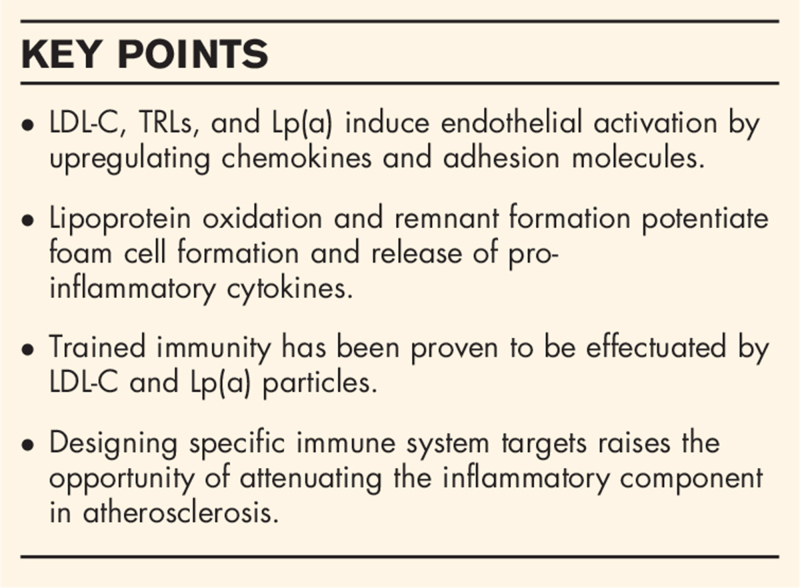
Lipid-mediated atherogenesis is hallmarked by a chronic inflammatory state. Low-density lipoprotein cholesterol (LDL-C), triglyceride rich lipoproteins (TRLs), and lipoprotein(a) [Lp(a)] are causally related to atherosclerosis. Within the paradigm of endothelial activation and subendothelial lipid deposition, these lipoproteins induce numerous pro-inflammatory pathways. In this review, we will outline the effects of lipoproteins on systemic inflammatory pathways in atherosclerosis.
Apolipoprotein B-containing lipoproteins exert a variety of pro-inflammatory effects, ranging from the local artery to systemic immune cell activation. LDL-C, TRLs, and Lp(a) induce endothelial dysfunction with concomitant activation of circulating monocytes through enhanced lipid accumulation. The process of trained immunity of the innate immune system, predominantly induced by LDL-C particles, hallmarks the propagation of the low-grade inflammatory response. In concert, bone marrow activation induces myeloid skewing, further contributing to immune cell mobilization and plaque progression.
Lipoproteins and inflammation are intertwined in atherogenesis. Elucidating the inflammatory pathways will provide new opportunities for therapeutic agents.
脂质介导的动脉粥样硬化形成的特点是慢性炎症状态。低密度脂蛋白胆固醇(LDL-C)、富含甘油三酯的脂蛋白(TRLs)和脂蛋白(a)[Lp(a)]与动脉粥样硬化有因果关系。在血管内皮激活和血管内皮下脂质沉积的范例中,这些脂蛋白诱导许多促炎途径。在这篇综述中,我们将概述脂蛋白在动脉粥样硬化中对全身炎症途径的影响。
载脂蛋白 B 脂蛋白具有多种促炎作用,从局部动脉到全身免疫细胞激活。LDL-C、TRLs 和 Lp(a) 通过增强脂质积累诱导内皮功能障碍,同时通过增强脂质积累激活循环单核细胞。固有免疫系统的训练免疫过程主要由 LDL-C 颗粒诱导,标志着低度炎症反应的传播。同时,骨髓激活诱导髓样细胞偏倚,进一步促进免疫细胞动员和斑块进展。
脂蛋白和炎症在动脉粥样硬化形成中相互交织。阐明炎症途径将为治疗药物提供新的机会。