Department of Dermatology, Veterans Health Service Medical Center, Seoul, Republic of Korea.
School of Electrical and Electronic Engineering, Yonsei University, Seoul, South Korea.
PLoS One. 2021 Aug 17;16(8):e0256290. doi: 10.1371/journal.pone.0256290. eCollection 2021.
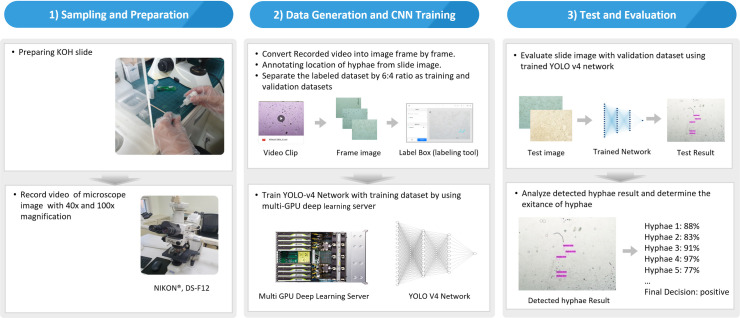
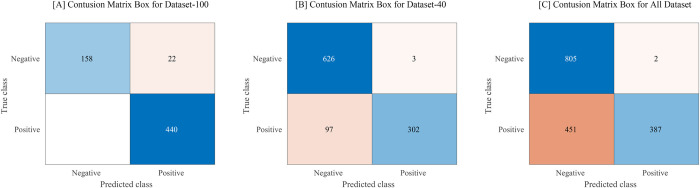
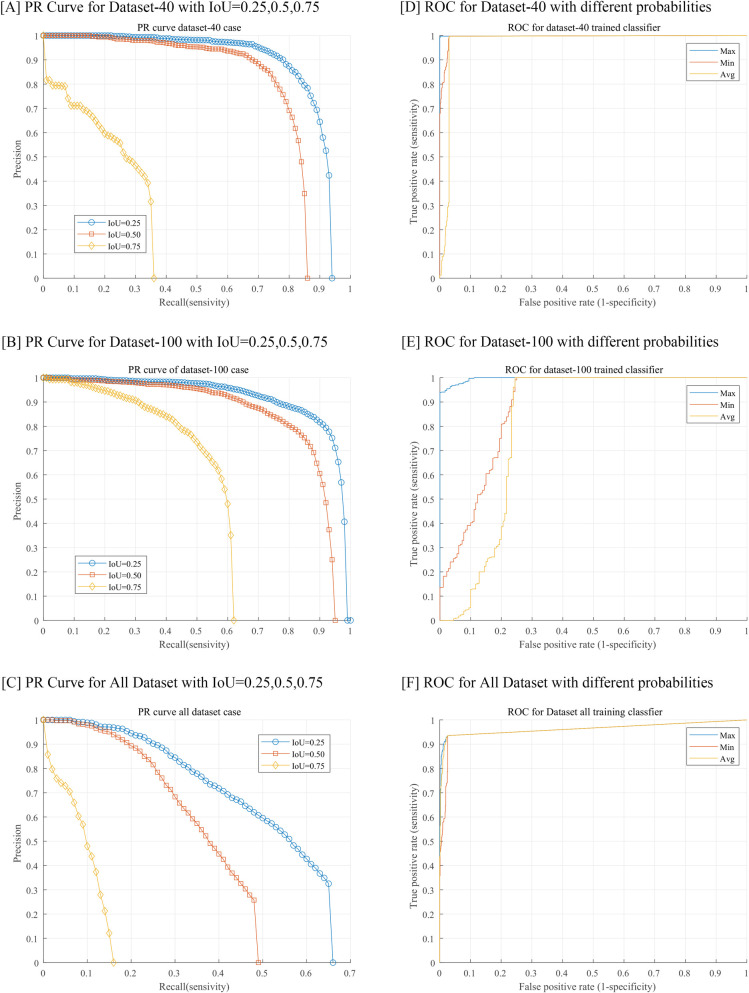
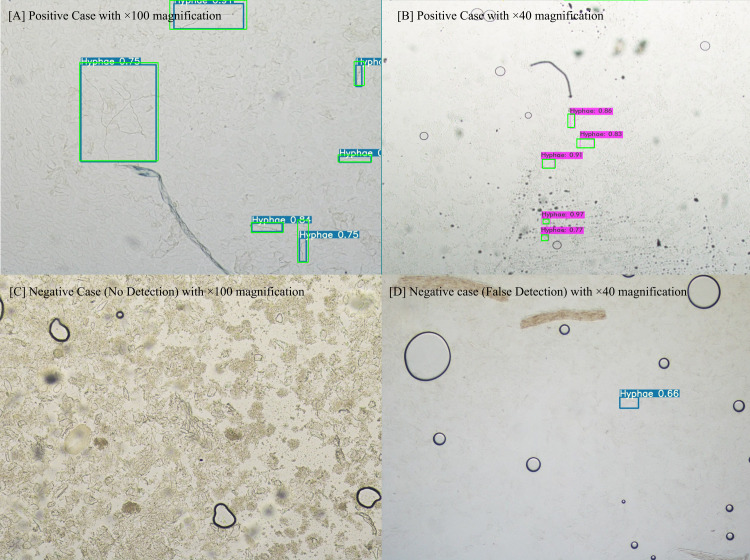
Direct microscopic examination with potassium hydroxide is generally used as a screening method for diagnosing superficial fungal infections. Although this type of examination is faster than other diagnostic methods, it can still be time-consuming to evaluate a complete sample; additionally, it possesses the disadvantage of inconsistent reliability as the accuracy of the reading may differ depending on the performer's skill. This study aims at detecting hyphae more quickly, conveniently, and consistently through deep learning using images obtained from microscopy used in real-world practice. An object detection convolutional neural network, YOLO v4, was trained on microscopy images with magnifications of 100×, 40×, and (100+40)×. The study was conducted at the Department of Dermatology at Veterans Health Service Medical Center, Seoul, Korea between January 1, 2019 and December 31, 2019, using 3,707 images (1,255 images for training, 1,645 images for testing). The average precision was used to evaluate the accuracy of object detection. Precision recall curve analysis was performed for the hyphal location determination, and receiver operating characteristic curve analysis was performed on the image classification. The F1 score, sensitivity, and specificity values were used as measures of the overall performance. The sensitivity and specificity were, respectively, 95.2% and 100% in the 100× data model, and 99% and 86.6% in the 40× data model; the sensitivity and specificity in the combined (100+40)× data model were 93.2% and 89%, respectively. The performance of our model had high sensitivity and specificity, indicating that hyphae can be detected with reliable accuracy. Thus, our deep learning-based autodetection model can detect hyphae in microscopic images obtained from real-world practice. We aim to develop an automatic hyphae detection system that can be utilized in real-world practice through continuous research.
直接镜检结合氢氧化钾通常被用作诊断浅部真菌感染的筛选方法。虽然这种检查方法比其他诊断方法更快,但评估一个完整的样本仍然很耗时;此外,它的可靠性也不一致,因为阅读的准确性可能因操作者的技能而异。本研究旨在通过使用实际实践中显微镜获得的图像,通过深度学习更快、更方便、更一致地检测真菌丝。使用 100×、40× 和(100+40)× 的放大倍数对显微镜图像进行了目标检测卷积神经网络 YOLO v4 的训练。该研究于 2019 年 1 月 1 日至 12 月 31 日在韩国首尔退伍军人健康服务医疗中心皮肤科进行,共使用了 3707 张图像(1255 张用于训练,1645 张用于测试)。使用平均精度来评估目标检测的准确性。对菌丝位置进行精确召回曲线分析,并对图像分类进行接收者操作特征曲线分析。使用 F1 分数、敏感性和特异性作为整体性能的衡量标准。在 100×数据模型中,敏感性和特异性分别为 95.2%和 100%,在 40×数据模型中,敏感性和特异性分别为 99%和 86.6%;在组合(100+40)×数据模型中,敏感性和特异性分别为 93.2%和 89%。我们模型的性能具有较高的敏感性和特异性,表明可以可靠地准确检测真菌丝。因此,我们基于深度学习的自动检测模型可以检测实际实践中获得的显微镜图像中的真菌丝。我们旨在通过不断的研究,开发一种可在实际中应用的自动真菌丝检测系统。