Vendrami C, Marques-Vidal P, Gonzalez Rodriguez E, Hans D, Waeber G, Lamy O
University of Lausanne, UNIL, CHUV, Lausanne, Switzerland.
Internal Medicine Unit, Internal Medicine Department, CHUV, Lausanne, Switzerland.
Osteoporos Int. 2022 Jan;33(1):195-204. doi: 10.1007/s00198-021-06081-4. Epub 2021 Aug 19.
Thyroid-stimulating hormone (TSH) excess or deficiency influences bone density and fracture risk. Nevertheless, does TSH in the reference range influence bone health? In euthyroid postmenopausal women, TSH levels in the reference range were positively associated with trabecular bone score and negatively with incident fractures, without affecting BMD.
Subclinical hyperthyroidism is associated with low bone mineral density (BMD) and increased fracture risk. In healthy postmenopausal women, association between thyroid-stimulating hormone (TSH) in the normal range and BMD is contradictory. Trabecular bone score (TBS), an index of bone micro-architecture, is often decreased in secondary osteoporosis (OP). The aim was to determine the association between thyroid hormones (TSH, fT4) and BMD, TBS, and the incident 5-year OP fractures, in euthyroid post-menopausal women.
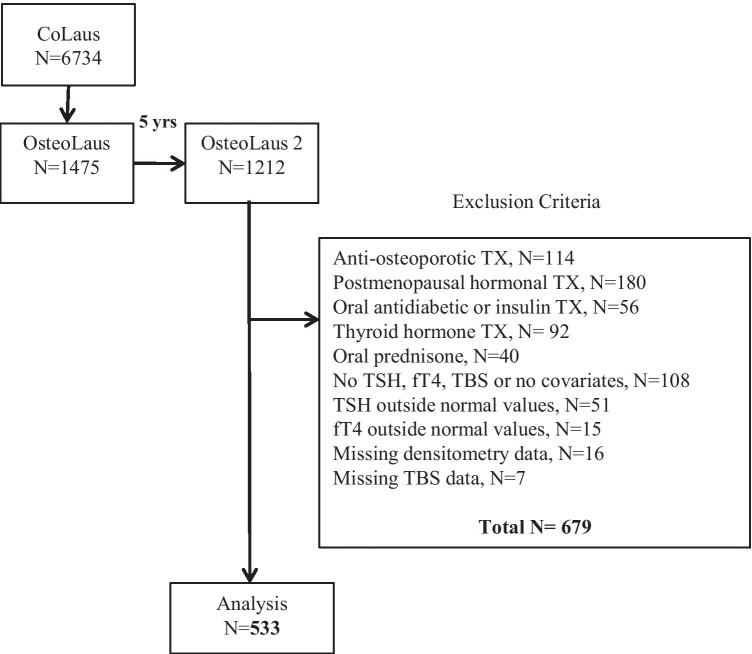
We assessed 1475 women of the CoLaus/OsteoLaus cohort. We evaluated BMD at lumbar spine, femoral neck and total hip, lumbar spine TBS, and vertebral fracture with DXA. Incident major OP fractures were evaluated 5 years later by questionnaire and DXA. Women with anti-osteoporotic, antidiabetic, thyroid-modifying, hormone replacement, or systemic corticoid treatment were excluded.
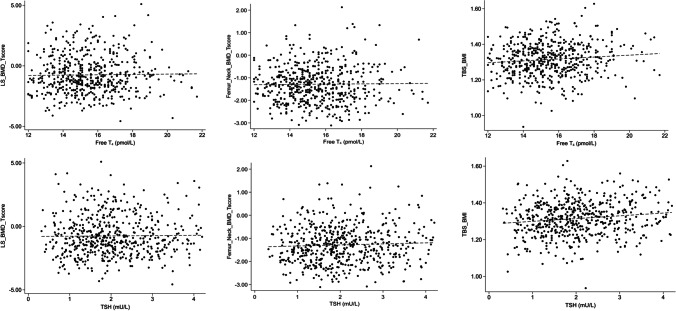
Five hundred thirty-three women (age 68.4 ± 7.3 years, BMI 25.9 ± 4.6 kg/m, TSH 2.03 ± 0.87 mU/l, fT4 15.51 ± 1.85 pmol/l) met the inclusion criteria. There was no significant association between TSH or fT4 and BMD measures at any site. A positive association was found between TSH and TBS (β = 0.138, p < 0.01), even after adjusting for age, BMI, and duration of menopause (β = 0.086, p < 0.05). After a 5-year follow-up, women with incident major OP fractures had lower TSH levels (1.77 ± 0.13 vs. 2.05 ± 0.04 mU/l, p < 0.05) than women without fractures, while no difference was found for fT4.
In euthyroid postmenopausal women, TSH levels were positively associated with TBS and negatively with incident fractures, without affecting BMD. Further studies are needed to evaluate the influence of thyroid hormones on TBS.
促甲状腺激素(TSH)分泌过多或过少会影响骨密度和骨折风险。然而,参考范围内的TSH会影响骨骼健康吗?在甲状腺功能正常的绝经后女性中,参考范围内的TSH水平与小梁骨评分呈正相关,与骨折发生率呈负相关,且不影响骨密度。
亚临床甲状腺功能亢进与低骨矿物质密度(BMD)及骨折风险增加相关。在健康的绝经后女性中,正常范围内的促甲状腺激素(TSH)与BMD之间的关联存在矛盾。小梁骨评分(TBS)是一种骨微结构指标,在继发性骨质疏松症(OP)中常降低。本研究旨在确定甲状腺激素(TSH、游离甲状腺素(fT4))与甲状腺功能正常的绝经后女性的BMD、TBS及5年OP骨折发生率之间的关联。
我们评估了CoLaus/OsteoLaus队列中的1475名女性。我们用双能X线吸收法(DXA)评估腰椎、股骨颈和全髋部的BMD、腰椎TBS及椎体骨折情况。5年后通过问卷调查和DXA评估主要OP骨折的发生率。排除接受抗骨质疏松、抗糖尿病、甲状腺调节、激素替代或全身性皮质激素治疗的女性。
533名女性(年龄68.4±7.3岁,体重指数25.9±4.6kg/m²,TSH 2.03±0.87mU/l,fT4 15.51±1.85pmol/l)符合纳入标准。TSH或fT4与任何部位的BMD测量值之间均无显著关联。TSH与TBS呈正相关(β=0.138,p<0.01),即使在调整年龄、体重指数和绝经持续时间后仍呈正相关(β=0.086,p<0.05)。5年随访后,发生主要OP骨折的女性TSH水平(1.77±0.13 vs. 2.05±0.04mU/l,p<0.05)低于未发生骨折的女性,而fT4水平无差异。
在甲状腺功能正常的绝经后女性中,TSH水平与TBS呈正相关,与骨折发生率呈负相关,且不影响BMD。需要进一步研究来评估甲状腺激素对TBS的影响。