IRCCS Istituto Auxologico Italiano, Department of Cardiovascular, Neural and Metabolic Sciences, piazzale Brescia 20, 20149, Milan, Italy.
IRCCS Istituto Auxologico Italiano, Cardiomyopathy Unit and Center for the Cardiac Arrhythmias of Genetic Origin, Department of Cardiovascular, Neural and Metabolic Sciences, piazzale Brescia 20, 20149, Milan, Italy.
Curr Cardiol Rep. 2021 Aug 19;23(10):135. doi: 10.1007/s11886-021-01566-4.
This review aims to assess the global impact of the COVID-19 pandemic on the cardiovascular diseases (CVDs), trying to assess the possible future trajectory of the CVDs and their management.
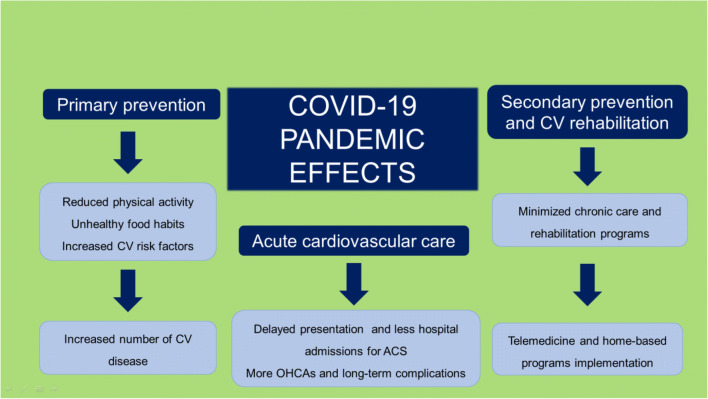
The COVID-19 pandemic has had a deleterious impact on the CV risk factors, with an increase in both sedentary and unhealthy food habits. The fear of contagion has decreased the access to the emergency systems with an increase in out-of-hospital-cardiac-arrests and late presentation of acute myocardial infarctions. The closure of the non-urgent services has delayed cardiac rehabilitation programmes and chronic clinical care. As a result of the COVID-19 pandemic impact on the population habits and on the management of CVDs, we will probably face an increase in CVD and heart failure cases. It is crucial to use all the non-traditional approaches, such as telemonitoring systems, in order to overcome the difficulties raised by the pandemic.
本综述旨在评估 COVID-19 大流行对心血管疾病(CVD)的全球影响,试图评估 CVD 的可能未来轨迹及其管理。
COVID-19 大流行对 CV 危险因素产生了有害影响,久坐不动和不健康的饮食习惯都有所增加。对感染的恐惧降低了人们对紧急系统的访问,导致院外心脏骤停和急性心肌梗死的延迟出现。非紧急服务的关闭延迟了心脏康复计划和慢性临床护理。由于 COVID-19 大流行对人群习惯和 CVD 管理的影响,我们可能会面临 CVD 和心力衰竭病例的增加。利用所有非传统方法(如远程监测系统)来克服大流行带来的困难至关重要。