Mechinkov North-Western State Medical University, 47 Piskaryovsky Prosp., 195067, St. Petersburg, Russia.
Saint Petersburg Institute of Bioregulation and Gerontology, St. Petersburg, Russia.
Sci Rep. 2021 Aug 25;11(1):17199. doi: 10.1038/s41598-021-96233-7.
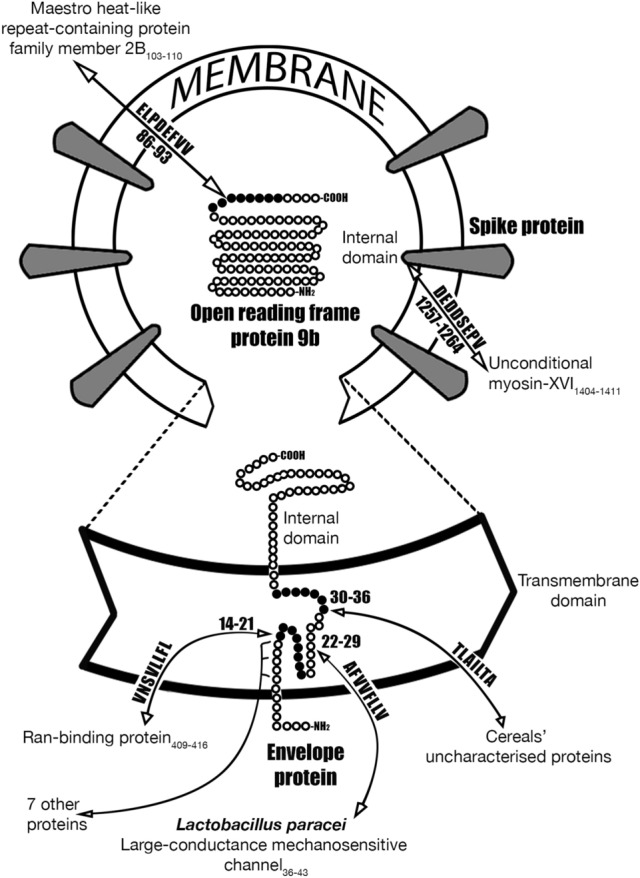
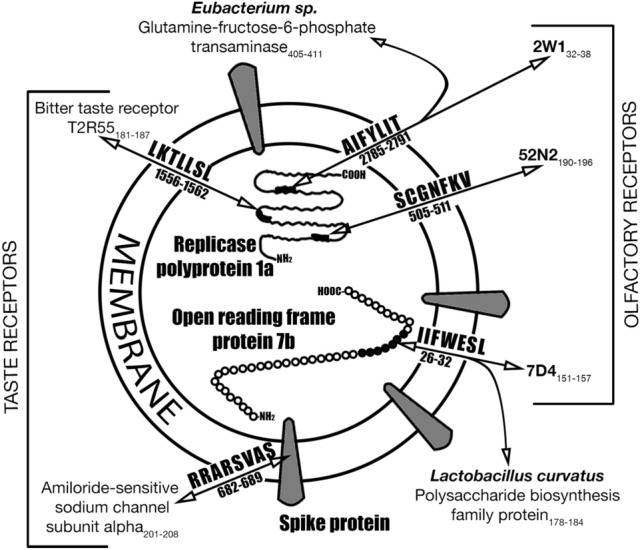
An extremely high contagiousness of SARS CoV-2 indicates that the virus developed the ability to deceive the innate immune system. The virus could have included in its outer protein domains some motifs that are structurally similar to those that the potential victim's immune system has learned to ignore. The similarity of the primary structures of the viral and human proteins can provoke an autoimmune process. Using an open-access protein database Uniprot, we have compared the SARS CoV-2 proteome with those of other organisms. In the SARS CoV-2 spike (S) protein molecule, we have localized more than two dozen hepta- and octamers homologous to human proteins. They are scattered along the entire length of the S protein molecule, while some of them fuse into sequences of considerable length. Except for one, all these n-mers project from the virus particle and therefore can be involved in providing mimicry and misleading the immune system. All hepta- and octamers of the envelope (E) protein, homologous to human proteins, are located in the viral transmembrane domain and form a 28-mer protein E VNSVLLFLAFVVFLLVTLAILTALRLCA. The involvement of the protein E in provoking an autoimmune response (after the destruction of the virus particle) seems to be highly likely. Some SARS CoV-2 nonstructural proteins may also be involved in this process, namely ORF3a, ORF7a, ORF7b, ORF8, and ORF9b. It is possible that ORF7b is involved in the dysfunction of olfactory receptors, and the S protein in the dysfunction of taste perception.
SARS-CoV-2 的极高传染性表明,该病毒已经发展出欺骗先天免疫系统的能力。病毒的外壳蛋白结构域中可能包含一些与潜在宿主的免疫系统已经学会忽略的结构相似的基序。病毒和人类蛋白的一级结构的相似性可能会引发自身免疫过程。我们使用开放获取的蛋白质数据库 Uniprot,将 SARS-CoV-2 的蛋白质组与其他生物体进行了比较。在 SARS-CoV-2 的刺突(S)蛋白分子中,我们定位了二十多个与人类蛋白同源的七肽和八肽。它们沿着 S 蛋白分子的全长散布,而其中一些融合成相当长的序列。除了一个之外,所有这些 n-肽都从病毒颗粒中伸出,因此可以参与提供模拟并误导免疫系统。包膜(E)蛋白中所有与人类蛋白同源的七肽和八肽都位于病毒的跨膜结构域中,并形成一个 28 个氨基酸的 E VNSVLLFLAFVVFLLVTLAILTALRLCA 蛋白。E 蛋白参与引发自身免疫反应(在病毒颗粒破坏后)的可能性似乎非常高。一些 SARS-CoV-2 的非结构蛋白也可能参与这个过程,即 ORF3a、ORF7a、ORF7b、ORF8 和 ORF9b。ORF7b 可能参与嗅觉受体的功能障碍,而 S 蛋白则参与味觉感知的功能障碍。