Araumi Akira, Osaki Tsukasa, Ichikawa Kazunobu, Kudo Kosuke, Suzuki Natsuko, Watanabe Sayumi, Watanabe Masafumi, Konta Tsuneo
Department of Cardiology, Pulmonology, and Nephrology, Yamagata University School of Medicine, Yamagata, Japan.
Department of Public Health and Hygiene, Yamagata University Faculty of Medicine, Yamagata, Japan.
Biochem Biophys Rep. 2021 Aug 17;27:101102. doi: 10.1016/j.bbrep.2021.101102. eCollection 2021 Sep.
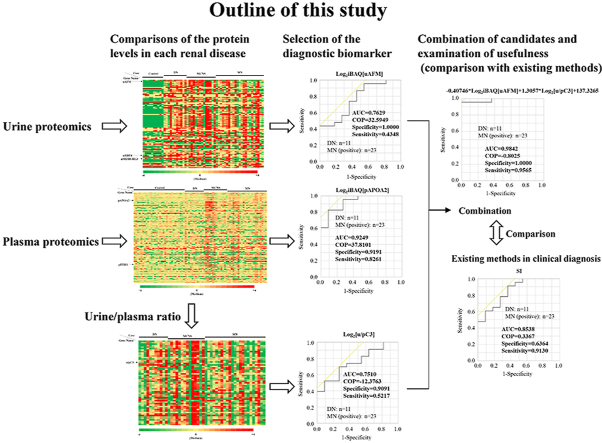
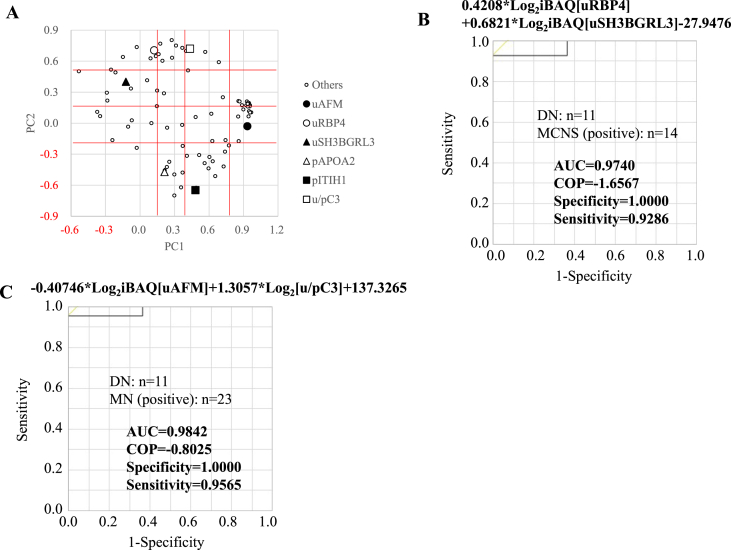
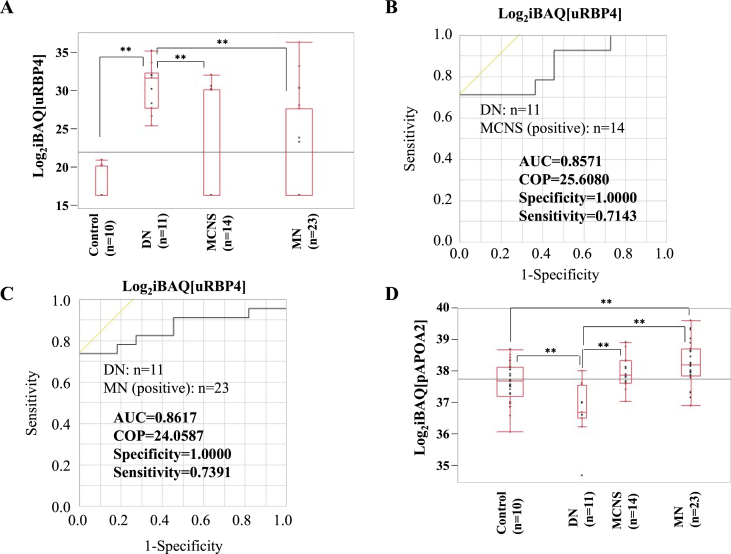
The choice of treatment for primary nephrotic syndrome depends on the pathologic type of the disorder. Renal biopsy is necessary for a definitive diagnosis, but it is burdensome for the patients, and can be avoided if tests could be performed using urine or plasma. In this study, we analyzed 100 urinary proteins, 141 plasma proteins, and 57 urine/plasma ratios in cases of diabetic nephropathy (DN; n = 11), minimal change nephrotic syndrome (MCNS; n = 14), and membranous nephropathy (MN; n = 23). We found that the combination of urinary retinol-binding protein 4 and SH3 domain-binding glutamic acid-rich-like protein 3 could distinguish between MCNS and DN, with an area under the curve (AUC) of 0.9740. On the other hand, a selectivity index (SI) based on serotransferrin and immunoglobulin G, which is often used in clinical practice, distinguished them with an AUC of 0.9091. Similarly, the combination of urinary afamin and complement C3 urine/plasma ratio could distinguish between MN and DN with an AUC of 0.9842, while SI distinguished them with an AUC of 0.8538. Evidently, the candidates identified in this study were superior to the SI method. Thus, the aim was to test these biomarkers for accurate diagnosis and to greatly reduce the burden on patients.
原发性肾病综合征的治疗选择取决于该疾病的病理类型。肾活检对于明确诊断是必要的,但对患者来说负担较重,如果能通过尿液或血浆进行检测则可避免。在本研究中,我们分析了糖尿病肾病(DN;n = 11)、微小病变肾病综合征(MCNS;n = 14)和膜性肾病(MN;n = 23)患者的100种尿蛋白、141种血浆蛋白以及57种尿/血浆比值。我们发现,尿视黄醇结合蛋白4和富含SH3结构域结合谷氨酸样蛋白3的组合能够区分MCNS和DN,曲线下面积(AUC)为0.9740。另一方面,临床实践中常用的基于血清转铁蛋白和免疫球蛋白G的选择性指数(SI)区分二者的AUC为0.9091。同样,尿α-胎儿蛋白和补体C3尿/血浆比值的组合区分MN和DN的AUC为0.9842,而SI区分二者的AUC为0.8538。显然,本研究中确定的候选指标优于SI方法。因此,目的是测试这些生物标志物以进行准确诊断并大幅减轻患者负担。