Ambrose Andrew J, Pham Nhan T, Sivinski Jared, Guimarães Larissa, Mollasalehi Niloufar, Jimenez Paula, Abad Maria A, Jeyaprakash A Arockia, Shave Steven, Costa-Lotufo Letícia V, La Clair James J, Auer Manfred, Chapman Eli
Department of Pharmacology and Toxicology, College of Pharmacy, University of Arizona Tucson AZ 85721 USA
School of Biological Sciences and Edinburgh Medical School, Biomedical Sciences, University of Edinburgh The King's Buildings CH Waddington Building 3.07 Max Born Crescent Edinburgh EH9 3BF UK
RSC Chem Biol. 2020 Nov 27;2(1):181-186. doi: 10.1039/d0cb00122h. eCollection 2021 Feb 1.
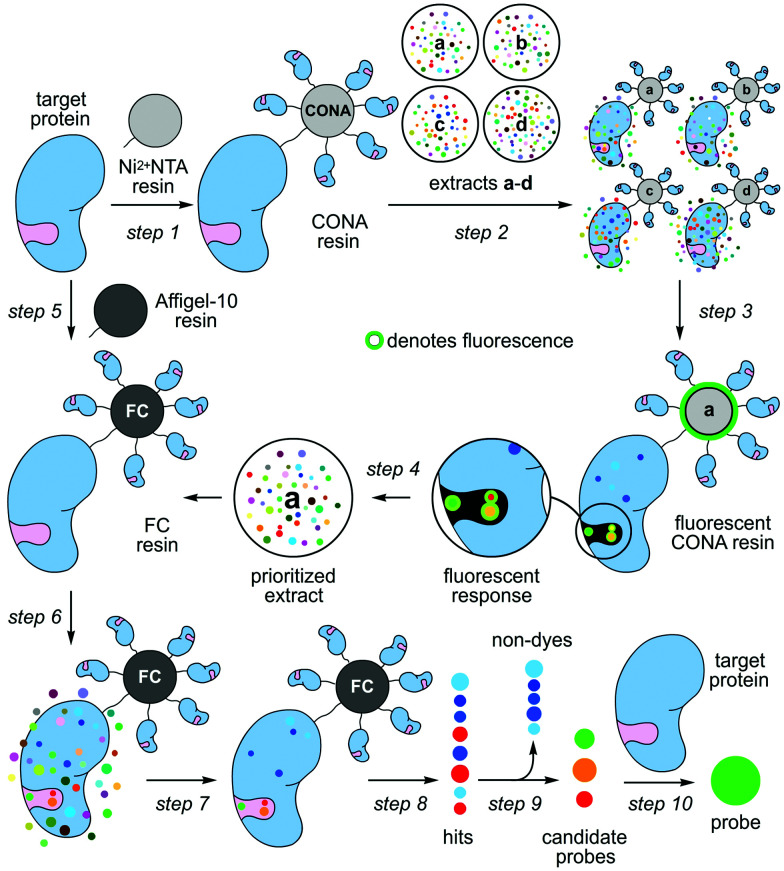
The identification of modulators for proteins without assayable biochemical activity remains a challenge in chemical biology. The presented approach adapts a high-throughput fluorescence binding assay and functional chromatography, two protein-resin technologies, enabling the discovery and isolation of fluorescent natural product probes that target proteins independently of biochemical function. The resulting probes also suggest targetable pockets for lead discovery. Using human survivin as a model, we demonstrate this method with the discovery of members of the prodiginine family as fluorescent probes to the cancer target survivin.
对于缺乏可检测生化活性的蛋白质而言,鉴定其调节剂仍是化学生物学领域的一项挑战。本文提出的方法采用了两种蛋白质-树脂技术,即高通量荧光结合测定法和功能色谱法,能够发现并分离独立于生化功能靶向蛋白质的荧光天然产物探针。所得探针还为先导化合物的发现提示了可靶向的口袋。以人类生存素作为模型,我们通过发现原肌球蛋白家族成员作为癌症靶点生存素的荧光探针来证明此方法。