Sakai-Kawada Francis E, Ip Courtney G, Hagiwara Kehau A, Awaya Jonathan D
Department of Molecular Biosciences and Bioengineering, University of Hawai´i at Mānoa, Honolulu, HI, United States.
Department of Biology, University of Hawai´i at Hilo, Hilo, HI, United States.
Front Microbiol. 2019 Jul 24;10:1715. doi: 10.3389/fmicb.2019.01715. eCollection 2019.
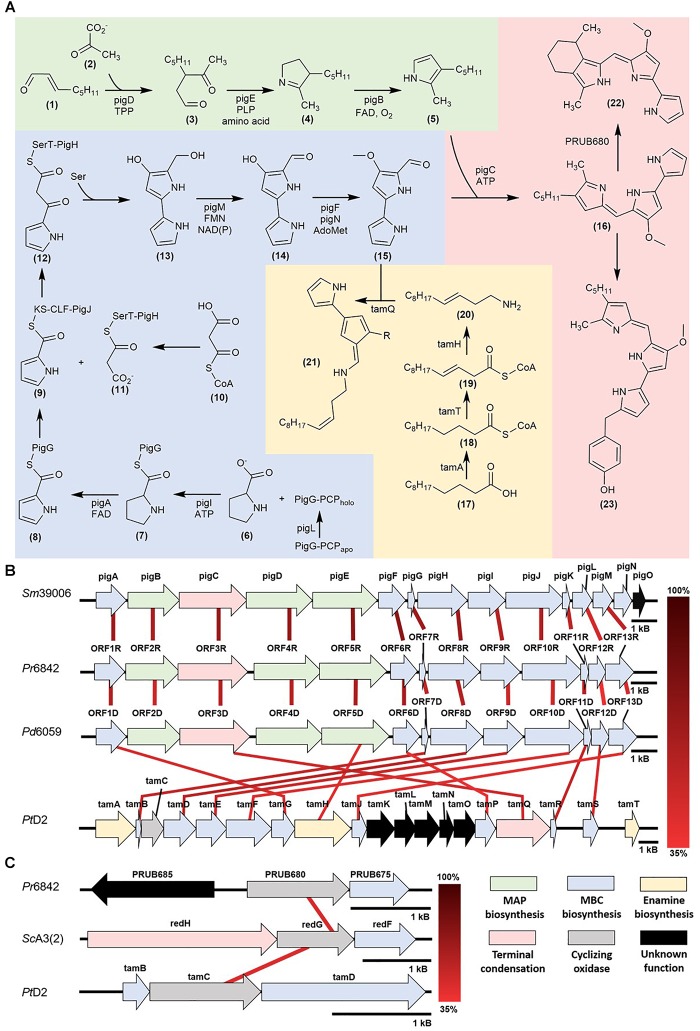
The Prodiginine family consists of primarily red-pigmented tripyrrole secondary metabolites that were first characterized in the Gram-negative bacterial species and demonstrates a wide array of biological activities and applications. Derivatives of prodiginine have since been characterized in the marine γ-proteobacterium, . Although biosynthetic gene clusters involved in prodiginine synthesis display homology among genera, there is an evident structural difference in the resulting metabolites. This review will summarize prodiginine biosynthesis, bioactivity, and gene regulation in in comparison to the previously characterized species of , discuss the ecological contributions of in the marine microbiome and their eukaryotic hosts, and consider the importance of modern functional genomics and classic DNA manipulation to understand the overall prodiginine biosynthesis pathway.
灵菌红素家族主要由红色色素的三吡咯次生代谢产物组成,这些代谢产物最初是在革兰氏阴性细菌物种中被鉴定出来的,具有广泛的生物活性和应用。此后,灵菌红素的衍生物已在海洋γ-变形杆菌中得到鉴定。尽管参与灵菌红素合成的生物合成基因簇在不同属之间显示出同源性,但所产生的代谢产物存在明显的结构差异。与先前鉴定的物种相比,本综述将总结灵菌红素在该物种中的生物合成、生物活性和基因调控,讨论该物种在海洋微生物群落及其真核宿主中的生态贡献,并考虑现代功能基因组学和经典DNA操作对于理解整个灵菌红素生物合成途径的重要性。