Higashitani Atsushi, Hashizume Toko, Takiura Mai, Higashitani Nahoko, Teranishi Mika, Oshima Rika, Yano Sachiko, Kuriyama Kana, Higashibata Akira
Graduate school of Life Sciences, Tohoku University, Sendai, Miyagi, Japan.
Advanced Engineering Services Co. Ltd., Tsukuba, Ibaraki, Japan.
NPJ Microgravity. 2021 Sep 1;7(1):33. doi: 10.1038/s41526-021-00163-7.
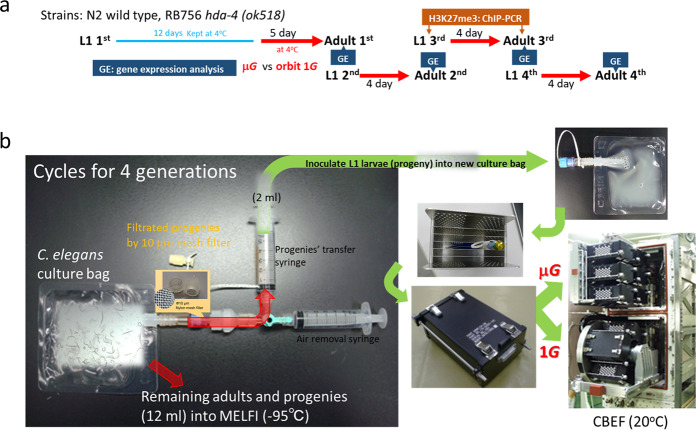
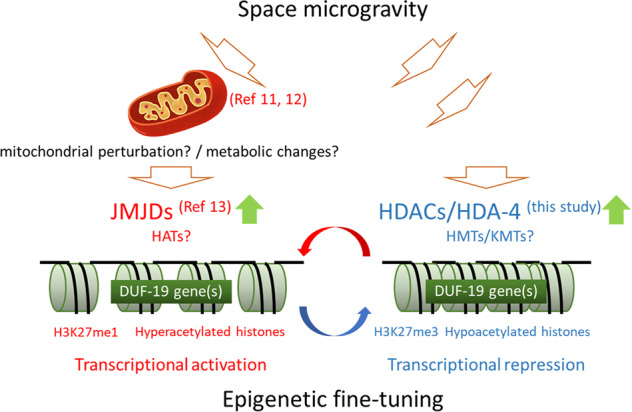
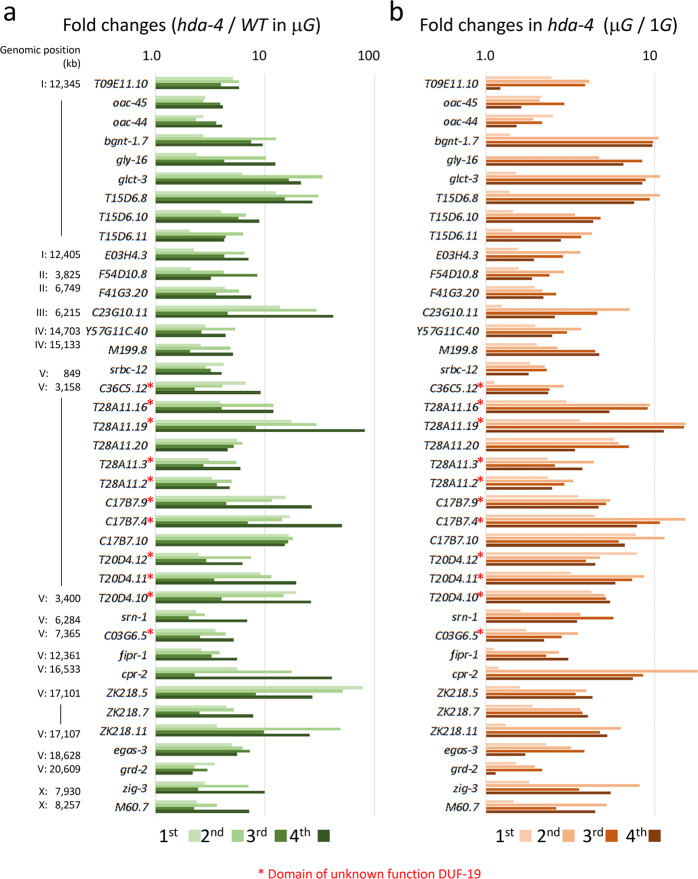
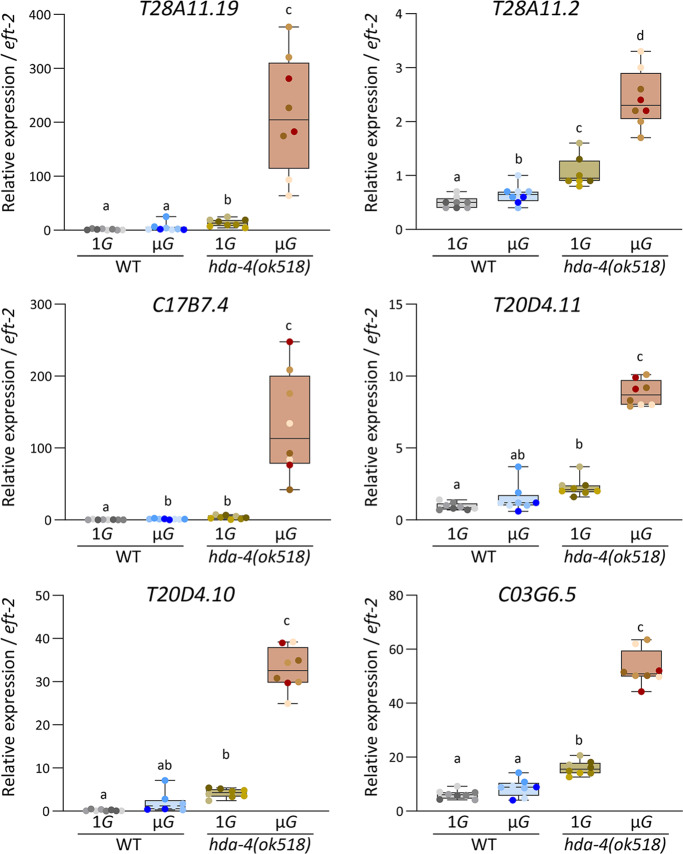
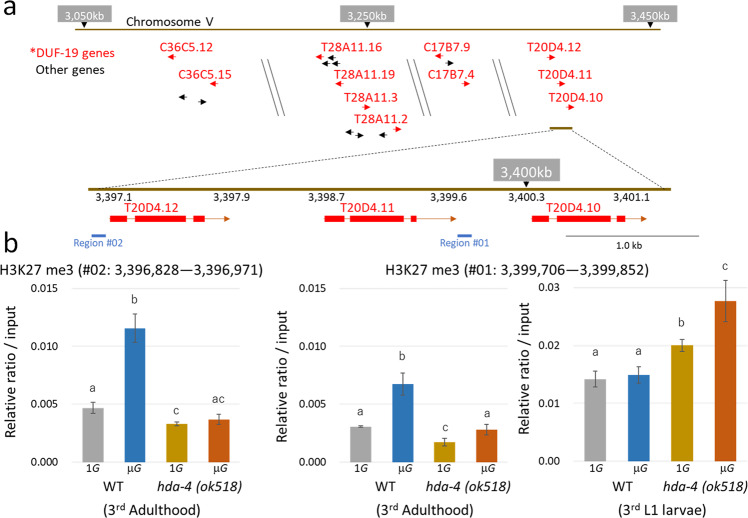
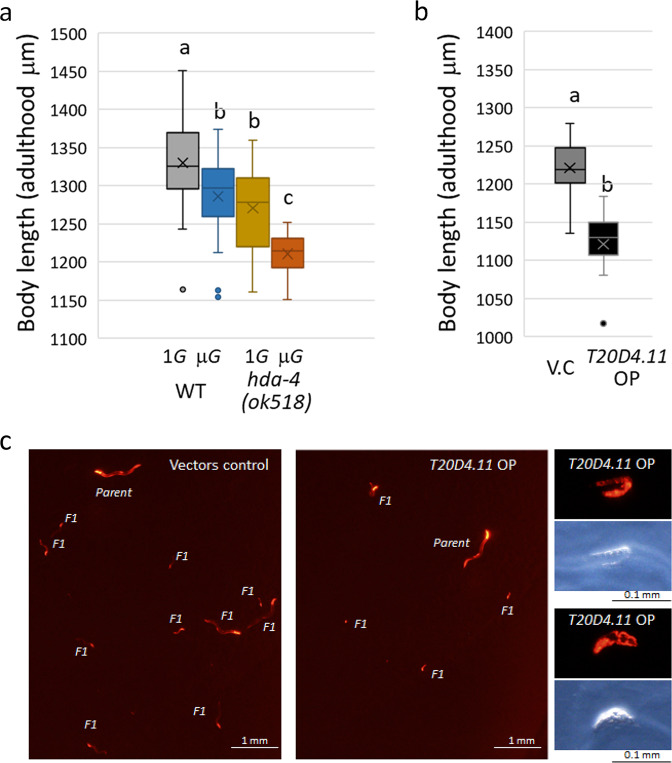
Epigenetic changes during long-term spaceflight are beginning to be studied by NASA's twin astronauts and other model organisms. Here, we evaluate the epigenetic regulation of gene expression in space-flown C. elegans by comparing wild type and histone deacetylase (hda)-4 mutants. Expression levels of 39 genes were consistently upregulated in all four generations of adult hda-4 mutants grown under microgravity compared with artificial Earth-like gravity (1G). In contrast, in the wild type, microgravity-induced upregulation of these genes occurred a little. Among these genes, 11 contain the domain of unknown function 19 (DUF-19) and are located in a cluster on chromosome V. When compared with the 1G condition, histone H3 trimethylation at lysine 27 (H3K27me3) increased under microgravity in the DUF-19 containing genes T20D4.12 to 4.10 locus in wild-type adults. On the other hand, this increase was also observed in the hda-4 mutant, but the level was significantly reduced. The body length of wild-type adults decreased slightly but significantly when grown under microgravity. This decrease was even more pronounced with the hda-4 mutant. In ground-based experiments, one of the T20D4.11 overexpressing strains significantly reduced body length and also caused larval growth retardation and arrest. These results indicate that under microgravity, C. elegans activates histone deacetylase HDA-4 to suppress overregulation of several genes, including the DUF-19 family. In other words, the expression of certain genes, including negative regulators of growth and development, is epigenetically fine-tuned to adapt to the space microgravity.
美国国家航空航天局(NASA)的一对双胞胎宇航员以及其他模式生物开始对长期太空飞行过程中的表观遗传变化展开研究。在此,我们通过比较野生型和组蛋白去乙酰化酶(hda)-4突变体,评估太空飞行的秀丽隐杆线虫中基因表达的表观遗传调控。与类地重力(1G)环境相比,在微重力环境下生长的成年hda-4突变体的所有四代中,39个基因的表达水平持续上调。相比之下,在野生型中,这些基因受微重力诱导的上调情况较少。在这些基因中,有11个含有未知功能域19(DUF-19),并且位于第五条染色体上的一个簇中。与1G环境相比,野生型成年线虫中,含有DUF-19的基因T20D4.12至4.10位点在微重力环境下赖氨酸27处的组蛋白H3三甲基化(H3K27me3)增加。另一方面,在hda-4突变体中也观察到了这种增加,但水平显著降低。野生型成年线虫在微重力环境下生长时,体长略有但显著下降。hda-4突变体的这种下降更为明显。在地面实验中,其中一个T20D4.11过表达菌株显著缩短了体长,还导致幼虫生长迟缓和停滞。这些结果表明,在微重力环境下,秀丽隐杆线虫激活组蛋白去乙酰化酶HDA-4以抑制包括DUF-19家族在内的多个基因的过度调控。换句话说,包括生长和发育负调控因子在内的某些基因的表达在表观遗传上进行了微调,以适应太空微重力环境。