Higashibata Akira, Hashizume Toko, Nemoto Kanako, Higashitani Nahoko, Etheridge Timothy, Mori Chihiro, Harada Shunsuke, Sugimoto Tomoko, Szewczyk Nathaniel J, Baba Shoji A, Mogami Yoshihiro, Fukui Keiji, Higashitani Atsushi
Human Spaceflight Technology Directorate, Japan Aerospace Exploration Agency, Tsukuba, Japan.
Graduate School of Medical and Dental Sciences, Kagoshima University, Kagoshima, Japan.
NPJ Microgravity. 2016 Jan 21;2:15022. doi: 10.1038/npjmgrav.2015.22. eCollection 2016.
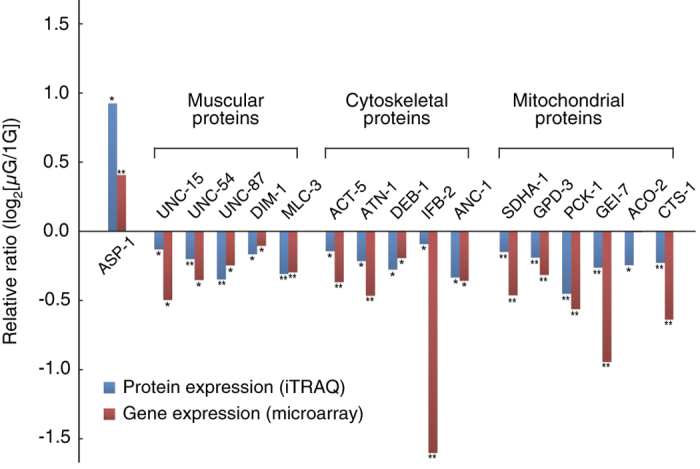
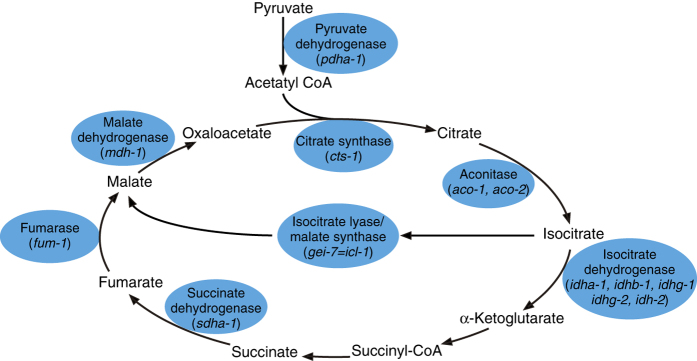
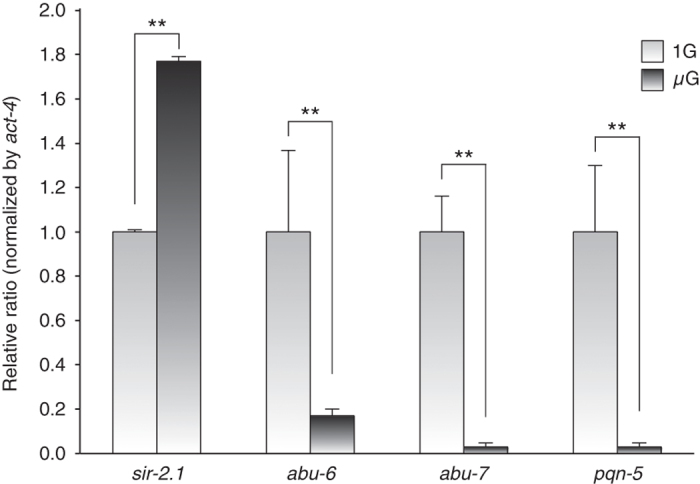
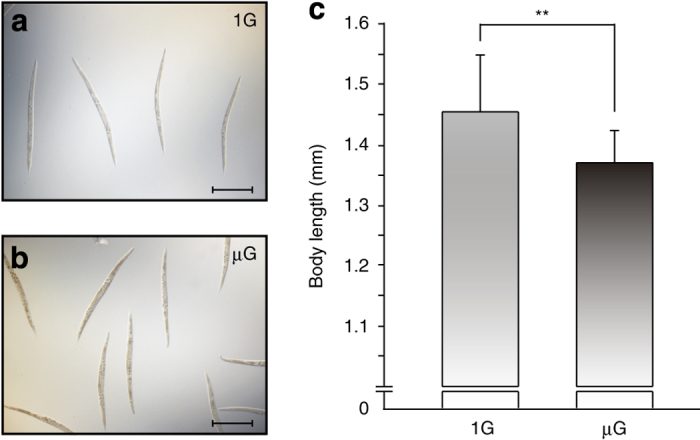
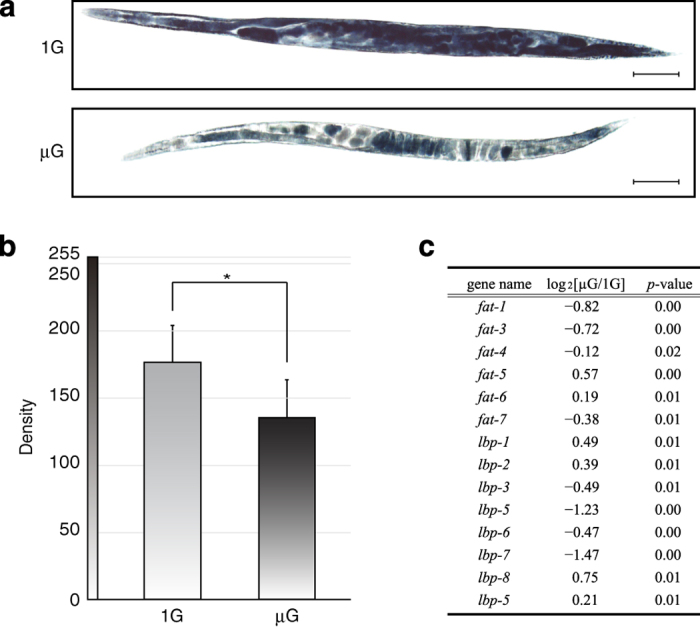
Although muscle atrophy is a serious problem during spaceflight, little is known about the sequence of molecular events leading to atrophy in response to microgravity. We carried out a spaceflight experiment using onboard the Japanese Experiment Module of the International Space Station. Worms were synchronously cultured in liquid media with bacterial food for 4 days under microgravity or on a 1-G centrifuge. Worms were visually observed for health and movement and then frozen. Upon return, we analyzed global gene and protein expression using DNA microarrays and mass spectrometry. Body length and fat accumulation were also analyzed. We found that in worms grown from the L1 larval stage to adulthood under microgravity, both gene and protein expression levels for muscular thick filaments, cytoskeletal elements, and mitochondrial metabolic enzymes decreased relative to parallel cultures on the 1-G centrifuge (95% confidence interval (⩽0.05)). In addition, altered movement and decreased body length and fat accumulation were observed in the microgravity-cultured worms relative to the 1-G cultured worms. These results suggest protein expression changes that may account for the progressive muscular atrophy observed in astronauts.
尽管肌肉萎缩是太空飞行期间的一个严重问题,但对于因微重力导致萎缩的分子事件序列却知之甚少。我们利用国际空间站日本实验舱进行了一项太空飞行实验。将线虫与细菌食物一起在液体培养基中同步培养4天,培养条件为微重力或1g离心力。肉眼观察线虫的健康状况和活动情况,然后冷冻。返回后,我们使用DNA微阵列和质谱分析了整体基因和蛋白质表达。还分析了体长和脂肪积累情况。我们发现,在线虫从L1幼虫阶段生长到成年期的过程中,与在1g离心力条件下平行培养的线虫相比,微重力条件下培养的线虫中,肌肉粗丝、细胞骨架成分和线粒体代谢酶的基因和蛋白质表达水平均下降(95%置信区间(⩽0.05))。此外,与1g条件下培养的线虫相比,微重力条件下培养的线虫出现了活动改变、体长缩短和脂肪积累减少的情况。这些结果表明蛋白质表达的变化可能是宇航员中观察到的进行性肌肉萎缩的原因。