Department of Health Statistics, School of Public Health, Shanxi Medical University, 56 XinJian South Road, Taiyuan, China.
Department of Health Statistics, School of Public Health, Jinzhou Medical University, 40 SongPo Road, Jinzhou, China.
Sci Rep. 2021 Sep 2;11(1):17558. doi: 10.1038/s41598-021-96914-3.
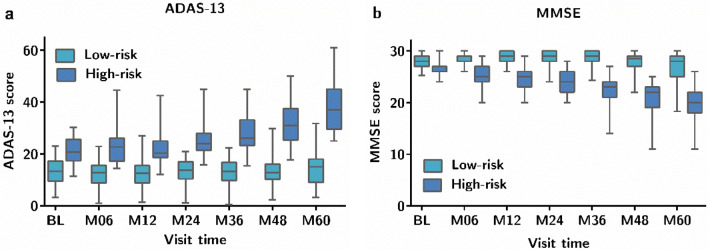
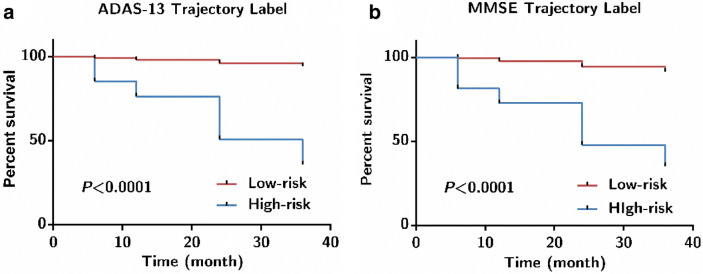
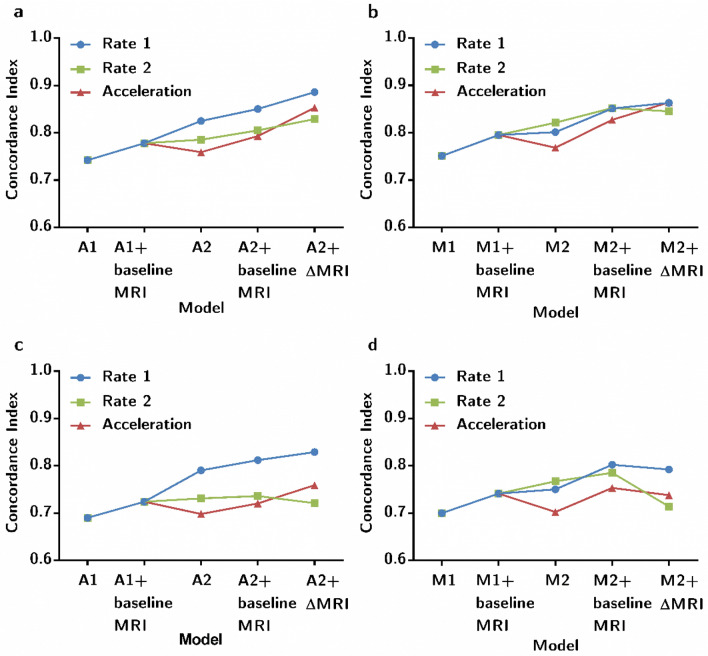
Individuals with mild cognitive impairment (MCI) are clinically heterogeneous, with different risks of progression to Alzheimer's disease. Regular follow-up and examination may be time-consuming and costly, especially for MRI and PET. Therefore, it is necessary to identify a more precise MRI population. In this study, a two-stage screening frame was proposed for evaluating the predictive utility of additional MRI measurements among high-risk MCI subjects. In the first stage, the K-means cluster was performed for trajectory-template based on two clinical assessments. In the second stage, high-risk individuals were filtered out and imputed into prognosis models with varying strategies. As a result, the ADAS-13 was more sensitive for filtering out high-risk individuals among patients with MCI. The optimal model included a change rate of clinical assessments and three neuroimaging measurements and was significantly associated with a net reclassification improvement (NRI) of 0.246 (95% CI 0.021, 0.848) and integrated discrimination improvement (IDI) of 0.090 (95% CI - 0.062, 0.170). The ADAS-13 longitudinal models had the best discrimination performance (Optimism-corrected concordance index = 0.830), as validated by the bootstrap method. Considering the limited medical and financial resources, our findings recommend follow-up MRI examination 1 year after identification for high-risk individuals, while regular clinical assessments for low-risk individuals.
患有轻度认知障碍(MCI)的个体临床表现存在异质性,向阿尔茨海默病进展的风险也各不相同。定期随访和检查可能既耗时又昂贵,尤其是对于 MRI 和 PET 而言。因此,有必要识别出更准确的 MRI 人群。在这项研究中,提出了两阶段筛选框架,用于评估高危 MCI 受试者中额外 MRI 测量的预测效用。在第一阶段,基于两种临床评估,采用 K-means 聚类进行轨迹模板分析。在第二阶段,筛选出高危个体,并采用不同策略将其纳入预后模型。结果表明,ADAS-13 更有助于筛选出 MCI 患者中的高危个体。最优模型包括临床评估变化率和三种神经影像学测量指标,与净重新分类改善(NRI)0.246(95%CI 0.021,0.848)和综合鉴别改善(IDI)0.090(95%CI-0.062,0.170)显著相关。ADAS-13 纵向模型的判别性能最佳(经 Bootstrap 校正的一致性指数=0.830)。考虑到有限的医疗和财政资源,我们的研究结果建议对高危个体在确诊后 1 年进行随访 MRI 检查,而对低危个体进行常规临床评估。