Institute of Biomaterials and Biomedical Engineering, University of Toronto, Toronto, Ontario, Canada.
Computational Brain Anatomy Laboratory, Brain Imaging Center, Douglas Mental Health University Institute, Verdun, Quebec, Canada.
PLoS Comput Biol. 2018 Sep 14;14(9):e1006376. doi: 10.1371/journal.pcbi.1006376. eCollection 2018 Sep.
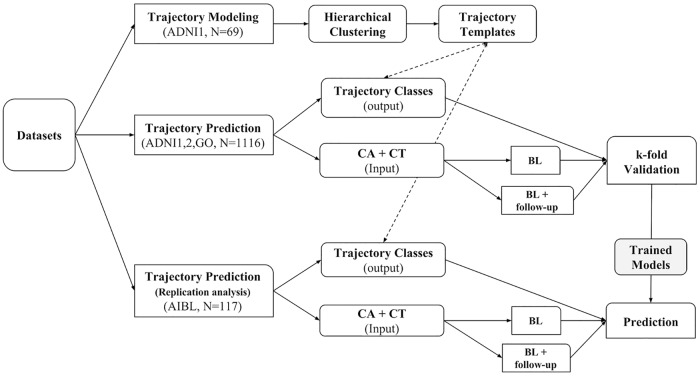
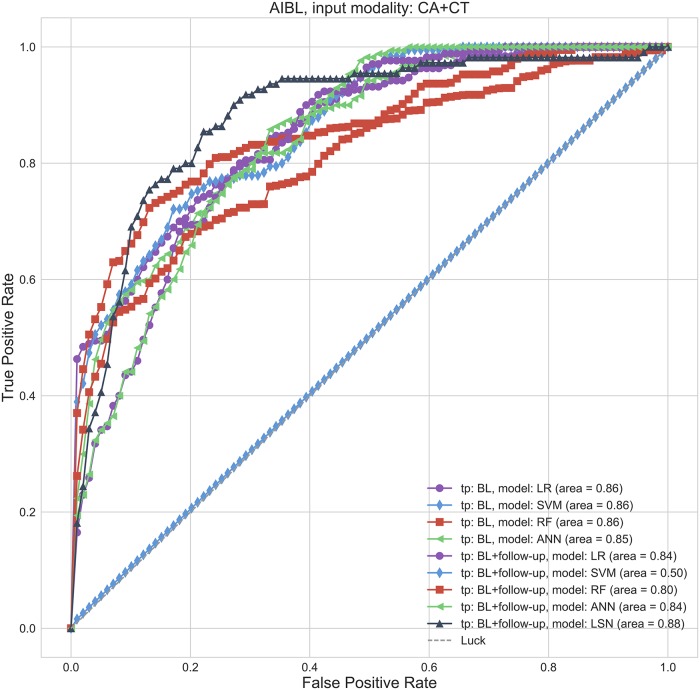
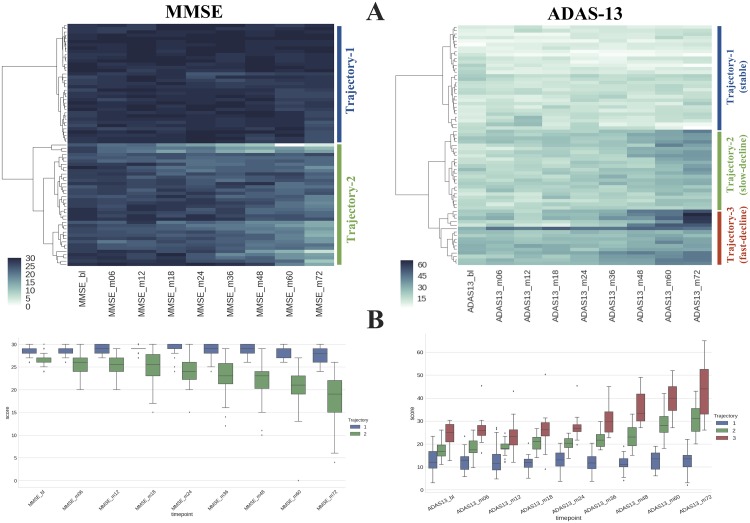
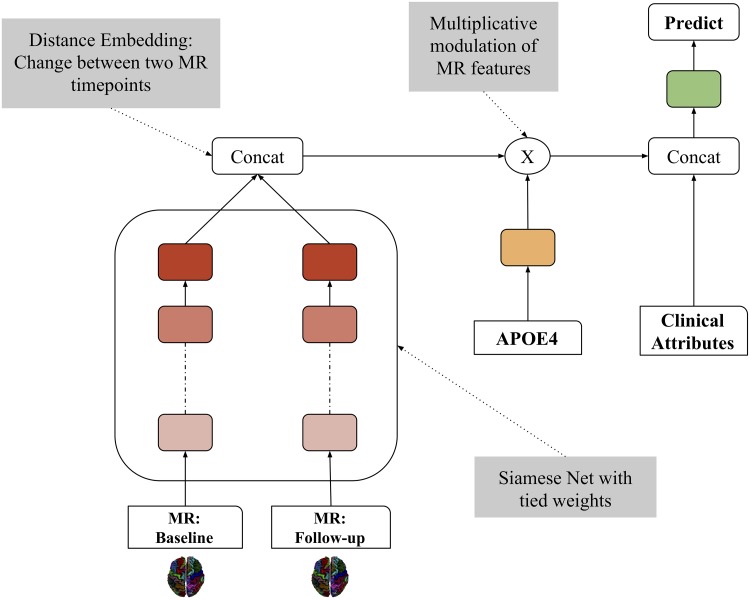
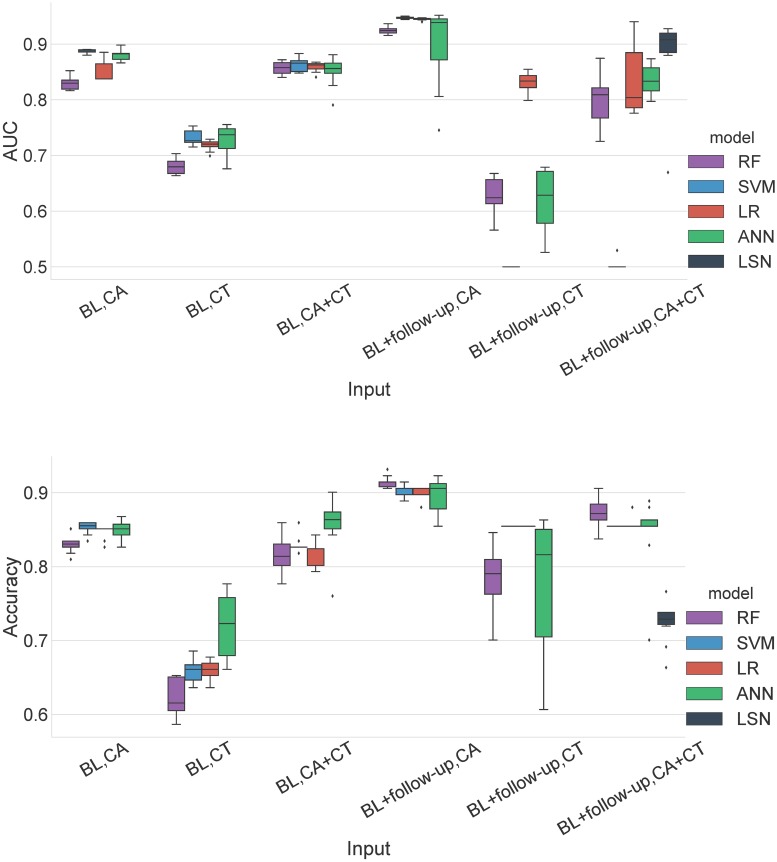
Computational models predicting symptomatic progression at the individual level can be highly beneficial for early intervention and treatment planning for Alzheimer's disease (AD). Individual prognosis is complicated by many factors including the definition of the prediction objective itself. In this work, we present a computational framework comprising machine-learning techniques for 1) modeling symptom trajectories and 2) prediction of symptom trajectories using multimodal and longitudinal data. We perform primary analyses on three cohorts from Alzheimer's Disease Neuroimaging Initiative (ADNI), and a replication analysis using subjects from Australian Imaging, Biomarker & Lifestyle Flagship Study of Ageing (AIBL). We model the prototypical symptom trajectory classes using clinical assessment scores from mini-mental state exam (MMSE) and Alzheimer's Disease Assessment Scale (ADAS-13) at nine timepoints spanned over six years based on a hierarchical clustering approach. Subsequently we predict these trajectory classes for a given subject using magnetic resonance (MR) imaging, genetic, and clinical variables from two timepoints (baseline + follow-up). For prediction, we present a longitudinal Siamese neural-network (LSN) with novel architectural modules for combining multimodal data from two timepoints. The trajectory modeling yields two (stable and decline) and three (stable, slow-decline, fast-decline) trajectory classes for MMSE and ADAS-13 assessments, respectively. For the predictive tasks, LSN offers highly accurate performance with 0.900 accuracy and 0.968 AUC for binary MMSE task and 0.760 accuracy for 3-way ADAS-13 task on ADNI datasets, as well as, 0.724 accuracy and 0.883 AUC for binary MMSE task on replication AIBL dataset.
预测个体水平症状进展的计算模型对于阿尔茨海默病(AD)的早期干预和治疗计划非常有益。个体预后受到许多因素的影响,包括预测目标本身的定义。在这项工作中,我们提出了一个计算框架,包括机器学习技术,用于 1)建模症状轨迹,2)使用多模态和纵向数据预测症状轨迹。我们对来自阿尔茨海默病神经影像学倡议(ADNI)的三个队列进行了主要分析,并使用澳大利亚成像、生物标志物和生活方式衰老旗舰研究(AIBL)的受试者进行了复制分析。我们使用 mini-mental state exam (MMSE) 和 Alzheimer's Disease Assessment Scale (ADAS-13) 的临床评估分数,基于分层聚类方法,在六年时间内的九个时间点上对典型症状轨迹类进行建模。随后,我们使用两个时间点(基线+随访)的磁共振成像(MR)成像、遗传和临床变量为给定受试者预测这些轨迹类。对于预测,我们提出了一种具有新架构模块的纵向暹罗神经网络(LSN),用于结合两个时间点的多模态数据。轨迹建模分别为 MMSE 和 ADAS-13 评估产生了两个(稳定和下降)和三个(稳定、缓慢下降、快速下降)轨迹类。对于预测任务,LSN 在 ADNI 数据集上的 MMSE 二进制任务中提供了高度准确的性能,准确率为 0.900,AUC 为 0.968,ADAS-13 三分类任务的准确率为 0.760,以及在复制 AIBL 数据集上的 MMSE 二进制任务的准确率为 0.724,AUC 为 0.883。