Department of Sociology, University of Hawai'i at Mānoa, Honolulu, HI, U.S.A.
Thompson School of Social Work & Public Health, University of Hawai'i at Mānoa Honolulu, HI, U.S.A.
Public Health. 2021 Sep;198:218-222. doi: 10.1016/j.puhe.2021.07.017. Epub 2021 Jul 23.
During the COVID-19 pandemic, the prevalence of psychological distress rose from 11% in 2019 to more than 40% in 2020. This study aims to examine the disparities among US adult men and women.
We used 21 waves of cross-sectional data from the Household Pulse Survey that were collected between April and December 2020 for the study. The Household Pulse Survey was developed by the U.S. Census Bureau to document the social and economic impact of COVID-19.
The study population included four groups of adults: emerging adults (18-24 years); young adults (25-44 years); middle-aged adults (45-64 years); and older adults (65-88 years). Psychological distress was measured by their Generalized Anxiety Disorder score and the Patient Health Questionnaire. The prevalence of psychological stress was calculated using logistic models adjusted for socio-demographic variables including race/ethnicity, education, household income, and household structure. All descriptive and regression analysis considered survey weights.
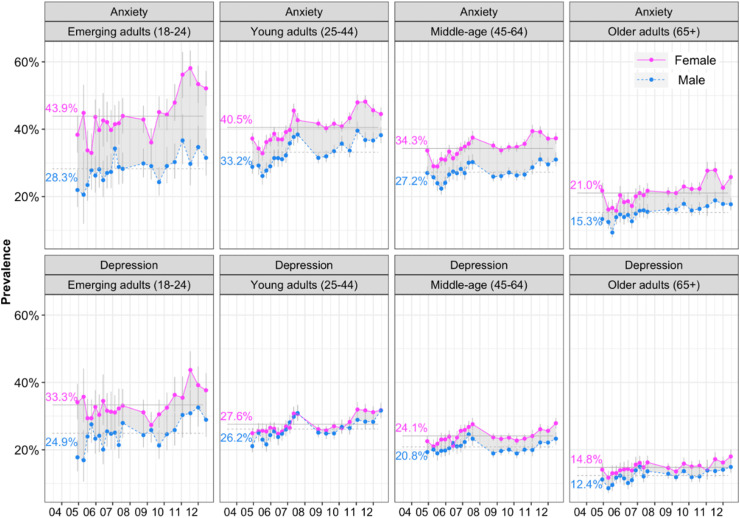
Younger age groups experienced higher prevalence of psychological distress than older age groups. Among emerging adults, the prevalence of anxiety (42.6%) and depression (39.5%) was more than twice as high as older adults who experienced prevalence of anxiety at 20% and depression at 16.6%. Gender differences were also more apparent in emerging adults. Women between 18 and 24 years reported higher differential rates of anxiety and depression than those with men (anxiety: 43.9% vs. 28.3%; depression: 33.3% vs. 24.9%).
Understanding the complex dynamics between COVID-19 and psychological distress has emerged as a public health priority. Mitigating the negative mental health consequences associated with the COVID-19 pandemic, for younger generations and females in particular, will require local efforts to rebuild capacity for social integration and social connection.
在 COVID-19 大流行期间,心理困扰的患病率从 2019 年的 11%上升到 2020 年的 40%以上。本研究旨在研究美国成年男女之间的差异。
我们使用了 2020 年 4 月至 12 月期间收集的来自家庭脉搏调查的 21 个横断面数据进行研究。家庭脉搏调查是由美国人口普查局开发的,用于记录 COVID-19 的社会和经济影响。
研究人群包括四组成年人:新兴成年人(18-24 岁);年轻人(25-44 岁);中年人(45-64 岁);和老年人(65-88 岁)。心理困扰通过他们的广泛性焦虑症评分和患者健康问卷来衡量。使用调整了种族/民族、教育、家庭收入和家庭结构等社会人口变量的逻辑模型计算心理压力的患病率。所有描述性和回归分析都考虑了调查权重。
年龄较小的群体比年龄较大的群体经历更高的心理困扰患病率。在新兴成年人中,焦虑症(42.6%)和抑郁症(39.5%)的患病率是老年人的两倍多,老年人焦虑症的患病率为 20%,抑郁症的患病率为 16.6%。性别差异在新兴成年人中也更为明显。18 至 24 岁的女性报告焦虑和抑郁的差异率高于男性(焦虑症:43.9%比 28.3%;抑郁症:33.3%比 24.9%)。
了解 COVID-19 与心理困扰之间的复杂动态已成为公共卫生的优先事项。减轻 COVID-19 大流行对年轻一代和女性尤其产生的负面心理健康后果,需要地方努力重建社会融合和社会联系的能力。