Lee Dongyun, Lee So-Jin, Park Chul-Soo, Kim Bong-Jo, Lee Cheol-Soon, Cha Boseok, Seo Ji-Yeong, Choi Jae-Won
Department of Psychiatry, Gyeongsang National University Changwon Hospital, Changwon, Republic of Korea.
Department of Psychiatry, Gyeongsang National University College of Medicine, Jinju, Republic of Korea.
Psychiatry Investig. 2019 Oct;16(10):773-776. doi: 10.30773/pi.2019.04.02.3. Epub 2019 Oct 7.
Resilience and impulsivity have opposite effects on depression in stressful situations. This study aimed to investigate the association among resilience, impulsivity, and depression in young males.
The participants consisted of 429 conscripts who underwent military training over 5 weeks. The surveys included the Connors- Davidson Resilience Scale-Korean version, the Barratt Impulsiveness Scale-11-Revised, and the Center for Epidemiological Studies- Depression Scale. The surveys were administered both before and after training.
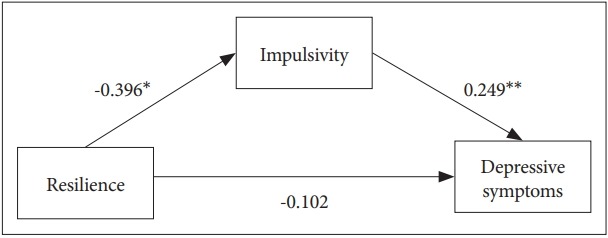
When simultaneously considering impulsivity and resilience, resilience was not associated with depression. Impulsivity had a complete negative mediating effect on resilience and depressive symptoms. Impulsivity is a significant negative mediating factor for the protective effect of resilience on depression.
This study recommends considering impulsivity when evaluating the protective role of resilience against depression.
心理韧性和冲动性在应激状态下对抑郁有相反的影响。本研究旨在探讨年轻男性心理韧性、冲动性和抑郁之间的关联。
参与者为429名接受为期5周军事训练的新兵。调查包括康纳斯-戴维森心理韧性量表韩语版、巴雷特冲动性量表-11修订版和流行病学研究中心抑郁量表。在训练前后均进行了调查。
同时考虑冲动性和心理韧性时,心理韧性与抑郁无关。冲动性对心理韧性和抑郁症状有完全的负向中介作用。冲动性是心理韧性对抑郁保护作用的显著负向中介因素。
本研究建议在评估心理韧性对抑郁的保护作用时考虑冲动性。