Betancur Daniel Fernando Arias, Tarragó Maria da Graça Lopes, Torres Iraci Lucena da Silva, Fregni Felipe, Caumo Wolnei
Graduate Program in Medical Sciences, School of Medicine, Federal University of Rio Grande do Sul (UFRGS), Porto Alegre, Brazil.
Laboratory of Pain & Neuromodulation, Clinical Research Center, Hospital de Clínicas de Porto Alegre (HCPA), Porto Alegre, Brazil.
Front Neurol. 2021 Aug 18;12:678198. doi: 10.3389/fneur.2021.678198. eCollection 2021.
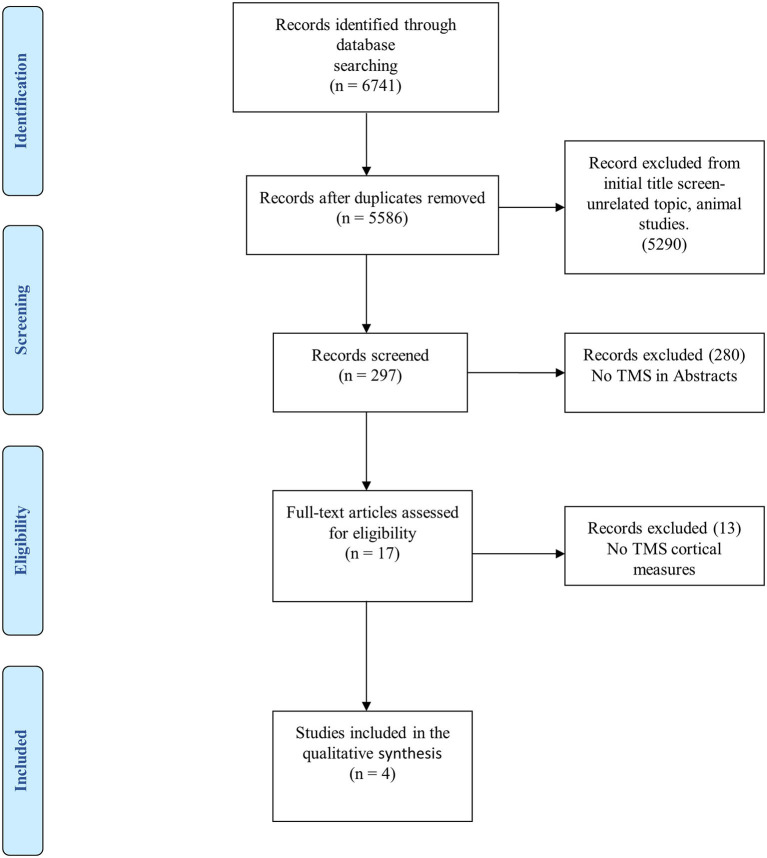
The physiopathology of central post-stroke pain (CPSP) is poorly understood, which may contribute to the limitations of diagnostic and therapeutic advancements. Thus, the current systematic review was conducted to examine, from an integrated perspective, the cortical neurophysiological changes observed transcranial magnetic stimulation (TMS), focusing on the structural damage, and clinical symptoms in patients with CPSP. The literature review included the databases EMBASE, PubMed, and ScienceDirect using the following search terms by MeSH or Entree descriptors: [("Cerebral Stroke") AND ("Pain" OR "Transcranial Magnetic Stimulation") AND ("Transcranial Magnetic Stimulation")] (through September 29, 2020). A total of 297 articles related to CPSP were identified. Of these, only four quantitatively recorded cortical measurements. We found four studies with different methodologies and results of the TMS measures. According to the National Institutes of Health (NIH) guidelines, two studies had low methodological quality and the other two studies had satisfactory methodological quality. The four studies compared the motor threshold (MT) of the stroke-affected hemisphere with the unaffected hemisphere or with healthy controls. Two studies assessed other cortical excitability measures, such as cortical silent period (CSP), short-interval intracortical inhibition (SICI), and intracortical facilitation (ICF). The main limitations in the interpretation of the results were the heterogeneity in parameter measurements, unknown cortical excitability measures as potential prognostic markers, the lack of a control group without pain, and the absence of consistent and validated diagnosis criteria. Despite the limited number of studies that prevented us from conducting a meta-analysis, the dataset of this systematic review provides evidence to improve the understanding of CPSP physiopathology. Additionally, these studies support the construction of a framework for diagnosis and will help improve the methodological quality of future research in somatosensory sequelae following stroke. Furthermore, they offer a way to integrate dysfunctional neuroplasticity markers that are indirectly assessed by neurophysiological measures with their correlated clinical symptoms.
中风后中枢性疼痛(CPSP)的生理病理学尚不清楚,这可能导致诊断和治疗进展的局限性。因此,本系统评价从综合角度进行,以研究经颅磁刺激(TMS)观察到的皮质神经生理变化,重点关注CPSP患者的结构损伤和临床症状。文献检索包括EMBASE、PubMed和ScienceDirect数据库,使用以下由医学主题词(MeSH)或入口词描述符组成的检索词:[(“脑卒”)AND(“疼痛”或“经颅磁刺激”)AND(“经颅磁刺激”)](截至2020年9月29日)。共识别出297篇与CPSP相关的文章。其中,只有4篇对皮质测量进行了定量记录。我们发现了4项关于TMS测量方法和结果不同的研究。根据美国国立卫生研究院(NIH)的指南,2项研究的方法学质量较低,另外2项研究的方法学质量令人满意。这4项研究将中风患侧半球的运动阈值(MT)与未受影响半球或健康对照进行了比较。2项研究评估了其他皮质兴奋性测量指标,如皮质静息期(CSP)、短间隔皮质内抑制(SICI)和皮质内易化(ICF)。结果解释的主要局限性在于参数测量的异质性、作为潜在预后标志物的未知皮质兴奋性测量指标、缺乏无疼痛的对照组以及缺乏一致且经过验证的诊断标准。尽管研究数量有限,无法进行荟萃分析,但本系统评价的数据集为增进对CPSP生理病理学的理解提供了证据。此外,这些研究支持构建诊断框架,并将有助于提高未来中风后体感后遗症研究的方法学质量。此外,它们提供了一种方法,将通过神经生理学测量间接评估的功能失调性神经可塑性标志物与其相关的临床症状整合起来。