Na Nongkhai Marisa Poomiphak, Yamprasert Rodsarin, Punsawad Chuchard
Department of Sports Science and Exercise, School of Medicine, Walailak University, Nakhon Si Thammarat 80160, Thailand.
Division of Applied Thai Traditional Medicine, Faculty of Public Health, Naresuan University, Phitsanulok 65000, Thailand.
Evid Based Complement Alternat Med. 2021 Aug 25;2021:6702767. doi: 10.1155/2021/6702767. eCollection 2021.
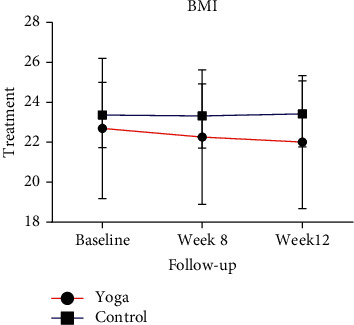
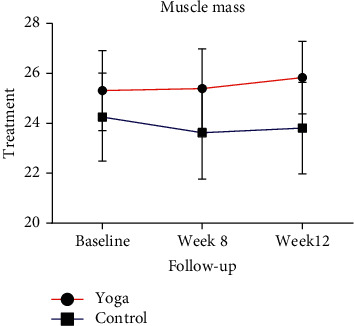
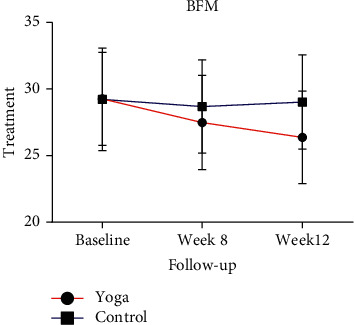
Overweight/obesity is a pressing international health concern, and conventional treatments demonstrate poor long-term efficacy. Several studies have shown that yoga can control risk factors for cardiovascular disease, obesity, and psychosocial stress. The present study aimed to assess the effect of continuous yoga (asanas, pranayama, and Surya Namaskar yoga) on body composition in overweight participants. Forty adolescents with obesity were enrolled in this study. The study was conceived as a prospective, single-center, single-blinded randomized controlled trial. The participants were divided into 2 groups: the intervention group ( = 20), which undertook a continuous yoga practice, and the control group ( = 20). Body composition, including body weight (BW), body mass index (BMI), body fat mass (BFM), and muscle mass, was evaluated using tetrapolar bioelectrical impedance (BIA). Our results showed that the mean BMI and BFM of the yoga intervention group were significantly decreased at week 8 and week 12. The muscle mass of the yoga group continued to improve at a rate of 0.515 per week, which was statistically significant. In conclusion, a continuous yoga practice had a tendency to decrease BMI and BFM and increase muscle mass. These findings demonstrate intervention effectiveness similar to that observed in other clinical research and indicate that continuous yoga practice may be used as an alternative therapy for obesity prevention and health promotion in adolescents with obesity.
超重/肥胖是一个紧迫的国际健康问题,传统治疗方法显示出较差的长期疗效。多项研究表明,瑜伽可以控制心血管疾病、肥胖和心理社会压力的风险因素。本研究旨在评估持续瑜伽(体式、呼吸法和拜日式瑜伽)对超重参与者身体成分的影响。40名肥胖青少年参与了本研究。该研究被设计为一项前瞻性、单中心、单盲随机对照试验。参与者被分为两组:干预组(n = 20),进行持续瑜伽练习;对照组(n = 20)。使用四极生物电阻抗(BIA)评估身体成分,包括体重(BW)、体重指数(BMI)、体脂肪量(BFM)和肌肉量。我们的结果显示,瑜伽干预组的平均BMI和BFM在第8周和第12周时显著降低。瑜伽组的肌肉量以每周0.515的速度持续增加,具有统计学意义。总之,持续瑜伽练习有降低BMI和BFM以及增加肌肉量的趋势。这些发现表明干预效果与其他临床研究中观察到的相似,并表明持续瑜伽练习可作为肥胖青少年预防肥胖和促进健康的替代疗法。