Department of Environmental Health Sciences, School of Public Health and Health Sciences, University of Massachusetts, Amherst, USA.
Department of Epidemiology and Biostatistics, School of Public Health, Imperial College, London, UK; MRC Centre for Environment and Health, Imperial College London, London, UK.
Sci Total Environ. 2022 Jan 10;803:149931. doi: 10.1016/j.scitotenv.2021.149931. Epub 2021 Aug 27.
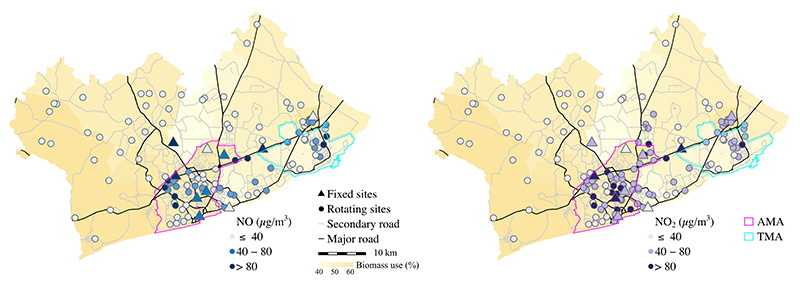
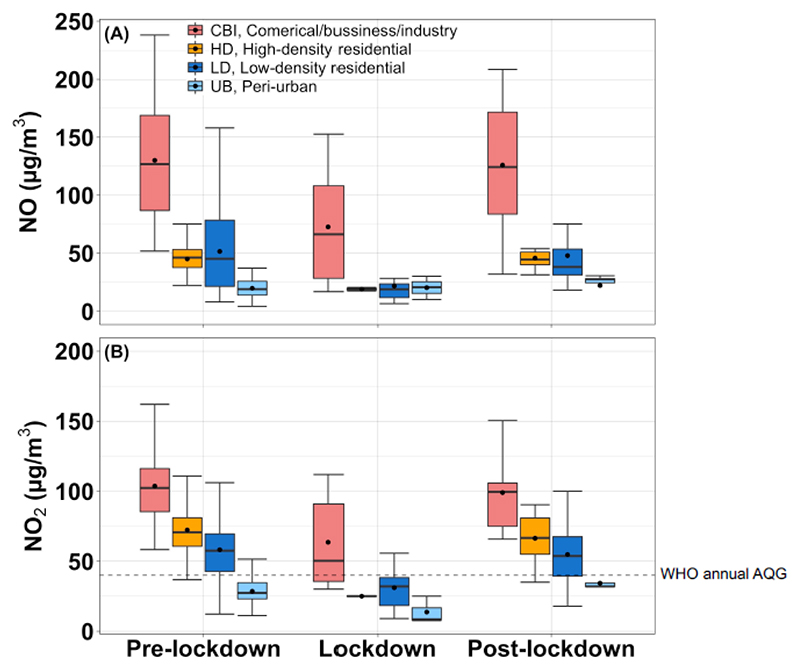
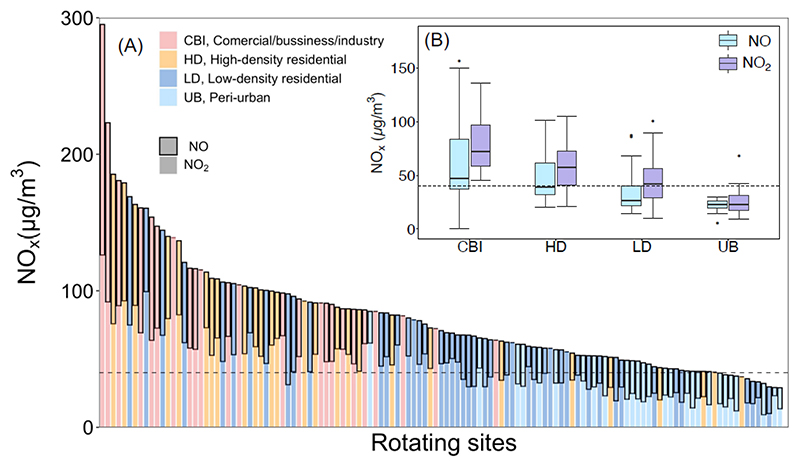
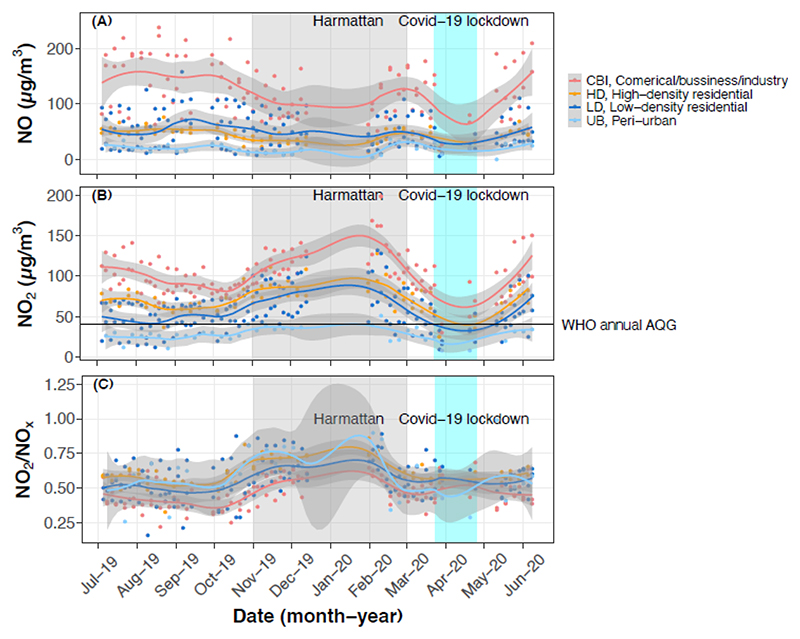
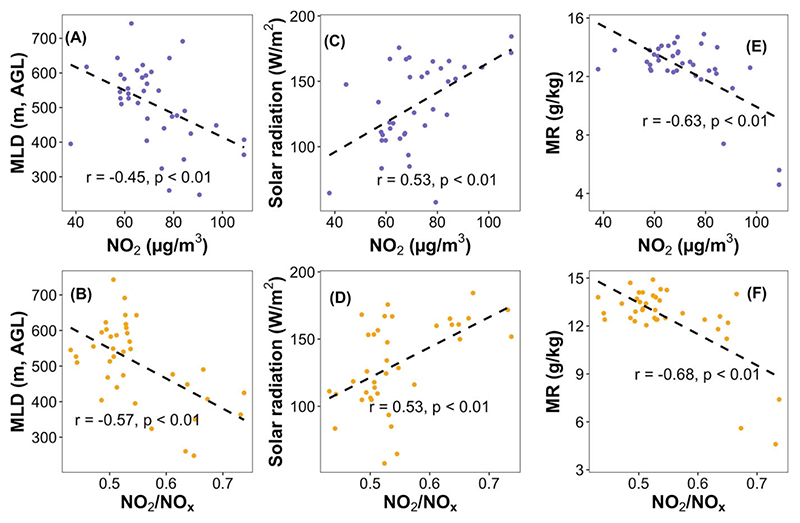
Economic and urban development in sub-Saharan Africa (SSA) may be shifting the dominant air pollution sources in cities from biomass to road traffic. Considered as a marker for traffic-related air pollution in cities, we conducted a city-wide measurement of NO levels in the Accra Metropolis and examined their spatiotemporal patterns in relation to land use and meteorological factors. Between April 2019 to June 2020, we collected weekly integrated NO (n = 428) and NO (n = 472) samples at 10 fixed (year-long) and 124 rotating (week-long) sites. Data from the same time of year were compared to a previous study (2006) to assess changes in NO concentrations. NO and NO concentrations were highest in commercial/business/industrial (66 and 76 μg/m, respectively) and high-density residential areas (47 and 59 μg/m, respectively), compared with peri-urban locations. We observed annual means of 68 and 70 μg/m for NO and NO, and a clear seasonal variation, with the mean NO of 63 μg/m (non-Harmattan) increased by 25-56% to 87 μg/m (Harmattan) across different site types. The NO/NO ratio was also elevated by 19-28%. Both NO and NO levels were associated with indicators of road traffic emissions (e.g. distance to major roads), but not with community biomass use (e.g. wood and charcoal). We found strong correlations between both NO and NO/NO and mixing layer depth, incident solar radiation and water vapor mixing ratio. These findings represent an increase of 25-180% when compared to a small study conducted in two high-density residential neighborhoods in Accra in 2006. Road traffic may be replacing community biomass use (major source of fine particulate matter) as the prominent source of air pollution in Accra, with policy implication for growing cities in SSA.
撒哈拉以南非洲(SSA)的经济和城市发展可能正在使城市中主要的空气污染来源从生物质向道路交通转变。我们认为,NO 是城市中与交通相关的空气污染的标志物,因此在阿克拉大都市进行了全城范围内的 NO 水平测量,并研究了它们与土地利用和气象因素的时空分布模式。在 2019 年 4 月至 2020 年 6 月期间,我们在 10 个固定(为期一年)和 124 个旋转(为期一周)站点每周收集一次综合 NO(n=428)和 NO(n=472)样本。同一时间的数据与之前的一项研究(2006 年)进行了比较,以评估 NO 浓度的变化。NO 和 NO 浓度在商业/商业/工业(分别为 66 和 76μg/m)和高密度住宅区(分别为 47 和 59μg/m)最高,而在城市周边地区较低。我们观察到 NO 和 NO 的年平均值分别为 68 和 70μg/m,且存在明显的季节性变化,不同站点类型的非哈马丹期平均 NO 浓度为 63μg/m,增加了 25-56%至 87μg/m(哈马丹期)。NO/NO 比值也升高了 19-28%。NO 和 NO 水平都与道路交通排放指标(例如,距主要道路的距离)相关,但与社区生物质使用(例如,木柴和木炭)无关。我们发现,NO 和 NO/NO 与混合层深度、入射太阳辐射和水汽混合比之间存在很强的相关性。与 2006 年在阿克拉的两个高密度住宅区进行的一项小型研究相比,这代表着增加了 25-180%。道路交通可能正在取代社区生物质使用(细颗粒物的主要来源),成为阿克拉空气污染的主要来源,这对 SSA 中不断发展的城市具有政策意义。