Gangarosa Department of Environmental Health, Rollins School of Public Health, Emory University, Atlanta, GA 30322.
School of Earth and Atmospheric Sciences, Georgia Institute of Technology, Atlanta, GA 30322.
Proc Natl Acad Sci U S A. 2023 Apr 18;120(16):e2208450120. doi: 10.1073/pnas.2208450120. Epub 2023 Apr 10.
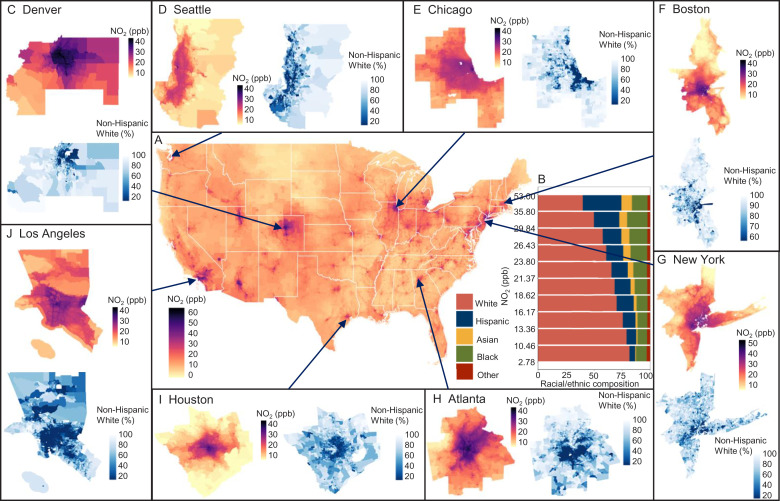
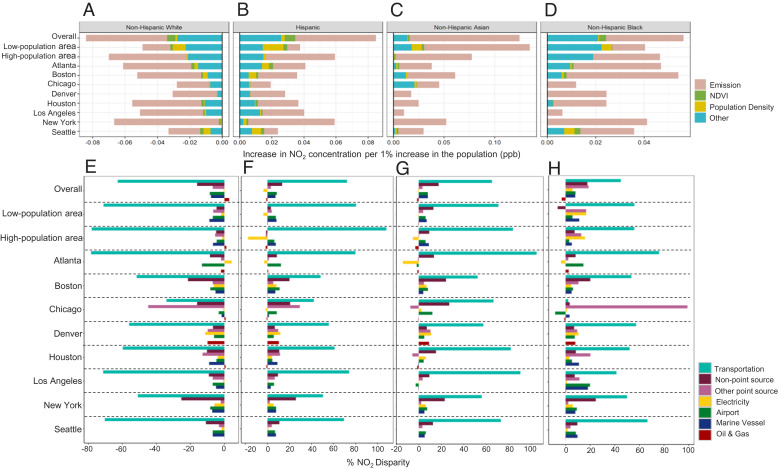
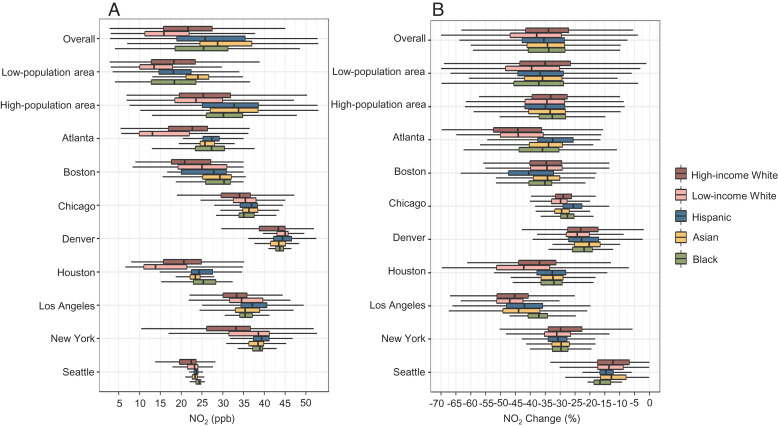
Average ambient concentrations of nitrogen dioxide (NO), an important air pollutant, have declined in the United States since the enactment of the Clean Air Act. Despite evidence that NO disproportionately affects racial/ethnic minority groups, it remains unclear what drives the exposure disparities and how they have changed over time. Here, we provide evidence by integrating high-resolution (1 km × 1 km) ground-level NO estimates, sociodemographic information, and source-specific emission intensity and location for 217,740 block groups across the contiguous United States from 2000 to 2016. We show that racial/ethnic minorities are disproportionately exposed to higher levels of NO pollution compared with Whites across the United States and within major metropolitan areas. These inequities persisted over time and have worsened in many cases, despite a significant decrease in the national average NO concentration over the 17-y study period. Overall, traffic contributes the largest fraction of NO disparity. Contributions of other emission sources to exposure disparities vary by location. Our analyses offer insights into policies aimed at reducing air pollution exposure disparities among races/ethnicities and locations.
尽管有证据表明,二氧化氮(NO)等重要空气污染物对少数族裔群体的影响不成比例,但造成接触差异的原因以及这些差异随时间如何变化仍不清楚。在这里,我们通过整合 2000 年至 2016 年美国各地 217740 个街区组的高分辨率(1 公里×1 公里)地面水平 NO 估计值、社会人口信息以及特定来源的排放强度和位置,提供了证据。结果表明,与白人相比,少数族裔在美国各地以及主要大都市区中,不成比例地暴露在更高水平的 NO 污染中。尽管在 17 年的研究期间,全国平均 NO 浓度显著下降,但这些不平等现象仍持续存在,在许多情况下甚至恶化。总的来说,交通是造成 NO 差异的最大因素。其他排放源对接触差异的贡献因地点而异。我们的分析为旨在减少种族/族裔和地点之间空气污染接触差异的政策提供了思路。