Wang Xiaojun, Mei Lina, Jiang Xuesheng, Jin Mingchao, Xu Yan, Li Jianyou, Li Xiongfeng, Meng Zhipeng, Zhu Junkun, Wu Fengfeng
Department of Orthopedics, Huzhou Central Hospital, Affiliated Central Hospital Huzhou University, Zhejiang University Huzhou Hospital, Huzhou, China.
Department of Orthopedics, Huzhou Traditional Chinese Medicine Hospital, Affiliated to Zhejiang Chinese Medical University, Huzhou, China.
Front Bioeng Biotechnol. 2021 Aug 19;9:625877. doi: 10.3389/fbioe.2021.625877. eCollection 2021.
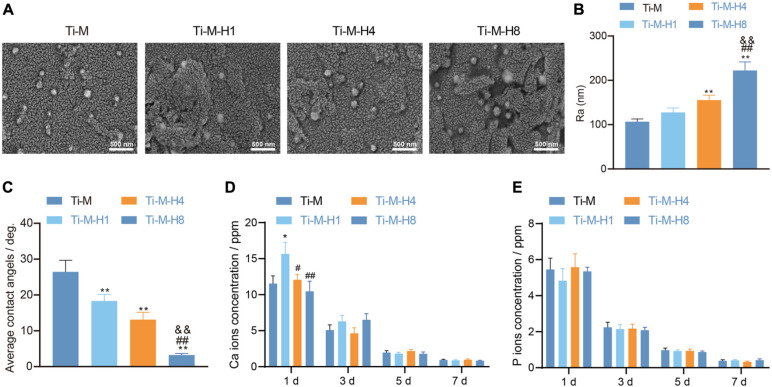
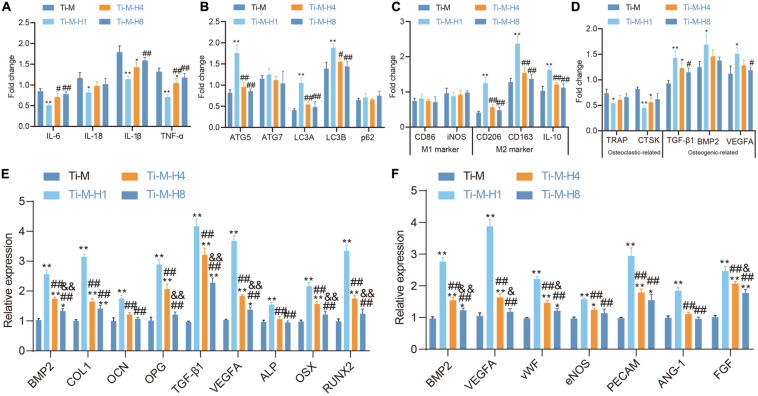
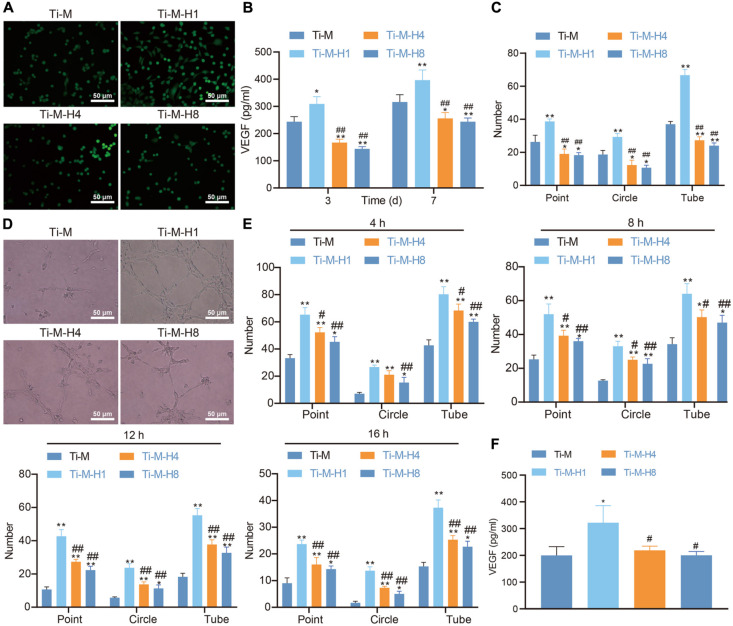
Titanium (Ti)-based alloys are widely used in tissue regeneration with advantages of improved biocompatibility, high mechanical strength, corrosion resistance, and cell attachment. To obtain bioactive bone-implant interfaces with enhanced osteogenic capacity, various methods have been developed to modify the surface physicochemical properties of bio-inert Ti and Ti alloys. Nano-structured hydroxyapatite (HA) formed by micro-arc oxidation (MAO) is a synthetic material, which could facilitate osteoconductivity, osteoinductivity, and angiogenesis on the Ti surface. In this paper, we applied MAO and steam-hydrothermal treatment (SHT) to produce HA-coated Ti, hereafter called Ti-M-H. The surface morphology of Ti-M-H1 was observed by scanning electron microscopy (SEM), and the element composition and the roughness of Ti-M-H1 were analyzed by energy-dispersive X-ray analysis, an X-ray diffractometer (XRD), and Bruker stylus profiler, demonstrating the deposition of nano-HA particles on Ti surfaces that were composed of Ca, P, Ti, and O. Then, the role of Ti-M-H in osteogenesis and angiogenesis was evaluated. The data illustrated that Ti-M-H1 showed a good compatibility with osteoblasts (OBs), which promoted adhesion, spreading, and proliferation. Additionally, the secretion of ALP, Col-1, and extracellular matrix mineralization was increased by OBs treated with Ti-M-H1. Ti-M-H1 could stimulate endothelial cells to secrete vascular endothelial growth factor and promote the formation of capillary-like networks. Next, it was revealed that Ti-M-H1 also suppressed inflammation by activating macrophages, while releasing multiple active factors to mediate osteogenesis and angiogenesis. Finally, results uncovered that Ti-M-H1 facilitated a higher bone-to-implant interface and was more attractive for the dendrites, which promoted osseointegration. In summary, MAO and SHT-treated Ti-M-H1 not only promotes osteogenesis and angiogenesis but also induces M2 macrophages to regulate the immune environment, which enhances the crosstalk between osteogenesis and angiogenesis and ultimately accelerates the process of osseointegration .
钛(Ti)基合金因其生物相容性提高、机械强度高、耐腐蚀和细胞附着性好等优点而被广泛应用于组织再生。为了获得具有增强成骨能力的生物活性骨植入物界面,人们开发了各种方法来改变生物惰性Ti及Ti合金的表面物理化学性质。通过微弧氧化(MAO)形成的纳米结构羟基磷灰石(HA)是一种合成材料,它可以促进Ti表面的骨传导性、骨诱导性和血管生成。在本文中,我们应用MAO和蒸汽-水热处理(SHT)来制备HA涂层Ti,以下称为Ti-M-H。通过扫描电子显微镜(SEM)观察Ti-M-H1的表面形态,并通过能量色散X射线分析、X射线衍射仪(XRD)和布鲁克触针轮廓仪分析Ti-M-H1的元素组成和粗糙度,证明了由Ca、P、Ti和O组成的纳米HA颗粒沉积在Ti表面。然后,评估了Ti-M-H在成骨和血管生成中的作用。数据表明,Ti-M-H1与成骨细胞(OBs)具有良好的相容性,可促进其黏附、铺展和增殖。此外,用Ti-M-H1处理的OBs可增加碱性磷酸酶(ALP)、I型胶原(Col-1)的分泌以及细胞外基质矿化。Ti-M-H1可刺激内皮细胞分泌血管内皮生长因子并促进毛细血管样网络的形成。接下来,研究发现Ti-M-H1还通过激活巨噬细胞来抑制炎症,同时释放多种活性因子来介导成骨和血管生成。最后,结果表明Ti-M-H1促进了更高的骨-植入物界面,对树突更具吸引力,从而促进了骨整合。总之,MAO和SHT处理的Ti-M-H1不仅促进成骨和血管生成,还诱导M2巨噬细胞调节免疫环境,增强成骨与血管生成之间的相互作用,最终加速骨整合过程。