Department of Pathobiology, College of Veterinary Medicine, University of Illinois at Urbana-Champaign, Urbana, Illinois, USA.
Microbiol Spectr. 2021 Oct 31;9(2):e0119921. doi: 10.1128/Spectrum.01199-21. Epub 2021 Sep 8.
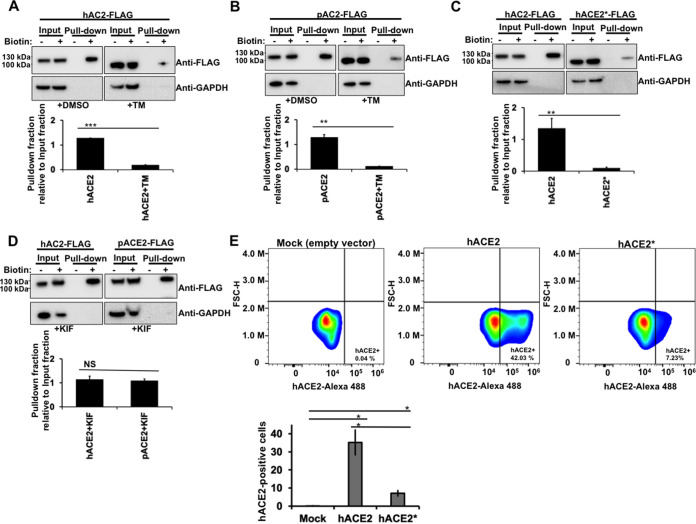
Human angiotensin I-converting enzyme 2 (hACE2) is a type I transmembrane glycoprotein that serves as the major cell entry receptor for SARS-CoV and SARS-CoV-2. The viral spike (S) protein is required for the attachment to ACE2 and subsequent virus-host cell membrane fusion. Previous work has demonstrated the presence of N-linked glycans in ACE2. N-glycosylation is implicated in many biological activities, including protein folding, protein activity, and cell surface expression of biomolecules. However, the contribution of N-glycosylation to ACE2 function is poorly understood. Here, we examined the role of N-glycosylation in the activity and localization of two species with different susceptibility to SARS-CoV-2 infection, porcine ACE2 (pACE2) and hACE2. The elimination of N-glycosylation by tunicamycin (TM) treatment, or mutagenesis, showed that N-glycosylation is critical for the proper cell surface expression of ACE2 but not for its carboxiprotease activity. Furthermore, nonglycosylable ACE2 was localized predominantly in the endoplasmic reticulum (ER) and not at the cell surface. Our data also revealed that binding of SARS-CoV or SARS-CoV-2 S protein to porcine or human ACE2 was not affected by deglycosylation of ACE2 or S proteins, suggesting that N-glycosylation does not play a role in the interaction between SARS coronaviruses and the ACE2 receptor. Impairment of hACE2 N-glycosylation decreased cell-to-cell fusion mediated by SARS-CoV S protein but not that mediated by SARS-CoV-2 S protein. Finally, we found that hACE2 N-glycosylation is required for an efficient viral entry of SARS-CoV/SARS-CoV-2 S pseudotyped viruses, which may be the result of low cell surface expression of the deglycosylated ACE2 receptor. Understanding the role of glycosylation in the virus-receptor interaction is important for developing approaches that disrupt infection. In this study, we showed that deglycosylation of both ACE2 and S had a minimal effect on the spike-ACE2 interaction. In addition, we found that the removal of N-glycans of ACE2 impaired its ability to support an efficient transduction of SARS-CoV and SARS-CoV-2 S pseudotyped viruses. Our data suggest that the role of deglycosylation of ACE2 on reducing infection is likely due to a reduced expression of the viral receptor on the cell surface. These findings offer insight into the glycan structure and function of ACE2 and potentially suggest that future antiviral therapies against coronaviruses and other coronavirus-related illnesses involving inhibition of ACE2 recruitment to the cell membrane could be developed.
人血管紧张素转换酶 2(hACE2)是一种 I 型跨膜糖蛋白,是 SARS-CoV 和 SARS-CoV-2 的主要细胞进入受体。病毒刺突(S)蛋白是与 ACE2 结合和随后病毒-宿主细胞膜融合所必需的。先前的工作表明 ACE2 中存在 N-连接聚糖。糖基化参与许多生物学活动,包括蛋白质折叠、蛋白质活性和生物分子的细胞表面表达。然而,N-糖基化对 ACE2 功能的贡献知之甚少。在这里,我们研究了 N-糖基化在两种对 SARS-CoV-2 感染易感性不同的物种(猪 ACE2(pACE2)和 hACE2)的活性和定位中的作用。用衣霉素(TM)处理或突变消除 N-糖基化表明,N-糖基化对于 ACE2 的适当细胞表面表达是关键的,但对于其羧肽酶活性不是关键的。此外,非糖基化的 ACE2主要定位于内质网(ER),而不是在细胞表面。我们的数据还表明,SARS-CoV 或 SARS-CoV-2 S 蛋白与猪或人 ACE2 的结合不受 ACE2 或 S 蛋白糖基化的影响,这表明 N-糖基化在 SARS 冠状病毒和 ACE2 受体之间的相互作用中不起作用。hACE2 N-糖基化的损伤降低了由 SARS-CoV S 蛋白介导的细胞间融合,但不降低由 SARS-CoV-2 S 蛋白介导的细胞间融合。最后,我们发现 hACE2 N-糖基化对于 SARS-CoV/SARS-CoV-2 S 假型病毒的有效病毒进入是必需的,这可能是由于去糖基化 ACE2 受体的细胞表面表达降低所致。 了解糖基化在病毒-受体相互作用中的作用对于开发破坏感染的方法很重要。在这项研究中,我们表明 ACE2 和 S 的糖基化缺失对刺突-ACE2 相互作用的影响最小。此外,我们发现 ACE2 N-聚糖的去除削弱了其支持 SARS-CoV 和 SARS-CoV-2 S 假型病毒有效转导的能力。我们的数据表明,ACE2 去糖基化降低感染的作用可能是由于病毒受体在细胞表面的表达减少。这些发现为 ACE2 的聚糖结构和功能提供了深入了解,并可能表明,未来针对冠状病毒和其他涉及 ACE2 募集到细胞膜的冠状病毒相关疾病的抗病毒疗法可以开发出来。