Department of Health Promoting Science, Sophiahemmet University, Stockholm, Sweden.
Department of Neurobiology, Care Sciences and Society, Division of Physiotherapy, Karolinska Institutet, Stockholm, Sweden.
Int J Behav Nutr Phys Act. 2021 Sep 8;18(1):121. doi: 10.1186/s12966-021-01193-w.
This aimed to evaluate the effects of self-monitoring of daily steps with or without counselling support on HbA1c, other cardiometabolic risk factors and objectively measured physical activity (PA) during a 2-year intervention in a population with prediabetes or type 2 diabetes.
The Sophia Step Study was a three-armed parallel randomised controlled trial. Participants with prediabetes or type 2 diabetes were recruited in a primary care setting. Allocation (1:1:1) was made to a multi-component intervention (self-monitoring of steps with counselling support), a single-component intervention (self-monitoring of steps without counselling support) or standard care. Data were collected for primary outcome HbA1c at baseline and month 6, 12, 18 and 24. Physical activity was assessed as an intermediate outcome by accelerometer (ActiGraph GT1M) for 1 week at baseline and the 6-, 12-, 18- and 24-month follow-up visits. The intervention effects were evaluated by a robust linear mixed model.
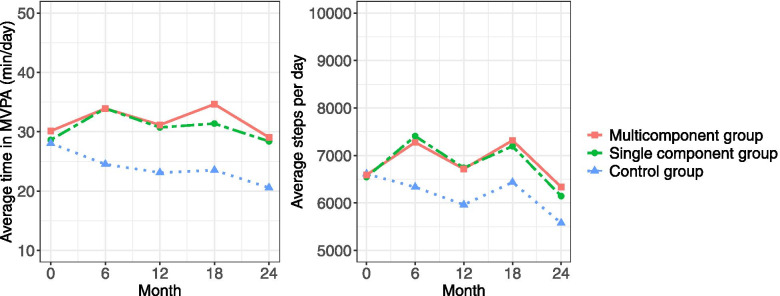
In total, 188 subjects (64, 59, 65 in each group) were included. The mean (SD) age was 64 (7.7) years, BMI was 30.0 (4.4) kg/m and HbA1c was 50 (11) mmol/mol, 21% had prediabetes and 40% were female. The dropout rate was 11% at 24 months. Effect size (CI) for the primary outcome (HbA1c) ranged from -1.3 (-4.8 to 2.2) to 1.1 (-2.4 to 4.6) mmol/mol for the multi-component vs control group and from 0.3 (-3.3 to 3.9) to 3.1 (-0.5 to 6.7) mmol/mol for the single-component vs control group. Effect size (CI) for moderate-to-vigorous physical activity ranged from 8.0 (0.4 to 15.7) to 11.1 (3.3 to 19.0) min/day for the multi-component vs control group and from 7.6 (-0.4 to 15.6) to 9.4 (1.4 to 17.4) min/day for the single-component group vs control group.
This 2-year intervention, including self-monitoring of steps with or without counselling, prevented a decrease in PA but did not provide evidence for improved metabolic control and cardiometabolic risk factors in a population with prediabetes or type 2 diabetes.
ClinicalTrials.gov, NCT02374788 . Registered 2 March 2015-Retrospectively registered.
本研究旨在评估在患有前驱糖尿病或 2 型糖尿病的人群中,进行为期 2 年的干预,自我监测日常步数并辅以咨询支持或单独进行自我监测对糖化血红蛋白(HbA1c)、其他心血管代谢风险因素以及客观测量的身体活动(PA)的影响。
Sophia Step 研究是一项三臂平行随机对照试验。在初级保健环境中招募了前驱糖尿病或 2 型糖尿病患者。按照 1:1:1 的比例分配到多组分干预(自我监测并辅以咨询支持)、单组分干预(自我监测但无咨询支持)或标准护理组。主要结局为基线和第 6、12、18 和 24 个月时的糖化血红蛋白(HbA1c)。使用加速度计(ActiGraph GT1M)在基线和第 6、12、18 和 24 个月的随访期间每周评估一次 PA,作为中间结局。通过稳健线性混合模型评估干预效果。
共纳入 188 名受试者(每组 64、59、65 名)。平均(SD)年龄为 64(7.7)岁,体重指数(BMI)为 30.0(4.4)kg/m2,HbA1c 为 50(11)mmol/mol,21%患有前驱糖尿病,40%为女性。24 个月时的失访率为 11%。主要结局(HbA1c)的效应大小(CI)在多组分组与对照组之间为-1.3(-4.8 至 2.2)至 1.1(-2.4 至 4.6)mmol/mol,在单组分组与对照组之间为 0.3(-3.3 至 3.9)至 3.1(-0.5 至 6.7)mmol/mol。中高强度体力活动的效应大小(CI)在多组分组与对照组之间为 8.0(0.4 至 15.7)至 11.1(3.3 至 19.0)min/天,在单组分组与对照组之间为 7.6(-0.4 至 15.6)至 9.4(1.4 至 17.4)min/天。
这项为期 2 年的干预措施包括自我监测步数并辅以咨询或单独进行自我监测,可预防 PA 下降,但并未提供改善代谢控制和心血管代谢风险因素的证据,该研究人群患有前驱糖尿病或 2 型糖尿病。
ClinicalTrials.gov,NCT02374788。于 2015 年 3 月 2 日注册-回顾性注册。